

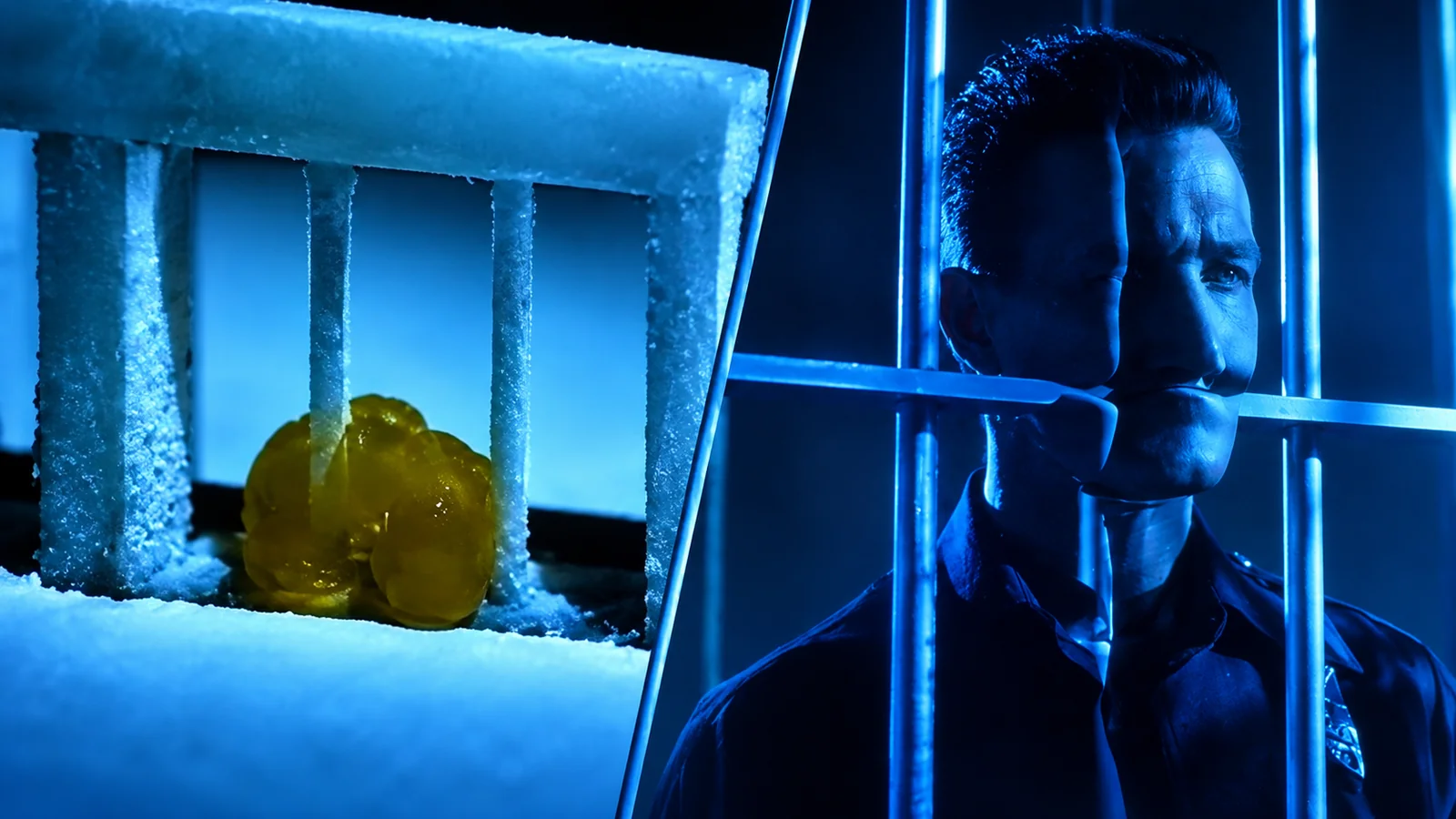
A robot that can squeeze through metal bars, swallow tiny objects and then merge with another robot sounds like something borrowed from a science-fiction film. But researchers in South Korea have demonstrated a real-world version of the idea.
The research team developed a millimetre-scale liquid robot that can dramatically change its shape, separate into sections and merge back together. Unlike conventional robots, which rely on solid frames, motors and mechanical joints, this unusual machine combines a liquid core with a protective shell made of microscopic particles.
The technology, called a Particle-armored liquid robot (PB), was developed by researchers from Seoul National University and Gachon University. Their findings were published in the peer-reviewed journal Science Advances on March 21, 2025, under the title "Particle-armored liquid robots".
The demonstrations bring a little of the shape-shifting T-1000 from Terminator 2 into experimental robotics. There is, however, an important distinction: this machine is not a self-aware liquid android. It is a carefully engineered material system whose movements are controlled using ultrasound.
Under the Hood: A Liquid With Armour
The central engineering challenge was surprisingly simple to describe: how do you make a liquid behave like a solid without sacrificing its ability to flow?
Ordinary water droplets can change shape easily, but they are mechanically fragile. Conventional liquid marbles, which consist of droplets coated in hydrophobic powder, can also deform and transport small objects. However, their protective particle layers can fail when the droplets are compressed or stretched too far.
The South Korean team addressed this weakness by significantly increasing the number of particles covering the liquid.
The resulting robot consists of a water-based liquid core surrounded by superhydrophobic particles. These particles repel water and form a protective outer layer. Their interactions help the structure maintain its integrity even when the underlying liquid changes shape.
The manufacturing technique is particularly clever. Rather than starting with a spherical water droplet, the researchers first freeze water into a rectangular block. They then coat the ice with tiny particles of polytetrafluoroethylene (PTFE), a water-repellent material commonly associated with non-stick surfaces.
Once the ice melts, the particles remain around the liquid, forming a flexible protective shell.
The particles have an average diameter of approximately 34 micrometres. That is roughly half the width of a human hair.
Why use an ice cube instead of a conventional droplet? Geometry matters. The researchers discovered that a cuboid offers more surface area relative to its volume than a sphere. That allows more protective particles to attach to the liquid during manufacturing.
The resulting structure combines two useful properties: the fluidity of water and the structural stability provided by its particle coating.
The Numbers: More Particles, More Strength
The researchers compared their particle-armored robots with conventional liquid marbles under controlled laboratory conditions.
The results showed that the new structures contained, on average, 59% more coating particles than conventional liquid marbles of comparable liquid volume.
That additional material made a measurable difference.
At an optimal aspect ratio of 1.55, the researchers measured a maximum compression force before bursting that was 252% greater than that of conventional liquid marbles.
In practical terms, the enhanced particle coverage helped prevent the liquid core from becoming exposed when the robot was heavily deformed.
The researchers also demonstrated that the robots could withstand impacts from falling. In one experiment, two separate liquid robots were dropped from a height of 13 millimetres without bursting.
But surviving compression is only part of the story. The real breakthrough is what these structures can actually do.
Splitting, Merging and Carrying Cargo
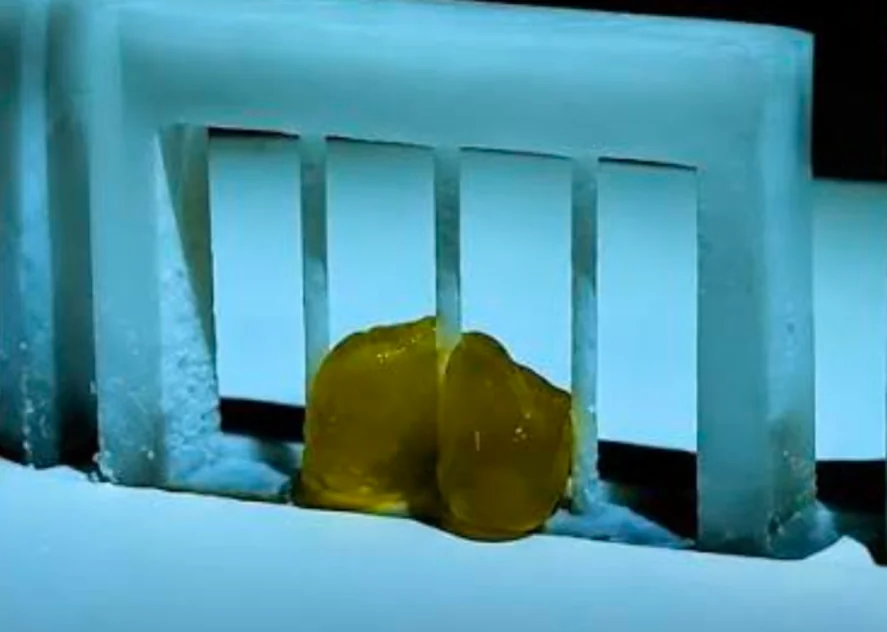
One of the most impressive demonstrations involved a robot navigating through an array of narrow pillars.
When it encountered the obstacles, its front section deformed and separated around individual pillars. The rear section followed, with the separated portions subsequently reconnecting. The robot emerged on the other side without losing its protective structure.
Conventional liquid marbles struggled with the same obstacle arrangement because their thinner particle coatings could not adequately protect the exposed liquid during deformation.
The researchers also demonstrated a process resembling biological phagocytosis, in which certain living cells engulf foreign particles.

The liquid robot can surround and absorb selected external objects into its interior. In the experiments, it successfully engulfed hydrophilic glass beads and transported them within its liquid body.
There is an important limitation: this process is selective. The experiments demonstrated the absorption of hydrophilic objects, rather than unrestricted ingestion of arbitrary materials.
Even more interesting is the robot's ability to merge with another robot.
When two particle-armored structures are brought into contact under sufficient force, their liquid interiors connect. The protective particle layers rearrange to accommodate the expanding surface, allowing the two separate structures to become one larger unit.
The researchers demonstrated a particularly interesting application by loading two robots with different chemical substances. After the robots merged, the contents mixed and triggered a chemical reaction that changed the colour of the resulting structure.
This effectively turned the merged robot into a tiny mobile chemical reactor.
Ultrasound Takes the Controls
Shape-shifting is impressive, but a useful robot also needs a way to move.
Instead of installing conventional motors or relying on magnetic materials, the researchers used acoustic radiation force generated by an ultrasonic transducer.
The experimental equipment was a Hielscher UP400S ultrasonic transducer rated at 400 watts and operating at 24 kilohertz.
In simple terms, ultrasound generates mechanical pressure that can push the liquid robot across a surface. By adjusting the position and application of the transducer, researchers can influence its movement and deformation.
This approach offers an important advantage: the robot does not need an onboard motor or conventional mechanical drive system.
The team demonstrated movement across solid surfaces and the ability to skim over water. It could also transition between land and water without losing its protective structure.
However, the system remains externally controlled. The experiments do not demonstrate an autonomous robot capable of independently navigating an environment, recognising obstacles or deciding where to go.
What Comes Next: Medicine and Miniature Machines
The potential applications extend well beyond laboratory demonstrations.
One particularly interesting possibility is targeted drug delivery. A liquid robot capable of squeezing through confined spaces, carrying substances and merging with other structures could eventually provide a new approach to transporting materials inside the human body.
The researchers also identify possible applications in biochemical systems, industrial cleaning, complex machinery and exploration in difficult-to-access environments.
However, these are proposed future applications, not demonstrated medical or commercial capabilities.
The current experimental robots are millimetre-scale structures made primarily from water and PTFE particles. Before the technology could be considered for medical use, researchers would need to address issues including biocompatibility, controlled movement inside biological environments, material safety and reliable operation in physiological fluids.
There are also engineering questions surrounding the propulsion system. Ultrasound provides a way to manipulate the robots experimentally, but translating that control into more complex environments will require further development.
The research team has already identified possible next steps. Corresponding author Professor Ho-Young Kim said the researchers were working on techniques that could allow the liquid robots to change shape more freely using sound waves or electric fields.
Co-corresponding author Professor Jeong-Yun Sun also highlighted plans to improve the material's functionality to support broader industrial applications.
A Different Kind of Robot
The significance of this research is not that scientists have finally built a miniature Terminator. They have demonstrated something more scientifically interesting: a robotic system that combines the adaptability of liquids with enough structural stability to perform repeatable physical tasks.
Traditional robotics generally begins with a mechanical structure and adds ways to move it. Particle-armored liquid robots take a different approach. Their body is itself the mechanism, allowing the material to deform, divide, merge and transport objects.
That shift could eventually prove valuable in environments where conventional machines struggle with rigid dimensions and mechanical complexity.
The technology is still at the experimental stage, and practical applications remain some distance away. But the demonstrations offer a compelling glimpse of a future in which robots might not need rigid bodies, joints or traditional mechanical components to perform useful work.
Sometimes, the next step in robotics is not building a better machine. It is rethinking what a machine can be.
Sources: This article is based on the original research published in Science Advances, Particle-armored liquid robots (2025), and the official Seoul National University research announcement.