


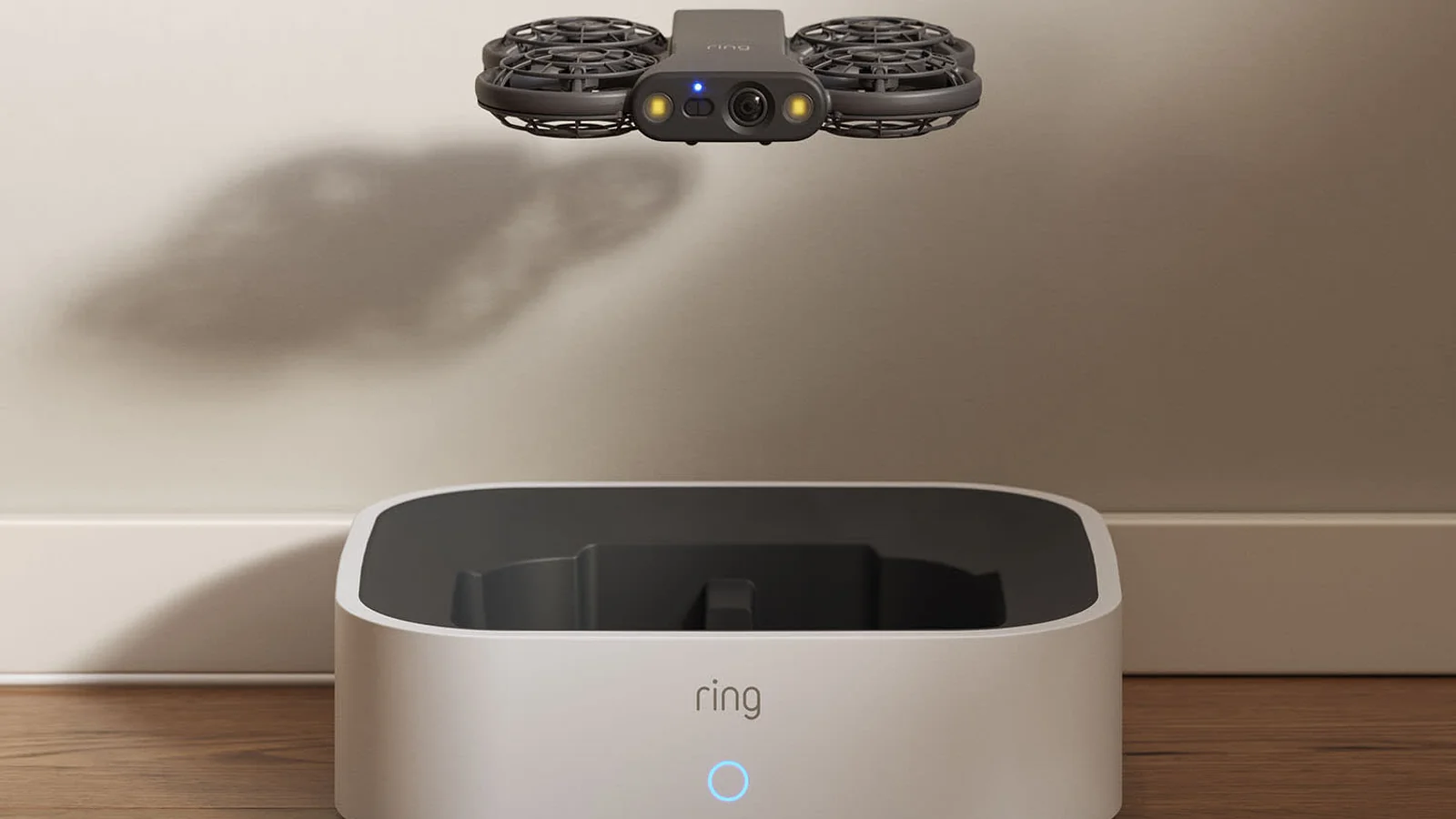
Your security camera has one view and a lot of blind spots. Ring's answer is to give the camera wings. On November 10, 2026, Amazon-owned Ring announced the Ring Drone Cam, a $249.99 indoor drone that sits in a dock, takes off when something trips an alarm, and flies to preset spots around your home to take a look.
It is the product Ring first showed in 2020 as the Always Home Cam. That concept never reached wide release, so a price and a ship date are the real news. Ring says the Drone Cam ships in the US on January 27, 2027, but it has not yet received FCC authorization and cannot be sold until it does.
The drone is part of a new line called Ring Robotics, which launched alongside the Ring Rover Cam, a $999.99 wheeled security robot for businesses. Rover Cam is due in the US on December 16, 2026.
Under the Hood
The Drone Cam is a compact gray quadcopter with guarded rotors, a front camera and two LED spotlights. It records 2K video (1920 x 1920) with a 148-degree field of view. For comparison, that is a much wider view than a typical phone camera, closer to a security camera than a selfie lens.
Navigation runs on a system Ring calls AI Pilot, which mixes onboard cameras, vision models, on-device sensors and cloud processing. During setup, you carry the drone through your home once. AI Pilot builds a floor plan, identifies rooms and suggests patrol points such as side doors and windows. In flight, it plans a route to each point and steers around furniture and shelving in real time.
There are three ways to launch it. You can send it manually from the Ring app, schedule routes, or let a linked Ring camera, doorbell, sensor or alarm trigger a flight. Ring says it can fly upstairs, something the original Always Home Cam could not do. It also works with Amazon's Alexa Home Map.
Night use relies on those two LED spotlights. There is no infrared night vision.
The Numbers
Ring rates a flight at up to eight minutes on a new, fully charged battery. The drone returns to its dock when the flight ends or the battery runs low. Reports from the launch event suggest a long recharge: roughly 40 minutes for a five-minute patrol. Think of it as a sprinter, not a marathon runner.
The drone measures 171.8 x 136.9 x 33.15 mm and is reported to weigh 165 grams. Setup takes about 5 to 10 minutes. It needs Wi-Fi, with Ring recommending at least 5 Mbps of upload speed, and it is rated for indoor use between 41°F and 95°F.
There are trade-offs. The drone has no microphone, speaker or siren. Manual flights and live view work without a subscri


