

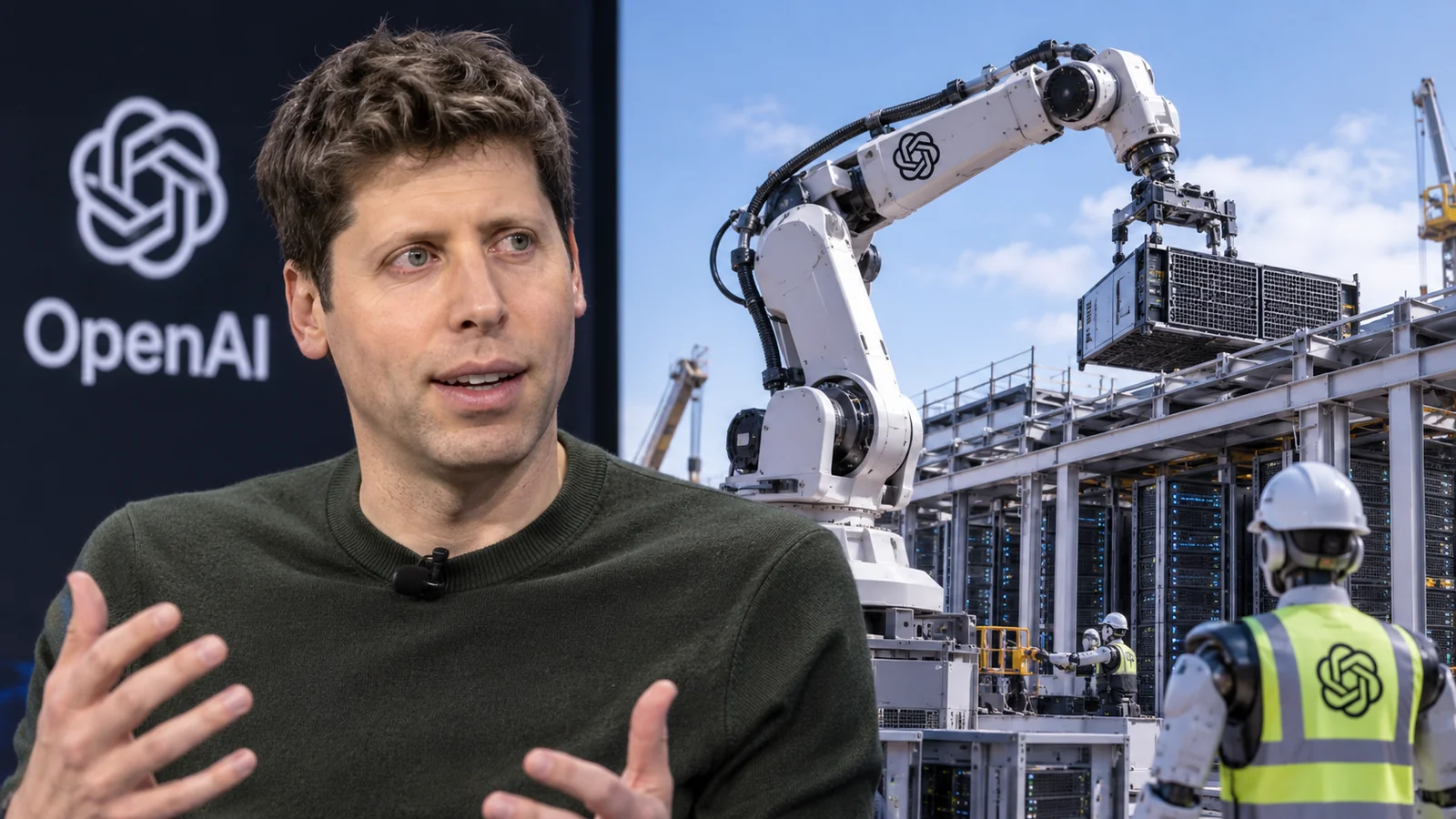
OpenAI plans to aim its robotics program at building data centers, CEO Sam Altman said on the Cheeky Pint podcast, hosted by Stripe co-founder John Collison and released on October 29, 2026. Altman said the idea of self-replicating data centers, built with the help of AI-controlled robots, is "within grasp."
The comments matter because AI companies are running into physical limits. Chips, memory, power equipment and permits are all in short supply, and Altman framed robot-built infrastructure as one long-term way around that. He gave no timeline, no robot specifications and no deployment numbers, so for now this is a stated direction and not a delivered capability.
What Altman actually described
Asked how the compute shortage is going, Altman said demand for capable models at low prices "only goes one way," in his words, and listed what OpenAI is doing to prepare. The company has designed its own chip, which he said delivers strong performance per watt. It is also learning to build its own data centers, and it has a robotics program that it intends to point at building many of them.
He contrasted the idea with RSI, short for recursive self-improvement, meaning AI that does AI research. Altman said there is relatively little discussion of self-replicating data centers. His version of the loop has AI controlling robots that run chip fabrication plants, build turbines or solar panels, and build data centers. The result, he said, would be a lot of really cheap compute.
Technical architecture and specifications
Altman did not describe any robot hardware, sensor suite, control model or construction workflow in the conversation. What he laid out is a supply chain loop rather than a product:
- AI systems control robots and machines.
- Those machines run fabs and manufacture power equipment such as turbines and solar panels.
- The same approach is applied to building the data centers that house the next generation of AI.
Later in the conversation Altman said he sees some early market response in components for industrial robots that "just make stuff faster," and he distinguished these from humanoid demos. He did not say which suppliers or which components he meant.
Empirical data and real-world impact
There are no deployment metrics, pilot sites, partners or construction results to report. The only numbers in the discussion concern cost, and they are illustrative rather than a target tied to robots.
Collison asked whether the dollars per gigawatt of leading-edge AI capacity will go up or down. Altman said it should go down. He picked $70 billion as a working figure for the five-year total cost of installing and running one gigawatt, noting that published estimates vary. He then said that if the number were $20 billion instead, "we should be much happier." Social media posts have framed this as a plan to cut costs from $70 billion to $20 billion with robots. The transcript does not support that reading: Altman did not commit to a $20 billion figure or tie it to robot construction. The tech outlet TNW also noted that it has not verified the cost figures.
Altman added that even reaching $20 billion would require cheaper energy and less margin stacking across the chain from raw materials to finished tokens. By his estimate, a world with free materials and no profits could only just get there within today's energy envelope.
Industry context and outlook
Collison pushed back during the conversation, saying data centers are limited more by permits and components than by labor. Altman answered that robots could eventually help make more of those components, and that this is how the shortage gets solved over a long period of time. That answer implies a multi-year effort, not a near-term change in how OpenAI builds facilities.
The wider supply picture is also part of the story. Altman said the market is not responding quickly to high prices for memory and chips. In his telling, memory makers remember past booms and busts and are cautious about adding capacity. He described the invisible hand as failing right now.
Several open questions remain over the coming 12 to 24 months:
- Whether OpenAI shows a working robotic construction or manufacturing system beyond the stated goal.
- How robots would deal with permitting and component bottlenecks, which are not purely labor problems.
- Whether the cost per gigawatt actually falls, and what share of any drop comes from automation rather than cheaper energy or chips.
Until OpenAI publishes concrete plans, sites or results, "self-replicating data centers" is best read as a strategic ambition voiced by the CEO.
Sources: Cheeky Pint episode 39 transcript and The Next Web report on the interview.