

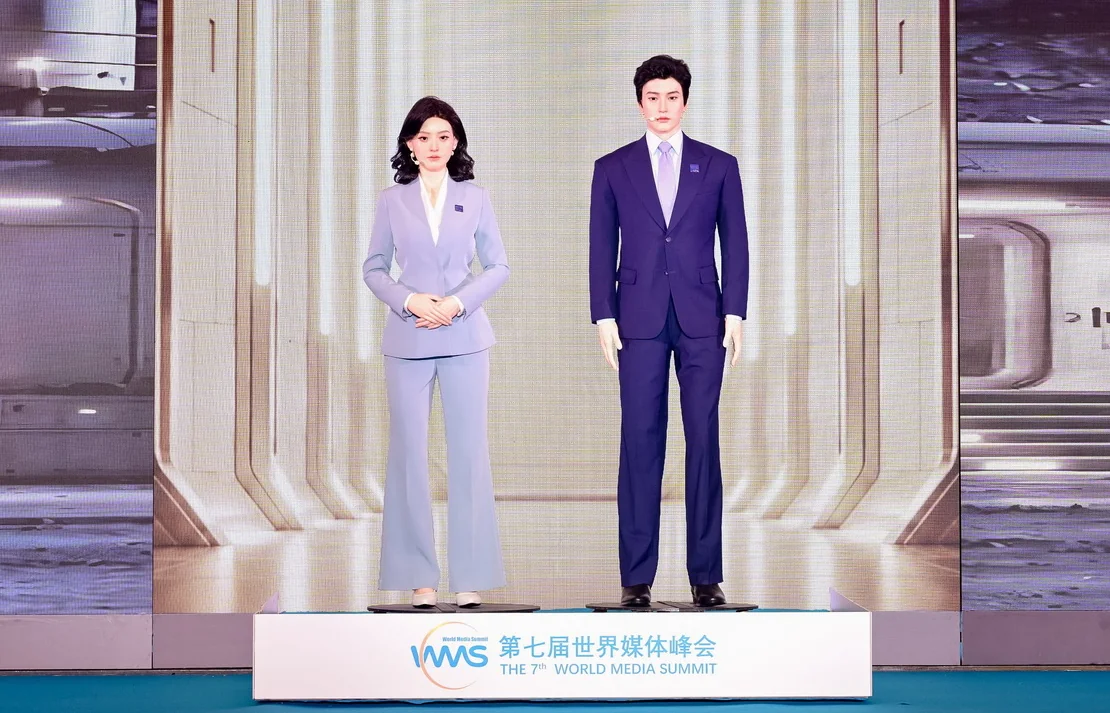
China’s Xinhua News Agency and robotics company UBTECH have unveiled two life-size humanoid robot news anchors, named Xinyan and Xinyu. The machines made their official debut on November 5, 2026, at the Artificial Intelligence and Chinese Modernization forum, part of the seventh World Media Summit in Beijing.
Xinhua describes the pair as the world’s first “bionic humanoid robot news anchors.” During the event, the robots greeted the audience in fluent English, and one of them delivered an opening news bulletin on stage. The announcement signals a move from screen-based AI presenters toward physical, embodied anchors that can appear in live news settings.
What the robots are
Xinyan and Xinyu were jointly developed by Xinhua and UBTECH. Chinese film director Zhang Yimou led the design of their visual identities. Xinhua says it holds the intellectual-property rights to the product.
The robots are built at human scale and customized for news applications. They are intended to deliver on-site broadcasts, support multilingual content, and interact with audiences in real time. Xinhua positions them as support systems for journalists and editors rather than replacements for human newsroom staff.
Robot anchors are intended to take on new roles in the newsroom, not to become the stars of the show.
Qian Tong, director-general of Xinhua’s New Media Center, made that point in the launch announcement. He said the robots would assist journalists and editors with news presentation, multilingual output, and on-site interaction.
How the system works
The anchors are powered by Xinhua’s AI newsbot, “Xinhua Yudian,” together with UBTECH’s proprietary technology stack. According to the launch announcement, that stack includes biomimetic skin, embodied AI hardware, operating systems, emotion-driven large language models, and mass-production capabilities.
Xinhua says the system uses an integrated “brain-expression-control” pipeline. It is designed to retrieve current political news and information in real time from vetted sources, with the stated aim of reducing misinformation risks associated with AI hallucinations.
The announcement does not provide detailed hardware specifications, such as actuator counts, battery capacity, walking speed, payload limits, or energy consumption. It also does not disclose the robots’ production cost or a commercial launch date.
First appearance and planned use
The debut took place during the seventh World Media Summit, which ran in Beijing from November 5 to 9. The summit was co-hosted by Xinhua and the Beijing municipal government and brought together roughly 500 representatives from nearly 330 media organizations, think tanks, government bodies, and international organizations across 112 countries and regions.
Xinhua says the robot anchors are planned for additional settings beyond the newsroom, including educational bases, urban public venues, overseas cultural exchanges, and reporting related to deep-space exploration. No deployment schedule, number of units, or named pilot locations has been announced.
Industry context
The unveiling arrives as news organizations worldwide experiment with generative AI for translation, story planning, information processing, fact-checking, and content production. Xinhua’s announcement frames the robots as an extension of that trend: AI-generated language combined with a physical humanoid interface.
The main unresolved questions concern reliability, editorial control, disclosure, and audience trust. Xinhua says its system draws from vetted sources, but the company has not published independent accuracy benchmarks, error rates, latency figures, or details of how human editors will approve robot-delivered content.
At the same summit, Reuters President Paul Bascobert said AI could increase speed, efficiency, and scale, but stressed that it does not replace journalistic standards. “We automate tasks. We do not automate judgment,” he said. AFP Chairman and CEO Fabrice Fries likewise described AI as a way to automate repetitive tasks while allowing journalists to focus on observation, context, and explanation.
For now, Xinyan and Xinyu remain a high-profile demonstration rather than a proven daily broadcast system. Their next test will be whether they can operate reliably in routine news production while maintaining clear human oversight of what they say.
Sources: The 7th World Media Summit launch announcement via GlobeNewswire; Xinhua News Agency coverage of the seventh World Media Summit.