

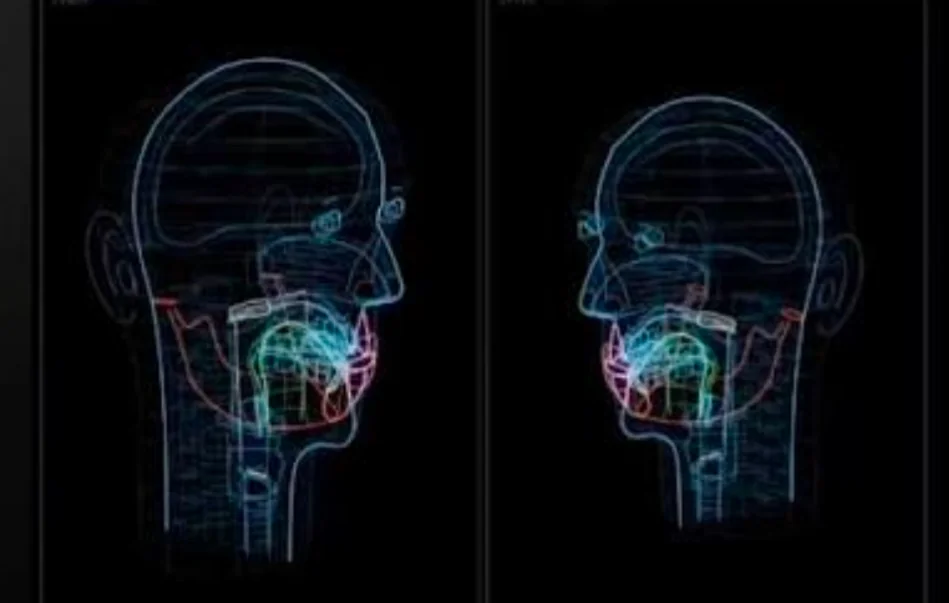
Most voice tools today lean on recorded clips or neural nets trained on thousands of speakers. Jameson Hodge just shipped something different. His open-source CHIMERA synthesizer builds every sound by simulating air moving through a virtual airway, and it runs right in a web browser.
Released in early November 2026 on GitHub under an MIT license, CHIMERA models lungs, vocal folds (or a bird’s syrinx), a branched vocal tract, tongue, lips, jaw and nasal port. No samples. No neural vocoder. The same Rust engine compiles to WebAssembly and runs inside an AudioWorklet for live playback, while a native CLI handles offline renders and measurements.
Air, Not Algorithms
Think of the vocal tract as a flexible tube. Air from the lungs sets the folds vibrating, producing a buzz rich in harmonics. The shape of the tube then boosts some frequencies (formants) and damps others, turning that buzz into “ee,” “ah” or “oo.” CHIMERA does the same thing in software. Users drag the tongue, lips and jaw on a live cutaway view; the geometry updates the acoustic model on the fly and the sound changes immediately. Male, female and child bodies blend continuously from the same parameters. The interface also shows live pressure, airflow, spectra and formant tracks pulled straight from the engine.
Speech mode converts English text (via the CMU Pronouncing Dictionary) or IPA into articulatory gestures. Sing mode places lyrics on a piano roll, with consonants timed just before the beat. Beatbox mode turns mouth gestures into percussion on a step sequencer. A bestiary adds a two-voice songbird syrinx, seal, alligator and elephant, each with its own modeled anatomy. Hodge described the core difference on X: “my vocal synth models the vocal tract as a network of branching acoustic tubes, unlike vocaloid which stitches together and pitch-shifts phoneme recordings.”
How Close It Gets
Vowel formants are tuned against classic measurements (Hillenbrand et al.). The project’s own calibration file shows the 22 vowel shapes landing within roughly 2 percent of their targets on average. Running speech is harder. In the project’s tests the Whisper recognizer mishears about 37 percent of CHIMERA’s words, versus 2.7 percent for 23 real speakers. A comparison against a real singer notes the voice source is “too pressed on most notes.” Hodge has said he is “still working on improving naturalness by tuning it against recordings of real singers.” The robotic, Vocaloid-like character remains available as a preset; the main development push is greater realism while keeping the instrument fully deterministic and real-time safe.
Within days of appearing, the project collected thousands of GitHub stars, hit the Hacker News front page (356 points), and sparked covers ranging from barbershop quartets to Queen and “The Lion Sleeps Tonight,” including animal and thunder-like timbres. Users can try the free browser demo at the project’s deployed app; the full source and documentation live on GitHub.
What Comes Next
The immediate engineering focus is naturalness: better fold vibration, consonant timing and less pressed phonation, all measured step-by-step against real recordings. Language support is expanding through shared front-ends (Korean and Russian already present) while keeping the English interface fixed. Mobile and plugin versions (CLAP/VST3/AU) are on the roadmap but secondary to the web instrument. Because everything is pure physics and open source, the tool also serves as a transparent teaching model for how one buzz becomes every vowel.
Sources: GitHub repository, ExplainerTools analysis, AlphaSignal report, Hacker News discussion.