

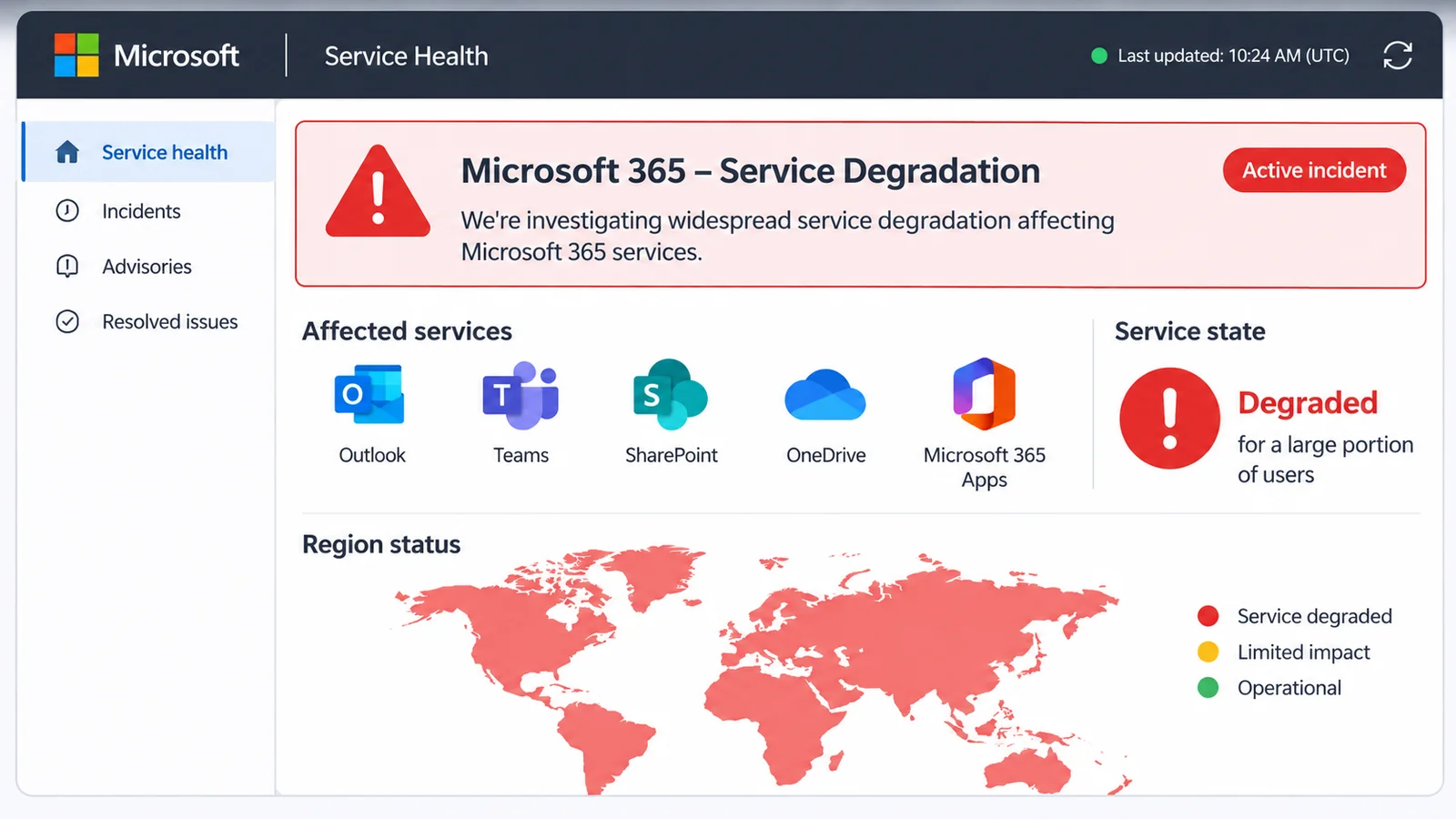
Microsoft confirmed on November 14, 2026, that all affected products were operational again after a widespread outage that began on November 12 and disrupted Microsoft 365 services for users across more than 70 countries. The incident primarily hit Exchange Online, which underpins Outlook email, Teams collaboration tools and the Copilot AI assistant, leaving many organizations unable to send or receive messages, schedule meetings or access related cloud features for more than 24 hours.
The disruption started between 17:00 and 18:00 UTC on November 12. Microsoft first reported problems accessing Exchange Online mailboxes in the Americas, then quickly expanded the advisory to a global scale. By the morning of November 14 the company stated that the underlying issue had been resolved and remaining customers and regions had regained service.
What Went Wrong
Microsoft attributed the outage to a technical issue introduced during an earlier network capacity upgrade. The problem surfaced after a subsequent network change. A process responsible for establishing secure connections became overwhelmed, causing servers to stop handling requests. Engineers rolled back the recent configuration change and restored capacity gradually to maintain stability.
The company explicitly stated the incident was not related to a cyber attack or to artificial intelligence agents. In a public update, Microsoft said: “We are deeply sorry for the disruption this incident has caused our customers and partners. We know the trust they place in our services and take that responsibility extremely seriously. This was a technical issue not related to cyber or AI / agents. The incident was introduced by an issue during an earlier network capacity upgrade that surfaced following a recent network change.”
Services that did not depend on Exchange Online continued to function for many users, but the core email and collaboration stack experienced the heaviest impact.
Scale of the Disruption
Outage-tracking data from Downdetector recorded reports from 74 countries and territories within the first hour. By the following day more than 7 million problem reports had been submitted for Microsoft services, making it the largest outage tracked by the platform in the preceding 12 months. Outlook alone generated more reports than any other single service outage in that period. Peak volumes rose again as successive regions entered their workdays.
Microsoft has stated that more than 430 million people use Microsoft 365 apps, with paid commercial subscriptions exceeding 450 million. The outage affected government agencies in Australia, Japan, Singapore, the United Kingdom, the United States and other nations. Courts, hospitals, police departments, airlines and financial firms reported delays or temporary shifts to alternative communication methods such as telephone, paper records or secondary email systems.
In the United Kingdom the National Health Service experienced interruptions to email, referrals and some scheduling. Several airlines, including carriers in India, reported that customer-support email channels were affected. Some companies postponed financial results announcements or activated contingency plans for earnings calls.
Recovery Process and Next Steps
Microsoft restored services in stages rather than attempting a simultaneous global restart. Engineers monitored email queues, expanded server capacity where needed and validated stability before bringing additional regions online. Consumer products recovered first on November 13, followed by full operational status for enterprise Microsoft 365 services by the morning of November 14.
The company has said it will publish a full post-incident report once its internal review is complete. That document is expected to detail the root cause, the sequence of events and specific engineering changes intended to reduce the likelihood of similar cascading failures in the future.
The length of the outage—longer than most previous Microsoft 365 incidents—has drawn attention to the concentration of critical communication infrastructure on a small number of cloud platforms. Organizations that maintained on-premises Exchange servers or multi-vendor email setups experienced less disruption than those fully reliant on Microsoft’s cloud services.
Sources: Wikipedia summary of the 2026 Microsoft outage, PBS News report on full restoration, Ookla Downdetector analysis of outage scale and duration, Microsoft public statements on X quoted across multiple outlets including Business Today.