


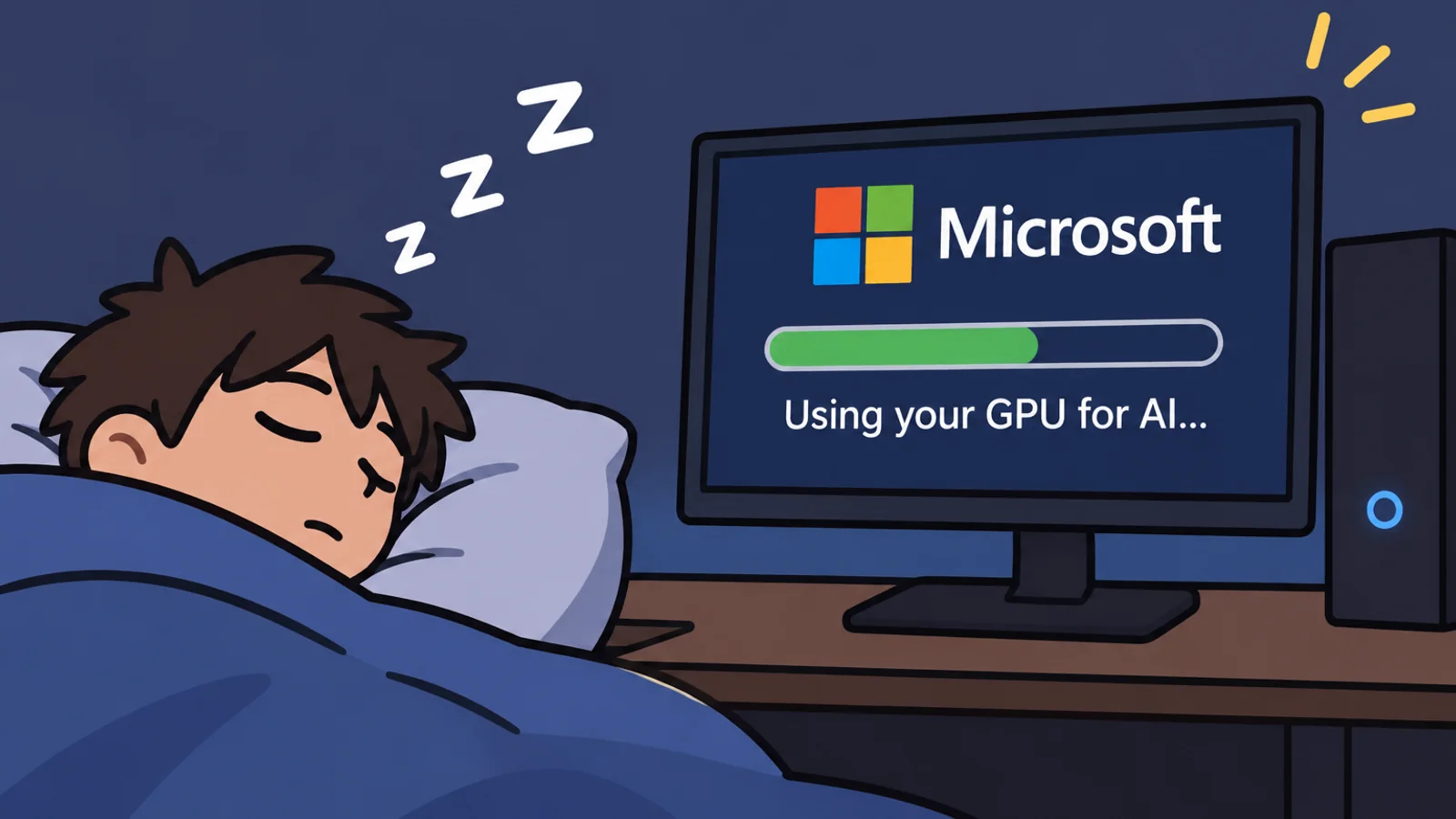
Microsoft has filed a patent application for a system that would borrow the unused graphics power of gaming PCs, laptops and phones to train AI models. The application is titled "Opportunistic Micro-training on Edge Devices Using Spare GPU Utilization." It was filed on April 30, 2025 and made public on November 5, 2026, and it was first picked up by hardware outlets in the days that followed. Owners would opt in, and the idea is that they would be rewarded for lending their hardware.
The timing is not random. AI training is hungry for GPU time, and gaming PCs often carry powerful graphics cards that sit largely idle once the game is closed. The filing treats that downtime as a pool of compute that could be tapped. One point matters up front: this is a published application, not a granted patent. As tbreak notes in its reporting, publication only makes the filing public. It does not mean the claims have been examined or allowed.
How the system is meant to work
According to KitGuru's reading of the document, the platform splits large AI workloads into independent subtasks. Software on each participating device monitors for spare capacity and sizes each micro-task to match. Metrics named in the filing include GPU utilization, graphics memory, operating temperature and power consumption, according to KitGuru.
Several safeguards are described:
- Load limits: if a machine heats up or the user launches something demanding, such as a game, the system is designed to scale back the compute load or restrict VRAM use.
- Result checking: identical calculations can be sent to several systems so that faulty or manipulated results are caught before the pieces are combined.
- Trust scoring: tbreak reports that machines with a good track record would be given more trust, and that the system would check in less often when a GPU is busy or hot.
- Voluntary participation: the filing describes an opt-in model.
TechRadar adds that the concept is not limited to gaming PCs, and could in theory run on any device with a capable GPU. The applicant is listed as Microsoft Technology Licensing, per tbreak. RuntimeWire lists the application number as US 2026/0349820 A1.
What the filing does and does not say about numbers and payment
There is no benchmark, trial result or deployment figure to report. The filing is a design description, and no partner, pilot program or launch date has been announced. tbreak says Microsoft has not commented and has not announced a Windows or Xbox program built on the idea.
Compensation is the least settled part. The description says the system could tally the work each device completes and credit the owner's account. KitGuru reports that possible incentives include direct payment, software access or account credits. tbreak adds that credits could also be redeemed for access to the trained model. However, tbreak, citing analysis by FourWeekMBA, says none of the filing's 20 claims covers paying owners. The money appears in a single paragraph of the description. KitGuru notes that the filing gives no payout figures and does not explain how rewards would be calculated.
Power draw is the obvious trade-off. Running training jobs on a gaming graphics card adds load to the hardware and to the electricity bill, so whether the scheme pays off depends on the reward structure. tbreak quotes the patent-tracking site Patentlyze as saying the technology "would add to, not reduce, a participant's electricity use."
Open questions and outlook
Patent applications often never become products, and KitGuru points out that there is no guarantee Microsoft intends to commercialize this one. Even if it did, the filing leaves open questions about handling personal data and about practical real-world testing. TechRadar's analysis raises the same issues from a user's point of view: how much system data would be monitored beyond standard Windows telemetry, whether thermal and memory limits would hold up, and how much added wear a GPU could take. TechRadar frames these as open concerns, not findings.
Volunteer computing is not new. TechRadar points to Folding@home and, before it, SETI@home as earlier examples of people lending spare PC power to large projects. The difference here is the commercial angle: rewards, and a platform that the Microsoft Technology Licensing filing suggests could serve more than Microsoft's own models. For now, the practical next signals would be an examination outcome at the patent office or an announcement from Microsoft. Neither has appeared yet.


