

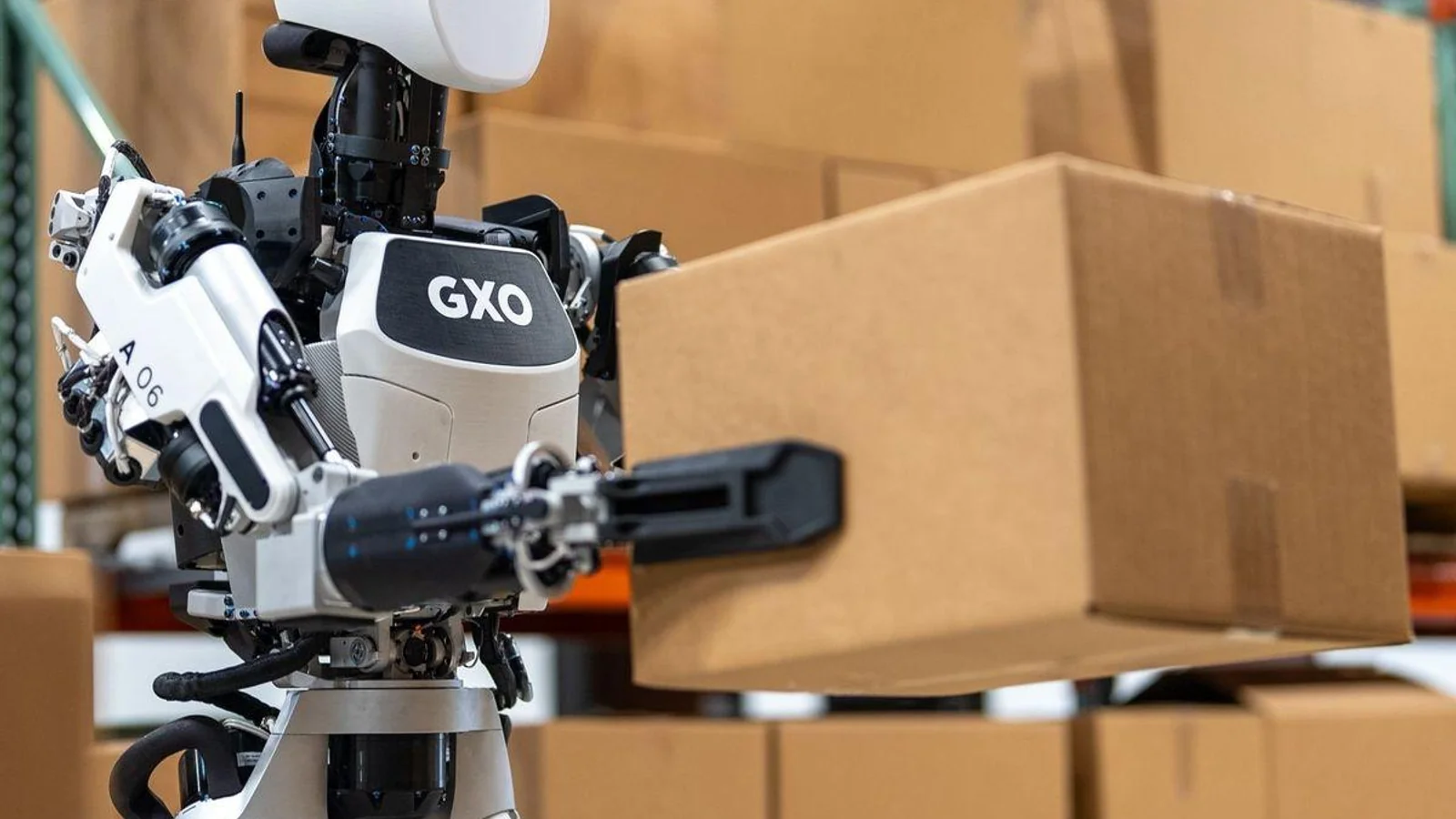
Warehouse robots are no longer just conveyor belts and shelf-moving shuttles. They are starting to walk.
On November 12, 2026, GXO Logistics announced a letter of intent with Austin-based robotics company Apptronik to expand trials of Apollo, Apptronik’s general-purpose humanoid robot. If the trials succeed, the companies intend to move toward a global rollout of up to 1,000 Apollo robots over the next four years, with initial deployments in North America in late 2027.
This is not yet a confirmed order for 1,000 machines. It is a conditional plan: GXO and Apptronik must first prove that Apollo can work safely, securely and productively in live logistics operations. But the scale of the target makes it one of the most consequential warehouse-humanoid commitments announced so far.
GXO is the world’s largest pure-play contract logistics provider, operating more than 1,000 facilities and more than 200 million square feet of space. That footprint gives the company a vast laboratory for testing whether human-shaped robots can earn their place beside conveyors, autonomous mobile robots and human workers.
What Apollo has to prove
Under the agreement, GXO and Apptronik will expand joint trials beginning in 2027. Apollo will be tested in live warehouse workflows, including goods-to-person and person-to-goods picking, moving cases and totes, packing, and sortation.
In plain English: the robot will need to fetch items, handle boxes and containers, pack orders and sort goods—repetitive, physically demanding work that occupies a large share of warehouse labor.
Each use case will be assessed against jointly agreed productivity, safety and operational key performance indicators. The companies say the trials will also validate the safety, security and technical requirements needed before deployment can scale.
That wording matters. A warehouse is not a trade-show floor. It is a fast-moving environment full of people, forklifts, conveyor systems, irregular packages and unpredictable exceptions. A humanoid must not merely walk; it must do useful work reliably, without slowing the operation or creating new risks.
Under the shell
Apollo is designed to look and move at roughly human scale. Apptronik lists the robot at 5 feet 8 inches tall and 160 pounds, with a stated lifting capacity of 55 pounds—about 25 kilograms. That is enough for many cartons, totes and consumer-goods packages, though not for the heaviest industrial loads.
The robot uses hot-swappable battery packs, each rated for four hours of operation. Rather than waiting for a recharge, a worker or automated system can replace a depleted pack and send Apollo back to work. Apptronik says this approach is intended to support “7x22” operation—essentially near-continuous use across a long working day, with brief pauses for battery changes.
Apollo’s force-control architecture is central to its workplace pitch. Instead of behaving like a rigid industrial machine, it is designed to regulate contact forces so it can operate more safely around people. Apptronik compares this approach to collaborative robotics, a category of machines built to share space with human workers rather than operate behind safety fencing.
The robot is also modular: it can use legs, wheels or a fixed base depending on the task. That flexibility matters in logistics, where a robot may need to traverse a warehouse floor in one workflow and remain stationary at a packing station in another.
The numbers behind the plan
The headline figure is up to 1,000 Apollo robots over four years. The initial commercial deployment is targeted for North America in late 2027, subject to the trials meeting the agreed performance, safety and operational benchmarks.
The commercial structure is expected to use Robotics-as-a-Service, or RaaS. Instead of buying a fleet outright, GXO would pay for robotic capability as a service—potentially making it easier to expand, replace or redeploy robots as warehouse needs change.
GXO and Apptronik began working together in 2024 with a proof-of-concept program. Earlier in 2026, Apollo completed a pilot with GXO in the United States focused on autonomous picking of small consumer goods. The companies also say they have conducted data collection and live autonomous evaluations across more than 50 logistics tasks at Apptronik’s Robot Park training facility.
GXO is already testing humanoids from more than one supplier. In October 2026, it announced an expanded partnership with Agility Robotics to deploy Digit humanoids at sites in North Carolina and Tennessee, supporting e-commerce fulfilment tasks. The Apptronik agreement therefore adds a second major humanoid platform to GXO’s automation strategy.
Why it matters
Humanoids are attractive to warehouse operators because they are built for a world designed around people: stairs, doors, shelves, carts, controls and workstations. A humanoid can, in principle, step into workflows without requiring an entire facility to be rebuilt around it.
That does not mean humanoids will replace conventional automation. Fixed robotic arms remain excellent at high-volume, highly repeatable tasks. Autonomous mobile robots are efficient at moving goods across predictable routes. Humanoids are betting on the messy middle: tasks that require mobility, manipulation and judgment, but occur often enough to justify automation.
GXO CEO Patrick Kelleher described humanoid robots as “the latest evolution of intelligent automation,” saying their increasing dexterity could make them one of the most transformative applications of physical AI in logistics.
Apptronik CEO and co-founder Jeff Cardenas said the partnership is defining what it takes to put humanoid robots to work in logistics, “measured against real operational KPIs in live facilities, and delivering real value.”
What comes next
The next 12 to 24 months will determine whether this becomes a landmark deployment or another cautious pilot. GXO and Apptronik must demonstrate consistent task completion, safe operation around employees, cybersecurity protections, dependable uptime and a clear economic case.
The central question is not whether Apollo can lift a box. It is whether it can do so thousands of times, in varied facilities, without becoming a bottleneck. If the answer is yes, 1,000 humanoid robots would mark a major step from warehouse experimentation to industrial-scale deployment.
If not, the letter of intent will remain exactly what it says: an intent, not an installed fleet.
Sources: GXO Logistics press release, November 12, 2026; Apptronik, “Apptronik Unveils Apollo”; Apptronik Apollo 2 product page; GXO and Agility Robotics partnership announcement, October 26, 2026.