

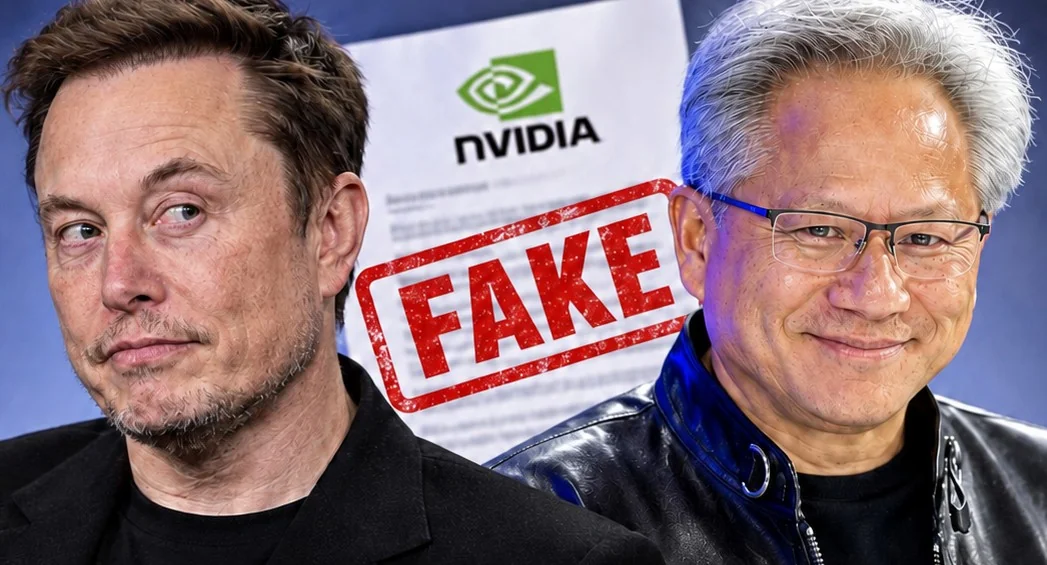
The promise sounds sweeping: leave Nvidia, and Elon Musk will have a job waiting. But the purported employee letter behind that claim is fabricated. Reports published on November 14 describe a false document demanding Jensen Huang’s reinstatement and claiming Musk had guaranteed positions for departing staff at SpaceX and Terafab.
The clearest rebuttal came from someone presented as a participant. Bryan Catanzaro, Nvidia’s vice president of applied deep learning research, publicly rejected the letter bearing his name. The reporting reviewed for this article does not establish a blanket hiring commitment from Musk or SpaceX.
That makes the viral story a case of a fabricated ultimatum, not an announced recruitment drive. Reported employee support for Huang’s return is a separate development—and does not authenticate the document.
A familiar script, with different names
The supposed letter demanded that Nvidia’s entire board resign, that independent directors replace it, and that Huang return as chief executive. It threatened that employees would otherwise leave for a SpaceX Terafab initiative. Names presented as signatories included senior technical leaders. Their appearance on the document was not proof of their involvement.
Its wording offered another warning sign. The document closely followed the protest letter OpenAI employees sent their board after Sam Altman’s dismissal in November 2023. Nvidia replaced OpenAI, Huang replaced Altman, and Musk replaced Microsoft as the proposed destination for departing workers.
The borrowed structure matters. It transferred the outline of a real corporate confrontation into a different company, then attached an unverified employment promise. A recognisable story is not the same thing as an authenticated one.
A named executive pushes back
According to ChosunBiz’s account of his November 13 post on X, Catanzaro wrote: “This letter is clearly fake, and even if it were real, I would not have signed it.” The outlet reported that he also expressed trust in Nvidia’s board and support for interim chief executive Colette Kress.
That denial directly contradicts the document’s presentation of him as a supporter. ChosunBiz also reported that the circulating post carried a Community Note highlighting the absence of verified reporting establishing that such a signed letter existed.
A document can name real executives and still misrepresent their involvement. Job titles are not digital signatures.
Real discontent, different evidence
There is reporting of employee concern inside Nvidia. Both ChosunBiz and The Asia Business Daily, citing WIRED, described an internal suggestion-board post by a longtime engineer seeking employee input into decisions about Huang’s future. It attracted more than 1,600 comments, many expressing support for him.
That figure measures discussion on an internal post. It is not a count of authenticated signatures on the viral letter, employees accepting rival jobs, or workers preparing to resign.
The same reports said Huang stepped down on November 12 and that chief financial officer Colette Kress became interim chief executive. The Asia Business Daily reported that the board had begun selecting a successor. Those leadership developments provide context for employee reactions; they do not establish that Musk offered everyone an alternative employer.
No hiring programme to measure
The document’s references to SpaceX and Terafab do not establish a recruitment programme, a staffing target or a technical roadmap. The reporting confirms neither a blanket job guarantee nor a resulting employee transfer. There are therefore no verified hiring totals, engineering assignments or deployment milestones to attach to this claim.
Looking ahead, Nvidia’s reported succession process is a concrete development to follow. A mass move to Musk’s businesses is not established. Any future recruitment announcement would need to stand on its own evidence—not on this discredited letter.
Sources: ChosunBiz’s report on the fabricated letter and Catanzaro’s denial; The Asia Business Daily’s account of the false document and reported employee reactions.