

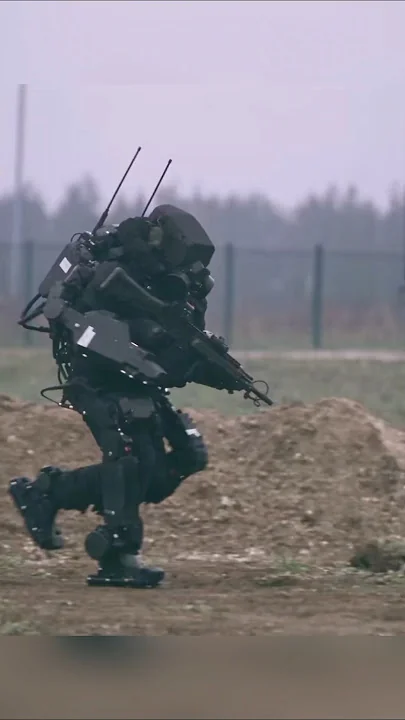
Ukrainian forces are testing wearable exoskeletons to reduce the physical strain of carrying ammunition and working at frontline artillery positions. Reports published in March 2026 documented powered devices used by the 147th Separate Artillery Brigade in the Pokrovsk sector, while April reporting described trials of a separate, Ukrainian-made passive support frame.
Those developments support the central idea behind a circulating social-media post: exoskeletons are being evaluated in frontline conditions. However, the reviewed reporting does not establish the post’s additional claim that soldiers are preparing to use anti-drone frames. The documented systems assist movement or redistribute carried weight; the sources provide no evidence that they intercept drones or protect wearers against drone-delivered explosives.
Wearable assistance, not powered armor
The powered device described by EFE is a roughly two-kilogram aluminum exoskeleton fitted around the waist and legs. It supplements the wearer’s movements rather than enclosing the body in armor, and folds into a suitcase-like transport case. According to the military unit, its battery supports approximately 17 kilometers of assisted walking.
Popular Science identified the equipment shown in the military footage as a consumer-facing Hypershell system, citing officials speaking in the video. Its account describes software that adjusts assistance to the wearer’s gait, using personal settings entered through a connected application. EFE likewise reported that the system adapts to movement patterns and terrain through onboard AI analysis. Neither report provides the underlying model architecture, training data or a detailed sensor specification.
There is an important distinction between identifying commercially available equipment in military footage and establishing a defense partnership. Hypershell told Popular Science that it had no direct involvement with Ukraine or military applications and that its products were intended for civilian use.
“Our technology was created to support movement, not conflict,” Hypershell told Popular Science.
What the field reports actually measure
The 7th Air Assault Corps says the powered devices can reduce physical load on leg muscles and related joints by up to 30 percent. That is a military-reported performance claim, not an independently established reduction in total equipment weight, injury rates or energy expenditure. The published accounts do not provide a controlled trial protocol, participant count or statistical analysis behind the percentage.
The practical workload is substantial. Kyrylo Titaiev, chief sergeant of the 147th Brigade’s Unmanned Aerial Vehicle Battery, told EFE that crews operating French CAESAR self-propelled howitzers and other artillery systems carry 47-kilogram shells over distances of dozens of meters. Repeated handling can bring the daily cumulative load to around 1,300 kilograms, he said. That figure describes weight handled across repeated lifts, not a load carried at one time.
“With this exoskeleton, we help the military to perform their tasks better and more efficiently, to get less tired, and to do them faster,” Titaiev told EFE.
His account offers direct operational feedback, but it does not establish a measured improvement across all crews or conditions. The reviewed reports do not disclose a fleet-wide deployment total, procurement value, maintenance cost or independently measured reduction in loading time.
A separate design removes the battery
A second approach comes from Ukrainian company Military Trade. Its Gyurza-1, described in April by UNITED24 Media citing Defense Express, is a passive exoskeleton: it has no batteries or electronic control system. Instead, a rigid back plate, shoulder supports, waist module and adjustable leg braces redistribute carried weight toward the pelvis and legs.]
The reported specifications put the frame’s weight below two kilograms and its intended carried load at up to 70 kilograms. Military Trade also says users can put it on or remove it in under two minutes. These remain reported design and manufacturer claims; the article does not publish independent biomechanical measurements validating the load rating or its effects on users.
The distinction between the two approaches matters. The powered system actively assists movement and depends on battery availability. Gyurza-1 relies on its mechanical structure to redistribute weight, avoiding charging requirements but providing no motor-driven assistance. They should not be treated as the same device or as a single procurement program.
UNITED24 reported that Gyurza-1 was undergoing testing across multiple units, with feedback from combat and support use informing design changes. Scaling production was described as a goal, not a completed mass deployment.
Drone exposure is context, not a protection rating
Drones help explain the interest in reducing soldiers’ physical workload. Titaiev told EFE that infantry personnel may need to walk as far as 15 kilometers to their positions with ammunition, food and equipment because drone threats make vehicle transport dangerous. Movement assistance could therefore be relevant even without offering any direct protection against a drone.
That relationship should not be confused with a demonstrated defensive capability. The reviewed sources provide no anti-drone interception results, blast-protection ratings or evidence that either exoskeleton can safely support an additional protective cage. The documented purpose is to reduce physical strain.
The next test is sustained use
Over the next 12 to 24 months, the meaningful questions are whether assistance remains useful across repeated missions, how reliably powered units operate between charges, and whether either design integrates comfortably with existing equipment. EFE reported that infantry applications still require further testing and adaptation, including modifications to improve compatibility with soldiers’ other gear.
The published evidence leaves important gaps: service life, repair requirements, battery logistics, injury outcomes and cost per equipped soldier remain unspecified. Closing those gaps would help distinguish a useful field aid from equipment ready for wider adoption. For now, the verified development is a set of frontline assistance trials—not a documented rollout of armored anti-drone exoskeletons.
Sources: EFE’s frontline reporting and interview with Kyrylo Titaiev; Popular Science’s account of the powered trials and Hypershell’s response; UNITED24 Media’s report on Military Trade’s Gyurza-1 trials, citing Defense Express.