
Disney is testing autonomous, Cars-inspired robots that could one day help guide drivers into parking spaces at Disneyland. The concept was presented during Disney Accelerator Demo Day 2026 at Walt Disney Studios in Burbank, alongside work from five technology companies participating in the accelerator program.
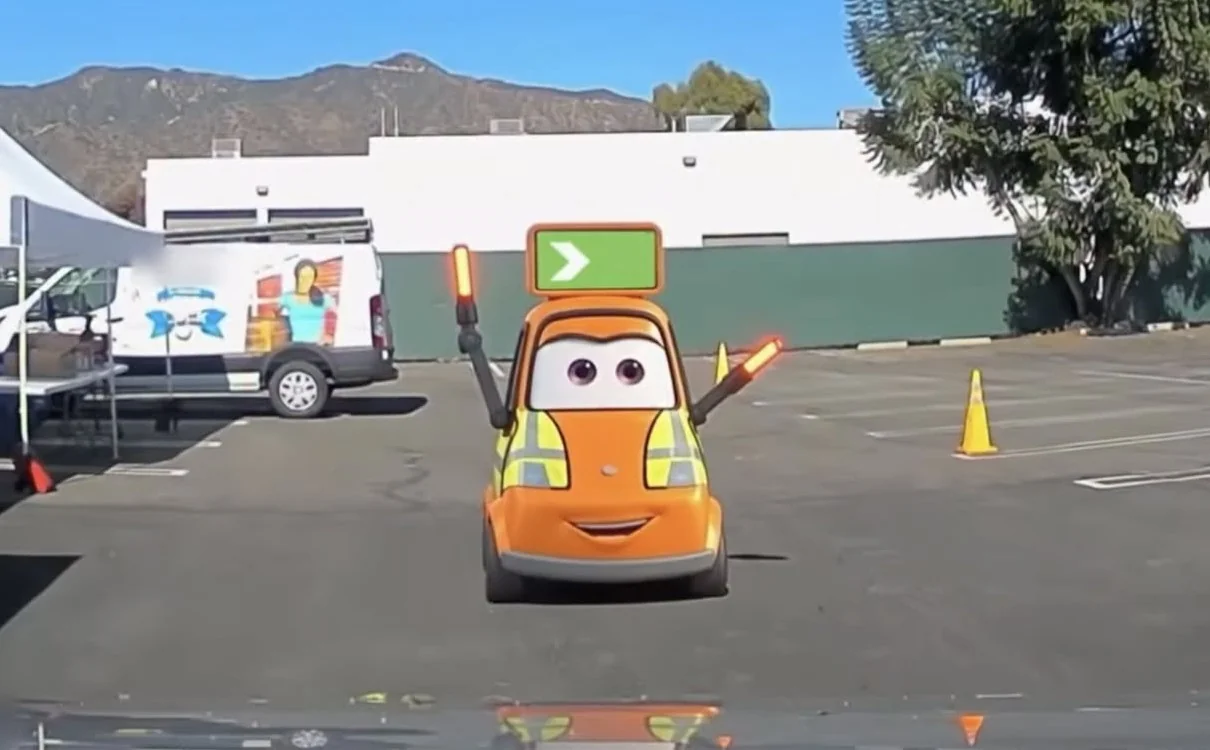
The project pairs Disney Experiences Technology and Walt Disney Imagineering R&D with Irvine, California-based FieldAI, a company that develops AI systems for robots. In a demonstration video, a small, orange, Cars-like robot wearing a yellow safety-vest design directs a vehicle toward an open parking space using light-up arms and an on-board display.
What Disney Is Testing
The robots are not self-parking vehicles. Instead, they are mobile parking assistants intended to help human drivers find and enter spaces. The demonstration showed a robot using illuminated traffic-control-style arms to point toward a spot, while a roof-mounted screen could provide instructions through text or images.
Disney has not announced a launch date, a deployment location, or a decision on whether the robots will become a permanent part of Disneyland operations. The company describes the work as an exploration of how autonomous systems could support parking operations in environments with uneven ground, changing layouts, crowds, and unpredictable weather.
How the Technology Works
FieldAI’s platform is designed to let robots operate in unstructured, real-world settings rather than follow fixed routes. According to reporting presented around the demo, the system uses multiple cameras as the robot’s “eyes and ears,” processing its surroundings in real time and collecting data as it operates.
The company says its physical AI platform has been used with roughly 30 different robot types, shapes, and sizes. FieldAI has previously worked in construction and energy environments on tasks including inspections, material transport, and construction support; its technology has also enabled the BDX droids that move through Star Wars: Galaxy’s Edge at Disneyland.
Walt Disney Imagineering R&D Lab Director Doug Fidaleo said FieldAI’s experience with demanding environments was a key reason for the collaboration.
That’s what drew us to FieldAI. The park of the future will be teeming with robot characters.
Real-World Impact
Disney has not published performance benchmarks, unit counts, cost figures, energy-consumption data, or trial-duration statistics for the parking robots. What has been confirmed is that a demonstration video showed a FieldAI-enabled robot guiding a car to a parking space, and that the companies are evaluating both technical operation and guest reactions.
Gary Daniels, senior vice president of products and experiences at Disney Experiences Technology & Digital, said the trial is intended to measure more than navigation.
The work we are doing now is a great way to see how the robots function and, as important, how people respond.
Daniels framed the concept as a familiar Pixar scenario brought into a practical setting: “Imagine if a character from Cars or robots from Wall-E direct you where to park when you arrive.”
Why It Matters
The experiment reflects a broader shift in theme-park robotics: from scripted, fixed-path animatronics toward machines that can perceive changing surroundings and interact with guests. Parking is a demanding early use case because it combines moving vehicles, pedestrians, variable lighting, weather, and constantly changing traffic patterns.
For Disney, the potential operational appeal is a more consistent arrival experience and support for Cast Members working in outdoor parking areas. For FieldAI, the project is a visible test of whether its navigation and human-robot interaction technology can function safely in a crowded consumer environment.
What Comes Next
Over the next 12 to 24 months, the main questions are safety, reliability, and public acceptance. Disney and FieldAI would need to demonstrate consistent performance around moving cars and crowds, establish clear operational boundaries, and determine whether the robots improve parking flow without creating new confusion or delays.
Disney has not said whether the robots will supplement human parking attendants, operate independently, or advance beyond the current testing phase. For now, the Cars-inspired assistants remain an experimental concept rather than an announced Disneyland feature.
Sources: People, The Orange County Register, and KTLA.