

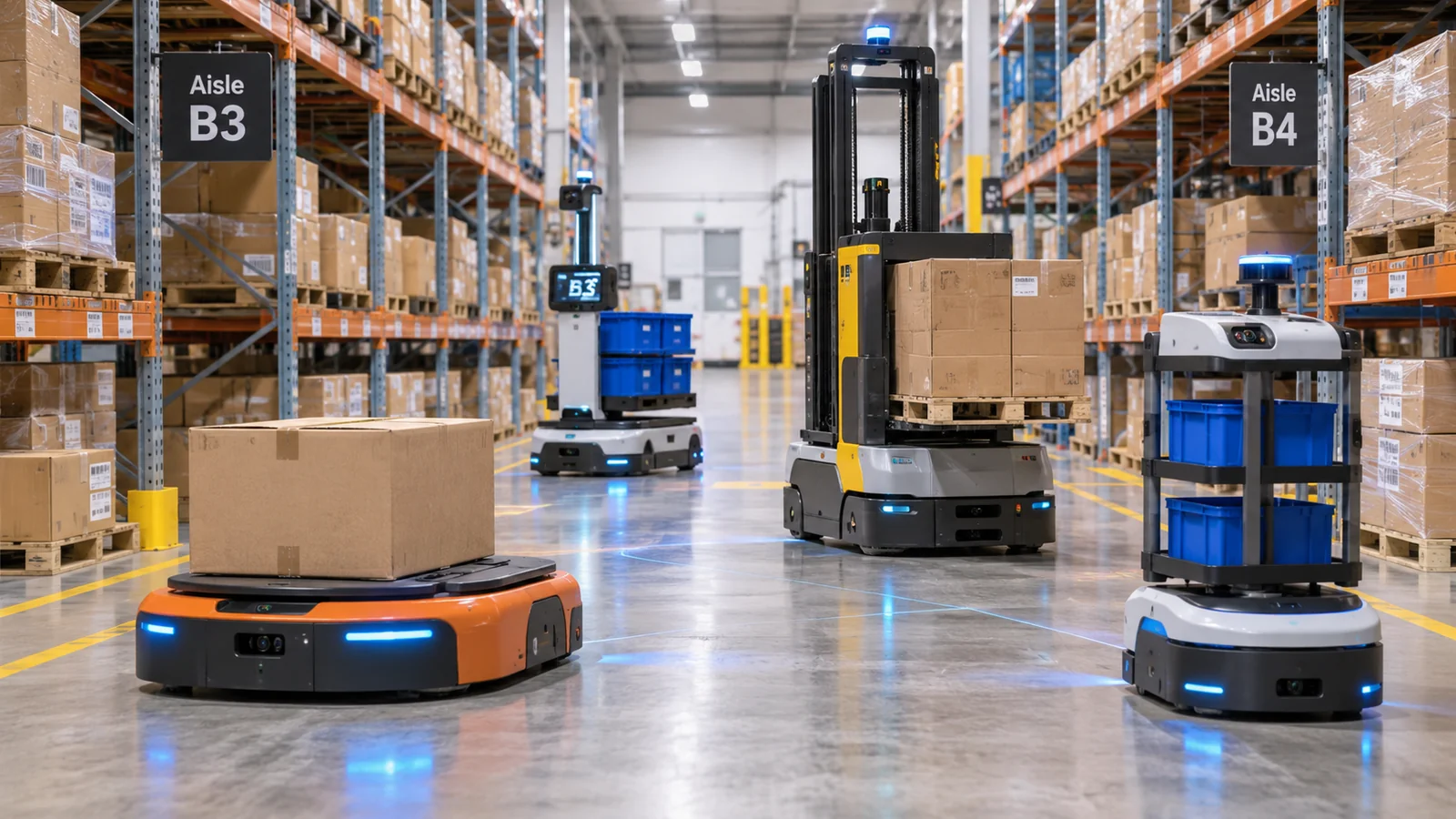
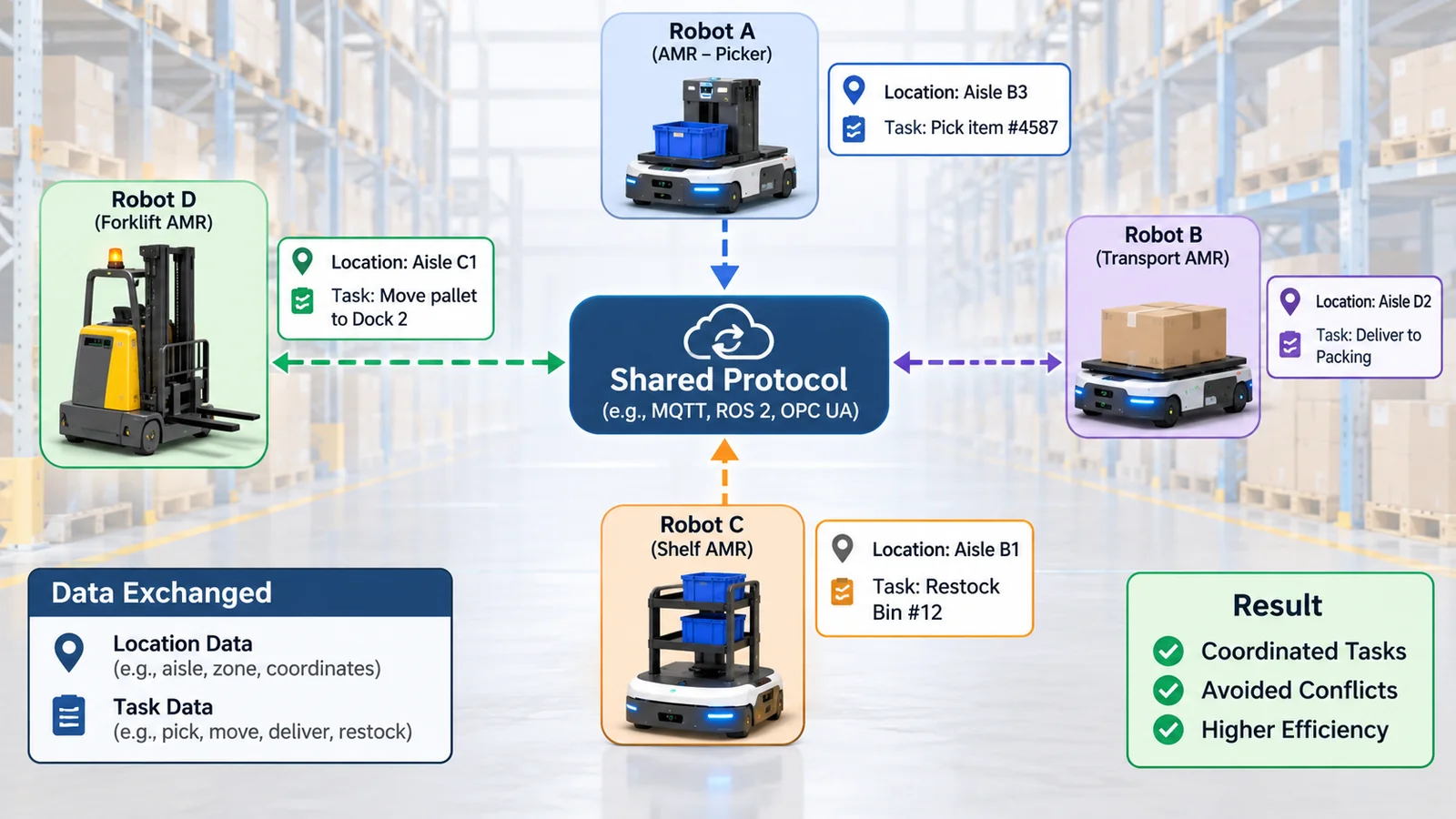
The Association for Advancing Automation announced on November 2, 2026, the publication of ISO 21423:2026, an international standard that defines how industrial mobile robots from different manufacturers exchange information and coordinate in the same facility. Developed by ISO Technical Committee 299, the document sets common communication requirements for automated guided vehicles, autonomous mobile robots and related systems so they can share location, speed, direction, condition, tasking and availability data.
As fleets of mobile robots expand across warehouses and factories, operators increasingly run machines from more than one supplier. Without a shared protocol, those robots often interfere with each other’s paths or require custom integration work. ISO 21423 addresses that gap by giving manufacturers and end users a single basis for communication that can be adopted worldwide.
How the Standard Works
ISO 21423:2026 specifies requirements for communication between industrial mobile robots (IMRs), IMR fleet managers, and other equipment in a shared industrial environment. That includes machines tended by the robots, enterprise resource planning tools, and building infrastructure such as lifts, automated doors and alarm systems. Workers using mobile devices can also share relevant information so human activity can be coordinated with the robots.
The standard supports both centralized and distributed architectures. Robots and systems can exchange identity, capability, state and command messages, along with data referenced to a common coordinate system. This allows machines from different vendors to locate themselves in the same spatial frame and negotiate movements without each needing proprietary bridges.
Navigation methods, mapping algorithms and safety requirements remain outside the scope of the document. Each manufacturer continues to use its own internal software for path planning and localization. The standard only defines how those systems communicate what they already know about position and status.
Practical Effects for Factories and Warehouses
For end users, the main expected gains are fewer path conflicts, higher robot availability and simpler expansion of mixed fleets. Companies can select robots based on application fit rather than vendor lock-in, and they can continue using equipment already installed alongside new machines from other suppliers.
Carole Franklin, A3’s director of standards development for robotics, stated: “Companies want to choose the robots that fit their applications and have those robots work together on the same floor. Many leading industrial users of mobile robots have asked for an interoperability standard for years. Now, ISO 21423 gives manufacturers and users a common basis for communication across fleets, no matter where in the world their facility is located. This standard can help companies expand automation with equipment from different vendors and make better use of the robots they already have.”
The standard builds on earlier frameworks such as the MassRobotics AMR Interoperability Standard and VDA 5050 while expanding the scope to cover a wider range of systems and both centralized and peer-to-peer coordination. It is the first non-safety robotics standard that A3 has helped produce.
Scope and Limits
ISO 21423 applies to industrial workplaces such as manufacturing, warehousing, logistics and distribution where the public is restricted. It explicitly excludes entertainment, consumer, military, medical and public-road applications. The document contains no safety requirements and does not prescribe navigation methods.
The published standard runs to 85 pages and is available through the A3 online store. Publication by ISO occurred in October 2026, with A3’s formal announcement following on November 2.
Sources: Association for Advancing Automation announcement, ISO 21423:2026 official page, The Robot Report coverage.