

Researchers from the LHCb experiment at CERN’s Large Hadron Collider have reported evidence of an ultra-rare particle decay that occurs roughly once in every ten billion beauty particles. Announced on 3 November 2026, the result, led by analysis from the University of Cambridge, probes interactions at scales of about a billion-trillionth of a metre—around 100 billion times smaller than an atom—a regime some physicists informally call the zeptoverse.
The finding marks the first time a single experiment has produced evidence for the decay of a Bd meson (a particle containing a beauty quark and a down antiquark) into a pair of muons. It is consistent with Standard Model predictions and places limits on heavier new particles that could influence the process.
How the LHCb Measured the Decay
Beauty quarks are heavy relatives of the up and down quarks that make up ordinary matter. Produced in large numbers in high-energy proton collisions at the LHC, they exist for only about 1.5 trillionths of a second before decaying. The specific channel studied, written as Bd → μ+μ-, is so rare that the Standard Model predicts it happens only about once in every ten billion such particles. Because the process is so suppressed, even small contributions from undiscovered particles could change the observed rate.
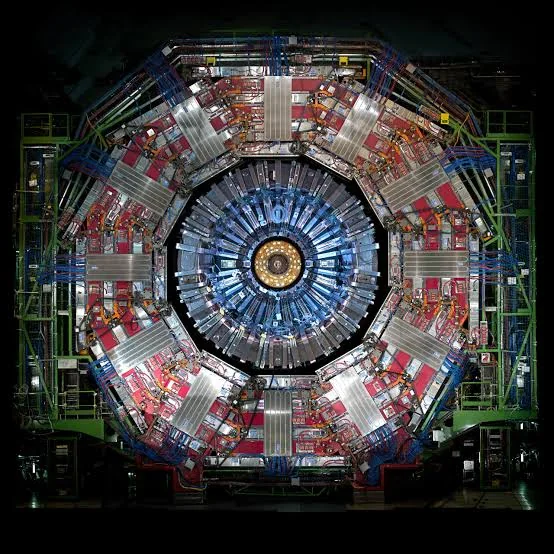
LHCb recorded data in two main periods: 2011–2018 and, after a major detector upgrade, 2024–2025. The upgrade allowed the experiment to collect data at up to five times the previous rate and improved its ability to distinguish particle types. Machine-learning algorithms were then used to suppress the large background of more common processes that would otherwise hide the rare signal.
Combined data yielded a statistical significance of 3.2 standard deviations—above the conventional three-sigma threshold used for “evidence” of a phenomenon, but short of the five-sigma level required for a formal discovery. The same analysis also delivered the most precise measurement to date of a related, slightly less rare decay, Bs → μ+μ-, first observed in 2015.
Scale, Sensitivity and What the Result Shows
The energy and precision of the measurement give physicists access to distance scales of order 10-21 metres (zeptometres). For comparison, a typical atom is roughly 10-10 metres across, so the new result reaches about 100 billion times smaller. At these distances, quantum effects from particles too heavy to be produced directly in LHC collisions can still leave a detectable imprint on rare decay rates.
The measured rate agrees with Standard Model calculations. That agreement does not rule out new physics; it simply constrains how large any additional contributions can be. Future, higher-statistics samples will tighten those constraints further. Some theoretical models suggest that particles at these scales could be sensitive to dark matter or other beyond-Standard-Model effects, though the current result does not claim a detection of dark matter.
We’re knocking on the door of this zeptoverse. And what we want to do now is go in and explore and find what new particles are waiting there. And to do that, what we need is more data.
Dr Harry Cliff of the University of Cambridge’s Cavendish Laboratory, who led the analysis team, told BBC News. He added that seeing clear evidence of the decay was thrilling after a search that began in the mid-1980s.
On the CERN announcement, Cliff stated: “Seeing evidence of this rare decay is incredibly exciting, opening up new possibilities to probe beyond the direct reach of the LHC. The future LHCb upgrade will allow us to observe many more of these decays, providing even greater sensitivity to undiscovered particles.”
Upgrades, Collaboration and Next Steps
The result comes from an international collaboration. UK groups, supported by the Science and Technology Facilities Council, made major contributions to the upgraded LHCb detector, including the Vertex Locator (a silicon-pixel device that sits only a few millimetres from the beam) and the Ring Imaging Cherenkov particle-identification system. Analysis involved physicists from the United Kingdom, Germany, Italy, Spain and the Netherlands.
Looking ahead, the High-Luminosity LHC is scheduled to start in 2030, and a further LHCb upgrade is planned for the middle of the next decade. Together these improvements are expected to increase the available data by roughly an order of magnitude, which should push the significance of the Bd → μ+μ- measurement well above five sigma and tighten sensitivity to new particles.
The measurement therefore functions as both a precision test of the Standard Model and a calibrated probe for physics that lies beyond the direct production reach of the current collider. Additional data will determine whether the rate remains exactly as predicted or whether a small deviation appears—the experimental signature that new particles at zeptometre scales would leave behind.
Sources: BBC News, University of Cambridge, CERN, UK Research and Innovation.