

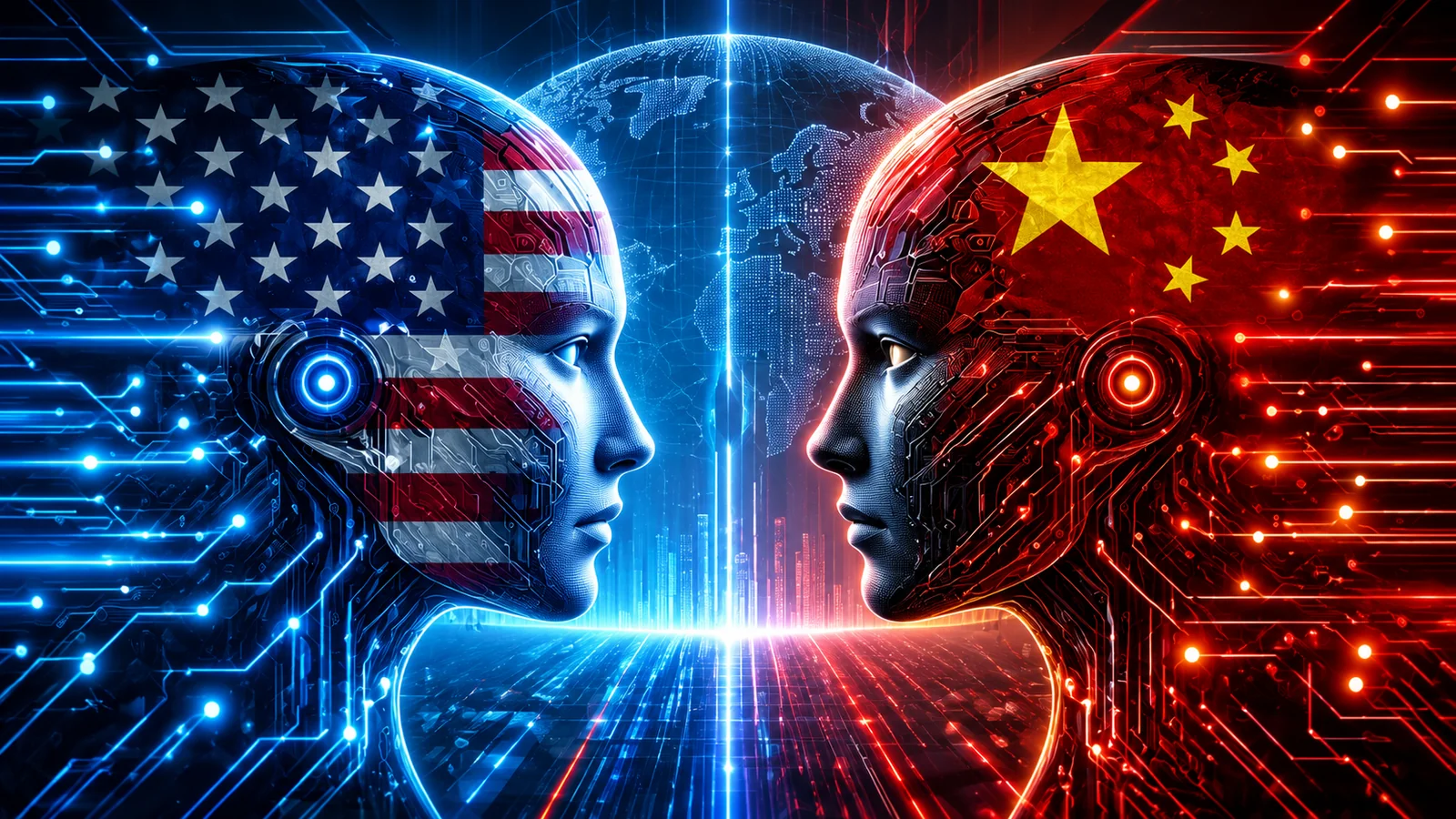
The United States are fighting to maintain its lead in artificial intelligence, while China's rapidly improving models are challenging established players. The launch of a new US-developed AI model highlights how the battle for technological dominance is entering a new phase. The global artificial intelligence race is becoming increasingly competitive. For years, American companies have dominated the development of some of the world's most advanced AI systems, but Chinese technology companies are closing the gap with powerful, increasingly accessible alternatives. From DeepSeek and Alibaba to OpenAI, Google, and emerging US startups, the competition is no longer just about building the smartest chatbot. It is about computing power, affordability, technological independence, and the ability to turn AI into a strategic economic advantage.

China's Open AI Models Are Changing the Competitive Landscape Chinese AI developers have become increasingly influential in the global technology market. Companies such as DeepSeek, Alibaba, Moonshot AI, and Z.ai are developing models that compete in areas including reasoning, software development, and autonomous AI agents. One of the most important changes is the growing popularity of open-weight models. Unlike conventional AI services, which can only be accessed through a company's platform or API, open-weight models allow developers to download model parameters and run the systems within their own infrastructure, subject to the applicable license. This approach offers several advantages. Businesses can customize models for specific tasks, maintain greater control over sensitive data, and reduce their dependence on external AI providers. Chinese companies have made this strategy particularly competitive by offering capable models at prices that can appeal to developers, startups, and enterprises with limited budgets. DeepSeek helped draw international attention to this trend, demonstrating that Chinese developers could compete in a market long associated with American technological leadership. The result is a more complicated competitive landscape. The United States remains home to major frontier AI developers, but Chinese companies have established themselves as serious competitors, particularly in the open-weight segment.
Reflection AI's Beam: An American Challenge to Chinese Models
Reflection AI's new Beam model represents an attempt to strengthen the American position in this increasingly important market. According to the company's October 5 announcement, Beam contains 501 billion parameters in total, with approximately 23 billion activated for a given operation. It uses a sparse Mixture-of-Experts architecture designed to balance model capacity with computational efficiency. Reflection has focused its development efforts on coding, reasoning, and agentic workloads. These capabilities are particularly valuable for applications that require AI systems to complete multiple steps, use tools, and solve problems rather than simply generate text. The company says Beam is competitive with several leading open-weight models and approaches Alibaba's Qwen 3.8-Max on certain coding and agent-related tasks. However, the results are not uniform across all benchmarks. Reflection's own published comparisons show that Chinese models retain advantages in several areas, including some demanding coding and research tasks. This distinction matters. The launch of Beam does not establish that the United States has regained an overall lead in open-weight AI. Instead, it demonstrates that American developers are investing heavily in alternatives designed to compete with China's strongest offerings. The model's eventual impact will depend on independent evaluations, practical performance, availability, and the cost of running it in real-world environments.
Why Open-Weight AI Matters
The competition between American and Chinese developers is not limited to the performance of their most advanced models. Increasingly, the question is who can provide the best combination of capability, affordability, accessibility, and control. Closed AI systems can offer convenient access to powerful technology without requiring users to manage their own infrastructure. However, customers may face usage limits, recurring fees, data-handling restrictions, and dependence on a particular provider. Open-weight models offer a different proposition.

Companies can deploy them on their own servers or through selected infrastructure providers. They can also adapt them to specialized tasks, subject to licensing terms and hardware requirements. For organizations operating in finance, healthcare, manufacturing, and government, this flexibility can be particularly attractive. Keeping certain workloads within controlled infrastructure may help address data governance and compliance requirements. There are trade-offs, however. Running a large model can require substantial computing resources, technical expertise, and ongoing maintenance. Open weights also do not automatically mean that the complete training data, training code, or development process is publicly available. Nevertheless, the growing quality of open-weight models could make advanced AI more accessible to organizations that do not want to rely entirely on a small number of commercial providers. For the United States, competing successfully in this market is becoming an important strategic objective.
Computing Power Remains a Critical Advantage

Despite rapid progress in model design, access to computing infrastructure remains one of the most important factors in AI development. Training and operating advanced models require powerful processors, large amounts of memory, energy, and specialized data-center infrastructure. American companies benefit from a strong ecosystem of semiconductor designers, cloud providers, research institutions, and investors. Nvidia, in particular, plays a central role in supplying the hardware used to train and run many advanced AI systems. China, meanwhile, faces restrictions on access to certain advanced American semiconductor technologies. These limitations have created additional challenges for Chinese developers seeking to train increasingly capable models. However, hardware restrictions have not prevented Chinese companies from making substantial progress. Developers can improve efficiency through architectural innovations, optimization techniques, and more effective training methods. These approaches can reduce the amount of computing power required to achieve a particular level of performance. This is one reason the AI race cannot be understood simply by comparing access to the most advanced chips. A company that develops a model capable of delivering strong results at a lower operating cost may gain a significant commercial advantage, even if it does not have access to the largest computing clusters. In the long run, the winners may be those that combine powerful infrastructure with efficient model design and effective distribution.
The Competition Is Becoming a Geopolitical Issue
The rivalry between the United States and China increasingly extends beyond commercial competition. Both countries view artificial intelligence as a technology with implications for economic growth, national security, scientific research, and international influence. The United States has used export controls to restrict China's access to certain advanced technologies, including high-performance AI chips. American officials have also raised concerns about the potential misuse of AI capabilities and the protection of sensitive technological knowledge. China is responding by strengthening its domestic technology ecosystem and seeking greater control over strategically important innovations. On October 16, 2026, Reuters reported that China had proposed additional export controls covering 23 AI-related technologies as part of a broader review of advanced technology exports. The proposals illustrate Beijing's growing interest in regulating the international transfer of sensitive AI capabilities. If implemented, such measures could affect how certain technologies are transferred abroad, although their practical impact will depend on the final rules and how they are enforced. These developments suggest that the global AI market could become more fragmented, with companies operating under different technological standards, regulatory requirements, and geopolitical constraints. For international businesses, this creates both risks and opportunities. Access to particular models, chips, and infrastructure may increasingly depend on where a company operates and which rules apply to its activities.
Who Is Actually Winning the AI Race?
Declaring a single winner would be premature. American companies continue to play a leading role in developing frontier AI systems, supported by major investments, strong research teams, and extensive computing infrastructure. Chinese developers, meanwhile, have demonstrated that they can produce highly competitive models and challenge established assumptions about the cost of advanced AI. The answer also depends on what is being measured. The most capable proprietary model is not necessarily the cheapest to operate. The most efficient open-weight model may not be the best at every task. A system that performs exceptionally well on coding benchmarks may offer fewer advantages in scientific research, multilingual communication, or other specialized applications. A meaningful comparison must therefore consider multiple factors: - Model performance: How accurately can the system solve complex problems? - Operating costs: How much computing power and money does it require? - Accessibility: Can businesses and developers use or customize it? - Reliability: Does it perform consistently under real-world conditions? - Security: Can it be deployed safely and responsibly? - Ecosystem: How easily can it be integrated into existing products and workflows? Independent testing will be essential to determining how Beam compares with leading Chinese alternatives. The same principle applies to claims made by Chinese AI companies. Company-reported benchmarks can be useful, but they should be evaluated alongside independent testing and practical results. Rather than treating the AI race as a contest with one definitive winner, it may be more accurate to view it as a competition across several interconnected markets.
What This Means for Businesses and Everyday Users
The growing competition between American and Chinese AI developers could have tangible benefits for consumers and businesses around the world. More competition can put downward pressure on prices, encourage faster innovation, and expand the range of available tools. Businesses may gain access to more affordable coding assistants, research tools, customer-service systems, and specialized AI applications. Developers could have more freedom to choose between proprietary services and models they can run within their own infrastructure. Competition may also reduce dependence on individual providers. If several companies offer comparable capabilities, customers have greater flexibility when negotiating prices, selecting vendors, and planning long-term technology strategies. But the growing availability of powerful AI systems also creates challenges. Organizations must consider data privacy, cybersecurity, intellectual property, reliability, and the possibility of harmful or misleading outputs. Open-weight systems introduce additional questions because users may be able to modify safeguards built into the original model. For governments, the challenge will be to encourage innovation while establishing appropriate protections against misuse. For users, the most important consequence may be that increasingly capable AI tools become available through a wider variety of products and services, potentially at lower prices.
The Next Phase of the AI Race
Reflection AI's Beam is one example of how American developers are responding to the growing influence of Chinese open-weight models. Its launch does not settle the question of which country leads the field. Instead, it highlights a market in which performance, efficiency, openness, and practical usefulness are becoming increasingly important. The United States retains significant advantages in computing infrastructure and the development of frontier AI systems. China has demonstrated an ability to innovate under technological constraints and compete aggressively in the open-weight market. Neither advantage guarantees lasting dominance. The next stage of the competition will likely depend on how quickly companies can improve their models, lower operating costs, attract developers, and turn technical progress into useful products. For businesses and consumers, that competition could mean more choice and better access to advanced AI. For policymakers, it will raise difficult questions about security, technological independence, and international cooperation. One thing is becoming increasingly clear: the future of artificial intelligence will not be determined by a single model or a single company. It will be shaped by an ongoing contest between competing technologies, business strategies, and national priorities. And as American and Chinese developers continue to push each other forward, the biggest beneficiaries may ultimately be the people and organizations using AI around the world.
Sources: