

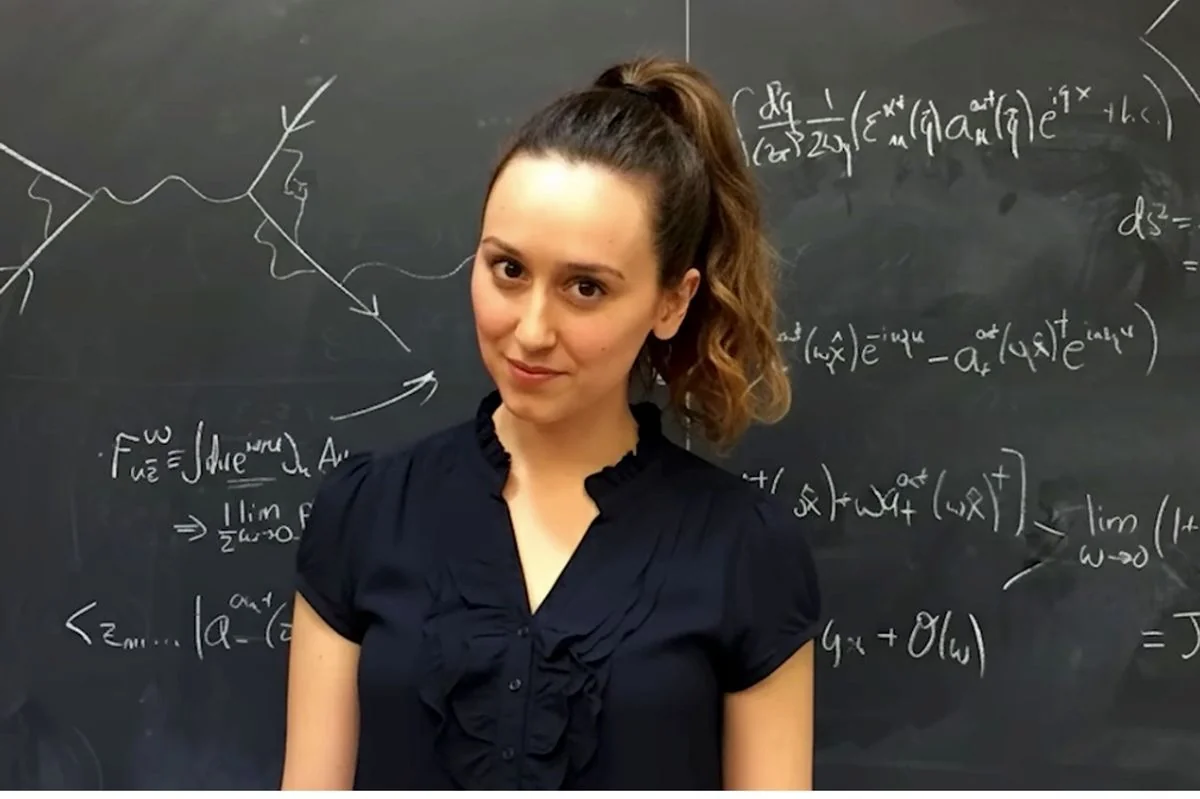
Sabrina Pasterski is pursuing a mathematical route toward reconciling gravity with quantum physics: describing gravitational processes through a theory on a two-dimensional celestial sphere. She leads the Celestial Holography Initiative at Perimeter Institute in Waterloo, Canada, which she founded after joining its faculty in 2021. The research is an ongoing theoretical program—not an announcement that scientists have proved the universe is a hologram.
The effort gained an international research framework through the Simons Collaboration on Celestial Holography, announced by Perimeter in July 2023. A subsequent institute profile, published in August 2025, reported an $8 million Simons Foundation grant supporting the work. Its objective is to develop a mathematical relationship that could bring quantum theory and gravity into a common description.
What celestial holography actually proposes
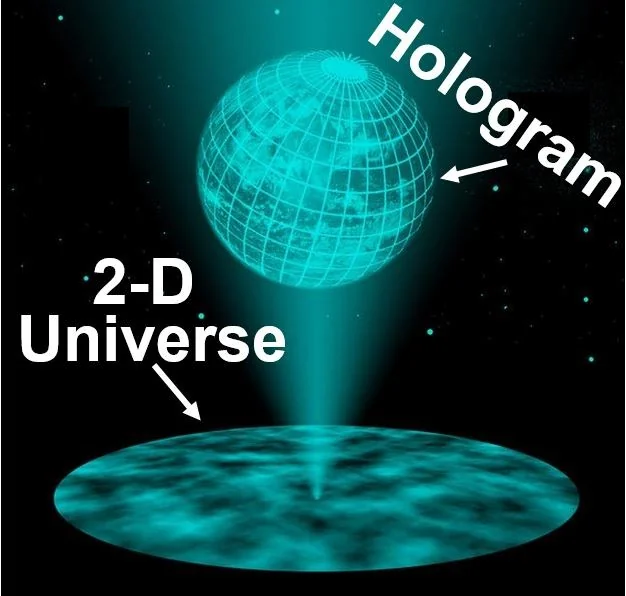
The underlying idea is duality: two apparently different theories can describe the same physics. In the holographic approach, a theory containing gravity in a spacetime region would have an equivalent description without gravity on that region’s boundary. This is a proposed equivalence between mathematical descriptions, not a claim that the universe is a computer-generated image.
An established example, the Anti-de Sitter/Conformal Field Theory correspondence, connects gravitational physics in negatively curved spacetime with a boundary field theory. Celestial holography seeks a different construction, one that researchers hope will connect more closely to the universe we observe.
There is an important limitation. Perimeter describes its celestial framework as applying to spacetimes with a vanishing cosmological constant. That assumption is not a complete description of our actual universe. Finding a more broadly applicable duality remains part of the research problem, rather than an already demonstrated result.
The architecture is mathematical, not hardware
The technical core is a translation between four-dimensional scattering calculations and a two-dimensional conformal field theory. Scattering calculations describe interactions through quantities called scattering-matrix elements; the celestial framework maps those quantities into correlations in a theory defined on the celestial sphere.
That sphere represents directions extending outward toward infinity. It provides the setting for the lower-dimensional description, rather than a physical screen installed somewhere in space. The research asks how information about interactions can be reorganized into this boundary language.
Perimeter identifies several useful features of the mapping. It exposes infinite-dimensional symmetries that are less apparent in conventional scattering calculations, recasts limits involving nearly aligned particles in the language of conformal field theory, and connects infrared and ultraviolet behavior. These are mathematical tools for investigating the structure of interactions, not performance benchmarks for a device.
The international collaboration combines several approaches. Pasterski’s work on scattering and symmetries intersects with Laurent Freidel’s research on local holography and corner symmetry. Kevin Costello contributes methods from twisted holography, offering a complementary route toward constructing the mathematical description. Andrew Strominger of Harvard serves as collaboration director.
What the evidence shows—and does not show
The concrete organizational scale is substantial for a theoretical project. The 2023 announcement named 13 principal investigators, including Pasterski, Freidel and Costello at Perimeter and 10 international colleagues. It described an initial four-year funding period, alongside research exchanges, meetings and graduate training. The $8 million figure appeared in Perimeter’s later 2025 profile; it was research funding, not a commercial deployment valuation.
The cited institutional accounts do not report an experimental confirmation of a complete celestial holographic description. They also provide no commercial deployment figures, computing speedups, energy savings or robotics applications. The reported outputs concern theoretical relationships, symmetries and research infrastructure.
One possible connection to observation involves the spin memory effect, which Pasterski co-discovered. Perimeter describes gravitational-wave memory as a lasting effect associated with waves passing through spacetime, and identifies LIGO or future gravitational-wave detectors as possible routes to observing the relevant signal. Its account presents this as a prospective connection between theory and measurement, not a completed detection validating celestial holography.
The next challenge is a testable description
The central challenge is to turn the connections among scattering, symmetry and boundary theories into a more complete account of quantum gravity. Researchers must also clarify how that framework relates to observable physics and to the properties of our universe. The institutional sources do not establish a deadline for solving those problems or promise an experimental breakthrough within the next 12 to 24 months.
Pasterski framed the collaboration as an effort to assemble previously separate results when it launched in 2023:
“We’re starting to finally see how to fit together a lot of pieces of the puzzle we’ve been building for the last decade”
For now, the meaningful development is the coordinated attempt to connect those pieces—not a declaration that quantum gravity has been solved. Celestial holography offers a research framework for asking whether gravitational physics can be expressed in a different mathematical language, with observational connections still under investigation.
Sources: Perimeter Institute’s Celestial Holography Initiative overview; its July 2023 Simons collaboration announcement; and its August 2025 profile of Sabrina Gonzalez Pasterski.