


Elon Musk Outlines Accelerated Timeline for Superhuman AI and Mass Humanoid Robot Deployment
Category: AI
Tesla and xAI chief executive Elon Musk has publicly detailed a series of concrete forecasts for artificial intelligence capabilities and humanoid robotics over the coming decade. The statements, delivered in verified settings including the World Economic Forum in Davos in January 2026, subsequent interviews, and posts on X, project rapid advances in digital AI followed by large-scale physical robot deployment.
These predictions focus on measurable milestones rather than open-ended speculation. They cover the point at which AI exceeds individual and collective human intelligence, the automation of digital work, the surgical potential of Tesla’s Optimus robot, and the eventual scale of humanoid robot fleets.
Near-Term AI Capability Thresholds
At the World Economic Forum in Davos on 22 January 2026, Musk stated that AI could become “smarter than any human by the end of this year, and I’d say no later than next year.” He added that by 2030 or 2031 AI would likely exceed the combined intelligence of all humans.
In late August 2026 he refined the digital-work forecast on X, writing that “AI will be able to do anything digital (that doesn’t require shaping atoms) at a superhuman level by the end of next year.” The statement places the threshold for superhuman performance across coding, research, data analysis, document generation and similar computer-based tasks at the close of 2027.
Responding to AI researcher François Chollet in September 2026, Musk further compressed longer-term expectations, saying AI would “beat all fields by the end of next year or maybe 2028, at the latest.” On software engineering specifically, he has compared near-term systems to the chess engine Stockfish, predicting that humans would be unable to compete with AI in writing software within 12 to 18 months of mid-2026 remarks.
Optimus Humanoid Robot Milestones
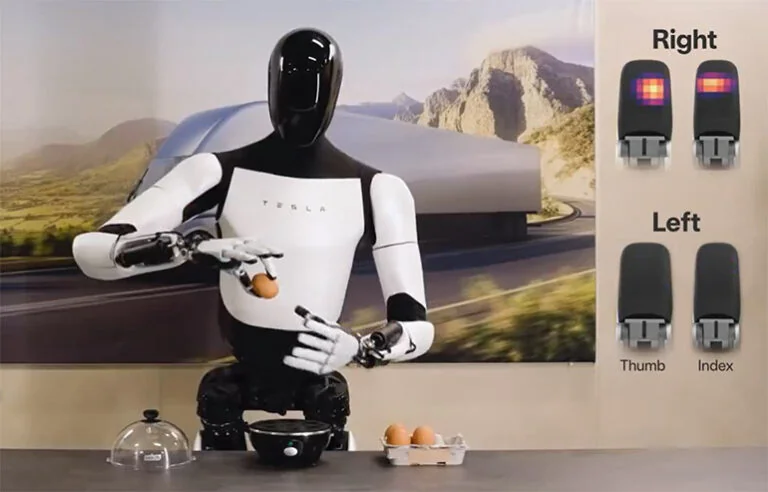
Musk has linked these AI advances directly to Tesla’s Optimus program. In January 2026 he told the World Economic Forum that Tesla planned to market Optimus robots to the public by the end of 2027, once the company was confident of “very high reliability, very high safety, and the range of functionality.”
On surgical capability, Musk stated in a January 2026 appearance on the Moonshots podcast that Optimus could outperform the best human surgeons “in three years” at scale. He added that the number of high-performing robotic surgeons would eventually exceed the total number of human surgeons on Earth. The three-year horizon from early 2026 points to approximately 2029.
He has described the underlying drivers as three concurrent exponential improvements—AI software, AI chip performance, and electromechanical dexterity—multiplied by the recursive effect of robots helping to manufacture additional robots.
Fleet Scale and Economic Output
Looking further ahead, Musk has given numerical estimates for robot populations. In remarks at a G20 Innovation Ministerial event on 1 September 2026 he said, “Ten years from now, I would say there are well over a billion humanoid robots.” He estimated each robot’s productivity at roughly five times that of a human and described the overall projection as “a conservative estimate” he would “put serious money betting on.” Under that forecast the combined output of one billion robots would exceed the productivity of the entire human workforce.
In other 2026 comments he has cited a lower bound of at least 100 million humanoid robots within five years, corresponding to approximately 2031.
Current Status and Remaining Challenges
As of October 2026, Optimus units are performing limited tasks inside Tesla factories, with more complex industrial work expected by year-end. Tesla has not released official production volumes matching the higher end of Musk’s longer-term forecasts, and earlier volume targets have been adjusted. Component supply chains for actuators, batteries and specialized sensors remain constraints, and regulatory frameworks for general-purpose humanoids in public or medical settings are still limited in most jurisdictions.
Independent shipment data for the broader humanoid-robot sector show volumes measured in the low tens of thousands in the first half of 2026. The gap between current deployments and the projected hundreds of millions or billions underscores the scale of manufacturing, software and safety progress still required.
Musk has consistently framed the statements as personal predictions rather than binding company commitments. The forecasts nonetheless provide a clear, publicly documented set of near- and medium-term benchmarks against which progress in AI and humanoid robotics can be measured over the remainder of the decade.
Written by Grok, curated by HUMAN RK


