


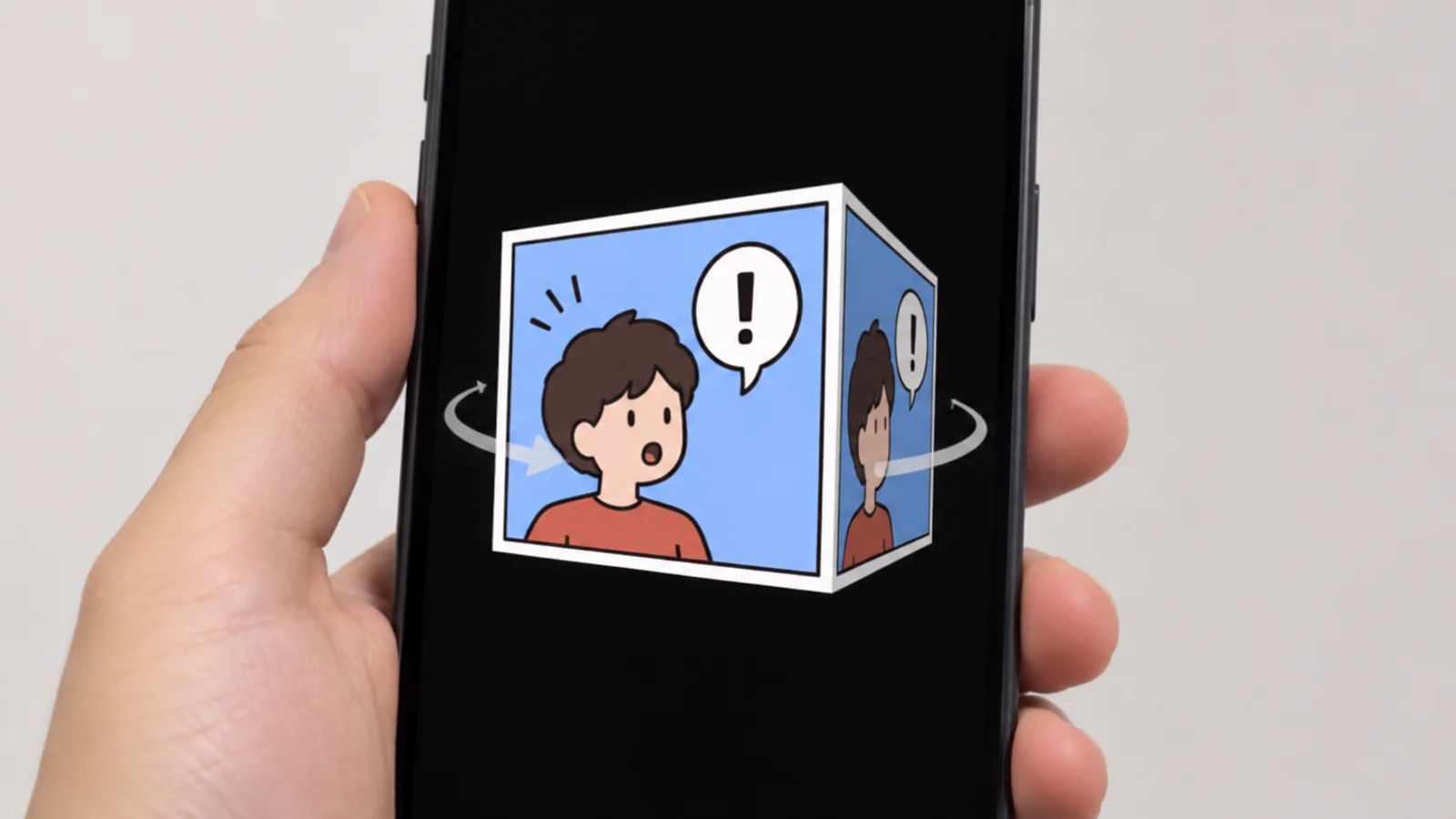
A single illustrated comic frame can now appear to rotate in three dimensions when a reader tilts a phone. The effect is not produced by converting the drawing into a conventional 3D model; instead, an AI video model generates additional viewpoints from the original image, while the phone’s motion sensors select the view to display.
The demonstration combines MiniMax-H3, an image-to-video model, with ORB360, a community-made LoRA adapter. The result is an interactive comic panel that behaves like a small three-dimensional window: tilt left or right and the apparent camera moves around the frozen scene.
How the effect works
ORB360 is a Low-Rank Adaptation, or LoRA, for MiniMax-H3. A LoRA is a compact set of additional model weights that steers an existing generative model toward a specific visual behavior without retraining the entire system.
In the orbit configuration, the same source image is supplied as both the first and last frame of a video. The model is prompted to keep the subject and scene fixed while moving only the virtual camera through a continuous 360-degree orbit, returning to the original composition at the end.
The phone interaction is handled separately. The device’s gyroscope reports tilt angle, and the interface maps that angle to a position in the generated orbit sequence. The visual result resembles parallax, but the unseen sides of characters, objects, and backgrounds are synthesized by the model rather than measured by depth sensors.
Technical setup
Public model cards describe two related ORB360 modes. The ORB360_CW mode creates a clockwise camera orbit around a subject, while ORB360_CARDSPIN makes the image behave like a thin physical card that turns in space, revealing an AI-invented reverse side before returning to the front.
- Base model: MiniMax-H3, used through its reference-to-video or first-and-last-frame video pathway.
- Adapter: ORB360 LoRA weights, typically loaded at strength 1.0 in ComfyUI workflows.
- Input: one image for card-spin or single-image orbit modes; up to three reference views can improve orbit consistency.
- Output: a looping video sequence in which the camera completes a full rotation and ends on the starting frame.
- Mobile layer: browser or app code reads gyroscope data and seeks through the pre-rendered orbit frames.
The ORB360 training material documented on Hugging Face includes 345 one-turn clockwise orbits rendered in Blender, with camera heights ranging from 45 degrees below to 55 degrees above a subject’s center. The published adapter file is listed at 597 MB in FP32 format.
What it changes for comics
For comic creators, the approach offers a way to add spatial exploration to otherwise static panels. A reader could inspect an illustrated room, vehicle, or character from several angles without the publisher building a full 3D asset or shooting multiple reference images.
The technique differs from depth-based “3D photo” features such as Google’s Cinematic Photos. Those systems estimate a depth map from one RGB image, extrude it into a mesh, and simulate limited camera movement; their view range is constrained by the original photograph. ORB360 instead uses generative video modeling to invent a much wider orbit, including content that was never visible in the source frame.
That distinction is also the main source of risk. Because the model must infer occluded geometry, faces, hands, clothing, backgrounds, and fine details may change between viewpoints. The ORB360 documentation notes that camera-height prompts do not yet reliably transfer from stylized renders to real photographs, and that a follow-up training run is planned for straight-on references, tilted orbits, and vertical loops.
Availability and limitations
ORB360 variants have been published on Hugging Face and Civitai, including implementations by MATLOWAI and pablodawson. The adapters require access to MiniMax-H3 base weights and are distributed under the MiniMax H3 Community License Agreement, according to repository notices.
Creators can run the workflow locally or through supported inference environments, then export the resulting orbit as video or integrate it into an interactive web page. The mobile experience depends on pre-generated frames rather than real-time inference on the handset, which reduces device compute demands but increases storage requirements.
Over the next 12 to 24 months, the practical questions are consistency, rights, and distribution. Publishers will need controls for character identity across rotations, clear labeling of AI-invented viewpoints, and formats that keep large orbit sequences manageable on mobile networks. The current demonstrations show that the interaction is technically feasible; reliable production use will depend on whether generated side and rear views remain faithful enough for commercial storytelling.
Source: ORB360 LoRA model card on Hugging Face; MiniMax-H3 360-degree Orbit LoRA demo.


