
Neuralink says its engineers spent 72 hours at the home of a participant in its VOICE clinical study, building and testing tools designed to turn intended speech into digital communication. In an October 29 update, the company detailed eight areas of work, including automatic speech-intention detection, iPhone call integration and a prototype for directing a Grok computer-use agent through its brain-computer interface. [18]
The development moves the focus beyond whether an implanted interface can decode a command to whether someone can use it conveniently in everyday conversation. Neuralink’s account describes practical obstacles: starting speech without pressing a button, correcting decoding mistakes and answering calls without navigating multiple screens. The company’s devices remain investigational and have not been approved by the FDA or other regulatory authorities. [18]
What Neuralink built during the visit
The team worked alongside the participant, his wife and his caregiver, using their feedback to revise prototypes on site. Neuralink did not identify the participant’s location in its engineering report. It also noted that some published demonstrations show interfaces refined in the weeks after the hackathon, rather than only what existed at the end of the three-day visit. [18]
A central addition was neural voice activity detection. Previously, speech decoding required a button press to start and stop recording. The new system detects when the participant is attempting to speak, allowing decoding to begin and end automatically. Neuralink presents this as a step toward hands-free communication, rather than evidence that all manual interaction has been eliminated. [18]
Other work focused on Bloom, the company’s mobile speech-BCI app. Engineers integrated BCI-generated speech directly into the microphone stream of an iPhone call and tested an optional opening message explaining that the caller uses an assistive communication device. The report describes the participant and his wife using the feature to joke together over the phone. [18]
The team also developed:
- An iOS keyboard integration that routes BCI-based dictation into apps.
- Editing interfaces intended to make decoding errors easier to correct.
- A Bloom Live Activity that provides access to speech functions from the lock screen.
- Real-time visualizations showing the intensity and distribution of neural signals, helping the participant explore different imagined speaking patterns.
These features address different parts of the same communication process: producing a message, checking it, correcting it and delivering it without unnecessary interaction with the phone. Neuralink did not publish comparative measurements of how much time each change saved. [18]
How the brain interface works
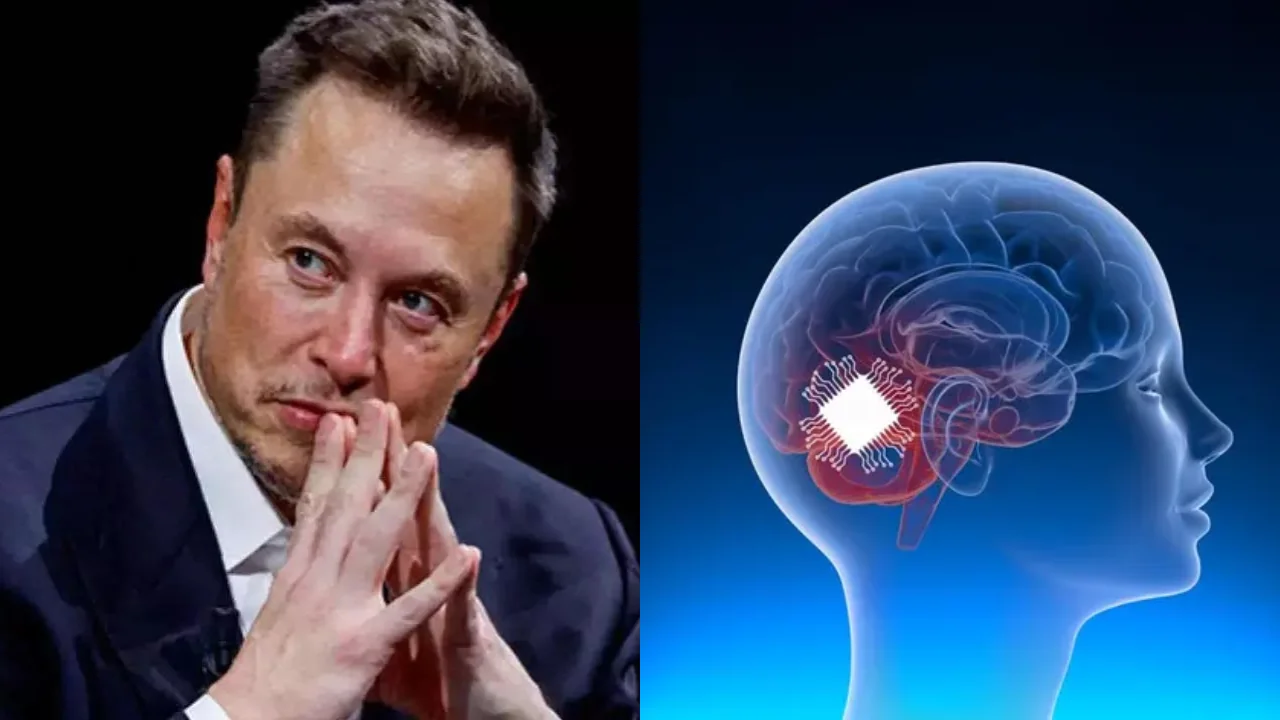
Neuralink’s published N1 hardware architecture uses 1,024 electrodes distributed across 64 flexible threads, each thinner than a human hair. Its R1 surgical robot inserts those threads into the cortex. Electronics inside the implant process recorded neural signals and transmit data wirelessly to software running on an external device. An onboard battery is recharged inductively, avoiding a physical connector through the scalp. These specifications describe the company’s disclosed N1 platform; the hackathon report does not provide a separate hardware specification for the participant’s implant. [6][18]
The distinction between movement decoding and speech decoding matters. Neuralink describes Telepathy as its first product, initially translating signals associated with hand and arm movement into digital commands. Its VOICE study instead aims to restore communication by reading signals from brain regions involved in speech production. Neither description establishes unrestricted access to a person’s thoughts: the reported applications decode particular intended or imagined actions for defined tasks. [10][18]
For the hackathon’s AI-agent prototype, the participant could think of saying “Hey Neuralink,” followed by a task, to trigger a Grok agent that would act on a computer. Neuralink explicitly describes this as a prototype. Its report does not disclose the Grok model version, task-completion rate, computing requirements or safeguards governing the agent’s actions. [18]
“Decoders are not perfect, and mistakes can be awkward or costly.”
That statement in Neuralink’s engineering report explains why editing received attention alongside decoding. A communication system needs a practical way to recover from an incorrect message, not just a way to generate one. [18]
What the reported results establish
The October update documents feature development with one VOICE participant, not a controlled clinical comparison. It provides no new words-per-minute result, word-error rate, end-to-end speech latency or numerical measure of phone-call intelligibility. The 72-hour figure describes the engineering visit, not a continuous-use endurance test or a clinical performance benchmark. [18]
Earlier company disclosures provide context, but they measure different capabilities. In its January 28, 2026 update, Neuralink reported 21 participants enrolled in trials worldwide. That is a dated company-reported figure, not a participant count established by the October hackathon report. [10]
The January update also reported:
- Typing speeds of up to 40 words per minute using a method that maps imagined finger movements to letters.
- Cursor-control performance exceeding 10 bits per second for a participant named Nick within his first week of BCI use.
- A VOICE study goal of communication at 140 words per minute.
Those figures should not be treated as interchangeable. Finger-based text entry, target-selection performance and intended-speech decoding are different tasks. The 140-word-per-minute figure is a stated goal, not an outcome demonstrated by the October report. [10][18]
There is also an established clinical setting behind Neuralink’s earlier device-control work. The company’s first human implantation in the PRIME study took place at Barrow Neurological Institute in Phoenix, Arizona. PRIME evaluates the safety of the implant and surgical robot and the initial functionality of the BCI for people with quadriplegia; it is distinct from the speech-focused VOICE work described in the latest update. [6][18]
Musk’s bandwidth prediction remains a forecast
On October 30, Elon Musk amplified the hackathon announcement with a post identifying Telepathy as Neuralink’s first product. He wrote: “Output bandwidth will vastly exceed the fastest human speech or typing in a few years.” That is a forward-looking executive claim, not a result established by the engineering update. [28][18]
Telepathy itself is not newly introduced by that post: Neuralink had already described the capability in its April 2024 PRIME update. The new development is the set of speech-interface prototypes and their testing in a participant’s home. [6][18]
The next challenge is reliable daily communication
Over the next 12 to 24 months, the relevant questions are whether these functions remain accurate across users and conditions, how often they activate unintentionally, and how quickly users can correct mistakes. Neuralink says neural activity varies with fatigue, attention and how a person imagines speaking. Its report identifies those variations as a reason to develop software alongside participants rather than rely solely on remotely collected data. It does not provide a dated public-release schedule for the hackathon features. [18]
Hardware stability remains another constraint. In May 2024, Neuralink disclosed that some threads in its first participant had retracted, reducing the number of effective electrodes and temporarily lowering cursor-control performance. Software changes subsequently improved performance, according to the company. In January 2026, Neuralink said it was exploring better thread retention, higher electrode counts and changes to the surgical process. Those disclosures underline why software demonstrations alone cannot establish long-term implant reliability. [8][10]
For now, the milestone is narrower than a general-purpose mind-reading system or a commercially available replacement for speech. Neuralink has reported an in-home development session that connected experimental neural decoding to familiar communication tools. Its practical significance lies in making those tools easier to operate; its clinical significance will depend on measurable, sustained outcomes beyond this participant’s experience. [18]
Sources: Neuralink’s October 29 engineering report; Neuralink’s January 2026 trial and performance update; Neuralink’s N1 architecture and PRIME study overview; Neuralink’s first-participant performance and thread-retraction report; and Elon Musk’s October 30 statement on X.