



Google’s Willow quantum chip made headlines in December 2024 after the company announced that its new processor had completed a computational benchmark in less than five minutes, a task Google estimated would take one of the world's fastest classical supercomputers approximately 10 septillion years. The announcement sparked widespread discussion about the future of quantum computing, including an unexpected suggestion from Google Quantum AI leadership that the results could support the multiverse hypothesis.
However, there is an important distinction between what Google actually demonstrated and what the headlines suggested. Willow did not prove that parallel universes exist. Instead, it demonstrated significant progress in quantum error correction and computational performance, addressing two major challenges that have historically limited the development of practical quantum computers.
Since its introduction on December 9, 2024, Willow has become an important milestone in Google's long-term effort to build large-scale, fault-tolerant quantum computers. Subsequent research announced in October 2025 has provided further evidence that the technology could eventually support more practical scientific applications.
What Google Actually Achieved
The headline-grabbing result came from a computational test known as Random Circuit Sampling (RCS). Developed and popularized by Google Quantum AI, this benchmark measures a quantum processor's ability to execute complex sequences of quantum operations and generate corresponding measurement results.
Google reported that Willow completed the selected RCS computation in approximately five minutes. According to the company's calculations, reproducing the same benchmark using a leading classical supercomputer would require approximately 1025 years, equivalent to 10 septillion years.
That estimate is vastly longer than the approximately 13.8-billion-year age of the observable universe. It illustrates the computational gap Google reported between its quantum processor and classical computing systems for this particular benchmark.
However, RCS is not a conventional business or scientific application. It does not directly solve problems such as discovering new medicines, designing batteries, optimizing transportation networks or developing artificial intelligence systems.
Its primary purpose is to demonstrate that a quantum processor can perform a particular computational task at a scale that is extremely difficult for classical computers to reproduce.
This distinction matters because exceptional performance on a specialized benchmark does not automatically translate into practical advantages across everyday computing applications.
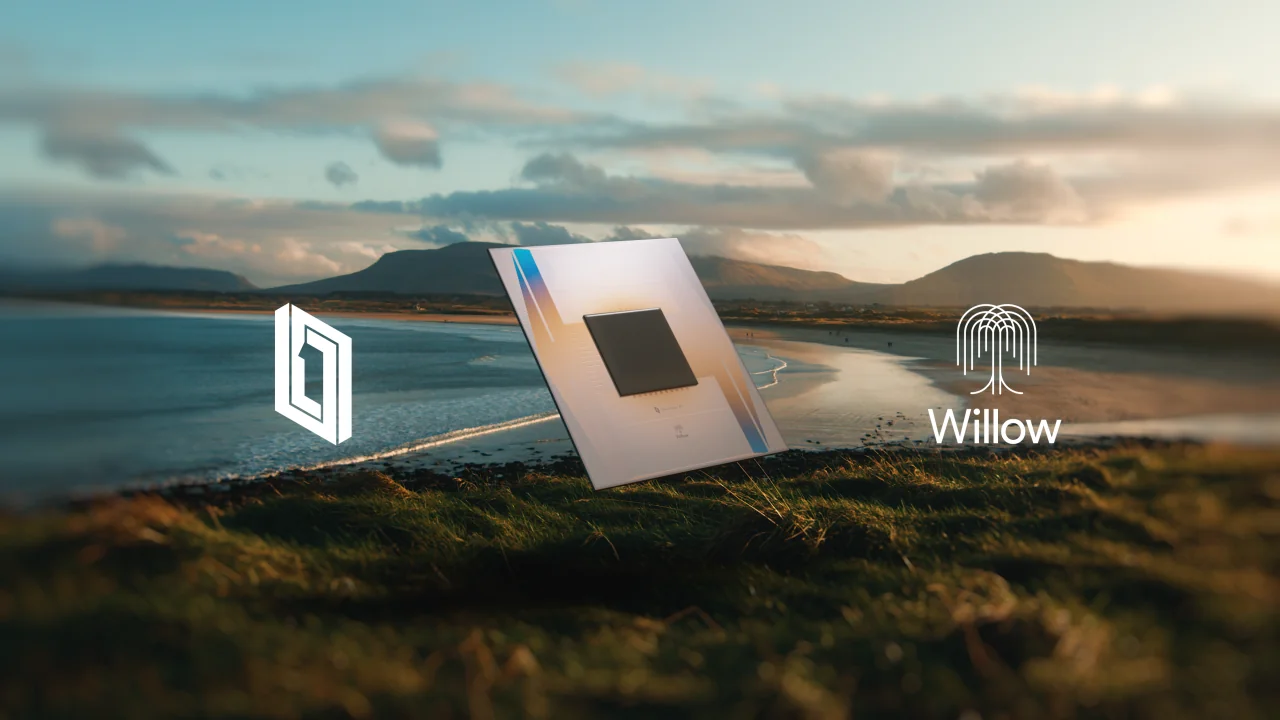
Inside Google's Willow Quantum Chip
Willow is based on superconducting quantum circuits, a technology that uses carefully controlled electrical circuits operating at extremely low temperatures to create and manipulate quantum bits, commonly known as qubits.
Unlike conventional computer bits, which represent information as either 0 or 1, qubits can exist in quantum superpositions of states. They can also become entangled, allowing their quantum states to be correlated in ways that have no direct equivalent in classical computing.
These properties make quantum processors fundamentally different from traditional CPUs and GPUs. They also introduce significant engineering challenges, particularly because quantum information is extremely sensitive to environmental disturbances.
Google's published Willow specifications include:
- 105 physical qubits: The processor's total number of quantum bits.
- Average connectivity of 3.47: With approximately four-way connectivity being typical.
- Single-qubit gate error: Approximately 0.035% on the error-correction configuration.
- Two-qubit gate error: Approximately 0.33% on the same configuration.
- Error-correction cycle time: Approximately 1.1 microseconds.
- Random Circuit Sampling: A separate Willow configuration demonstrated the benchmark using 103 qubits and circuits with a depth of 40.
These specifications describe two different experimental configurations used for quantum error correction and Random Circuit Sampling, rather than suggesting that every measurement was obtained simultaneously from one identical operating configuration.
The hardware is important, but the most significant development is how Google has addressed one of quantum computing's biggest weaknesses: errors.
The Real Breakthrough: Quantum Error Correction
Quantum computers have historically struggled with reliability. Qubits can lose their quantum information through interactions with their surroundings, while imperfect operations introduce additional computational errors.
Adding more physical qubits does not automatically solve this problem. In fact, larger quantum systems can introduce additional sources of noise and make calculations increasingly difficult to control.
Google's Willow research demonstrated an important improvement in this area through a technique known as surface-code quantum error correction.
The approach combines multiple physical qubits to create a more reliable logical qubit. Rather than depending on a single physical component, quantum information is distributed across a group of qubits, allowing errors to be detected and corrected through repeated measurements.
Google tested increasingly large error-correcting arrangements using 3×3, 5×5 and 7×7 qubit lattices. The researchers reported that increasing the code distance reduced the logical error rate, demonstrating operation below the surface-code error threshold.
The findings were published in Nature on December 9, 2024, in a research paper titled Quantum error correction below the surface code threshold.
The published research reported that the larger distance-7 logical memory achieved an error rate of approximately 0.143% per error-correction cycle. It also demonstrated that the logical memory could outperform its best individual physical qubit in terms of lifetime.
This is particularly important because reliable logical qubits are a necessary foundation for building quantum computers capable of executing long and complex calculations.
In other words, Google's achievement was not simply about making a quantum computer faster. It was about demonstrating that a larger error-corrected quantum system can become more reliable rather than less reliable.
Did Google Prove That We Live in a Multiverse?
One of the most widely shared aspects of the Willow announcement concerned the possibility of multiple universes.
Hartmut Neven, founder and head of Google Quantum AI, suggested in his December 2024 announcement that Willow's performance lent credibility to the idea that quantum computation could involve parallel universes, connecting the results to the multiverse interpretation of quantum mechanics associated with physicist David Deutsch.
The suggestion attracted considerable attention because it connected an engineering achievement with one of the biggest unanswered questions in theoretical physics.
However, Willow did not experimentally establish the existence of a multiverse.
The processor's performance demonstrates that quantum systems can execute certain computations in ways that are extremely difficult to simulate using conventional computers. It does not independently establish which interpretation of quantum mechanics is correct.
Quantum mechanics has several interpretations, including the many-worlds interpretation. Although these interpretations offer different explanations of quantum phenomena, the Willow experiment was not designed to distinguish between them.
The multiverse suggestion should therefore be understood as a theoretical interpretation rather than an experimentally confirmed scientific conclusion.
The more firmly established results concern quantum error correction, superconducting hardware performance and the execution of complex quantum circuits.
What Does the Breakthrough Mean for Real-World Applications?
Despite the impressive benchmark results, there is still a considerable distance between Willow and a commercially useful, large-scale quantum computer.
Random Circuit Sampling demonstrates computational capability, but practical applications require additional improvements in reliability, scalability and the ability to execute useful algorithms with sufficiently low error rates.
Potential applications of mature quantum computing systems include:
- Drug discovery: Modeling molecular interactions and helping researchers understand complex chemical structures.
- Materials science: Simulating materials with properties that are difficult to investigate using conventional computational methods.
- Battery development: Studying chemical processes that could support the development of improved energy-storage technologies.
- Energy research: Modeling complex physical and chemical systems relevant to advanced energy technologies.
- Scientific simulations: Investigating quantum systems that are particularly difficult to reproduce using classical computing.
These are potential areas of application, not proof that Willow can already deliver commercial advantages in each of them.
Google's Quantum Echoes: A Further Step Forward
Google's quantum computing research did not stop with the initial Willow announcement.
On October 22, 2025, Google Quantum AI announced another milestone involving an algorithm called Quantum Echoes, executed on the Willow processor.
Unlike Random Circuit Sampling, Quantum Echoes was designed to investigate the behavior of physical quantum systems. The algorithm uses a sequence of quantum operations, introduces a controlled disturbance to one qubit and then reverses the evolution of the system to measure the resulting quantum signal.
Google reported that the algorithm ran approximately 13,000 times faster on Willow than the best classical algorithm used for comparison on one of the world's fastest supercomputers.
The company also described a proof-of-principle experiment conducted in collaboration with the University of California, Berkeley. Researchers used the technique to investigate two molecules containing 15 and 28 atoms, respectively.
According to Google, the quantum results matched traditional nuclear magnetic resonance measurements while revealing additional information about molecular structure.
This development is particularly relevant because it moves beyond a benchmark designed primarily to demonstrate computational complexity. It explores how quantum processors might eventually help investigate real physical systems.
Google's announcement was published alongside research in Nature and represented a further step toward demonstrating verifiable quantum computational advantages on actual hardware.
What Still Needs to Be Solved?
Despite the progress, several engineering challenges remain before quantum computers can become widely useful.
1. More reliable logical qubits
Current systems still require significant improvements in error correction. Building a useful quantum computer will require logical qubits that can maintain their information over extended periods while supporting large numbers of operations.
2. Scaling the hardware
Moving from approximately 100 physical qubits to systems containing substantially larger numbers of qubits introduces difficult manufacturing, control, calibration and engineering requirements.
3. Practical quantum algorithms
Researchers must continue developing algorithms that demonstrate measurable advantages on useful scientific or industrial problems rather than only specialized computational benchmarks.
4. Classical computing competition
Classical supercomputers and simulation algorithms continue to improve. Consequently, comparisons between quantum and classical systems must be regularly reassessed using the best available methods.
5. Commercial viability
Building and operating advanced quantum processors requires sophisticated infrastructure, specialized cooling systems, precision electronics and significant research investment. These requirements must eventually be reconciled with practical operating costs.
The Road Ahead for Quantum Computing
Google's Willow processor represents an important development in the transition from experimental quantum computing toward more reliable and potentially useful systems.
The December 2024 announcement demonstrated two major achievements: improved quantum error correction below the surface-code threshold and exceptional performance on a specialized computational benchmark.
The subsequent Quantum Echoes research announced in October 2025 added another important development by demonstrating a quantum algorithm that Google reported could outperform the best classical comparison by approximately 13,000 times on a particular task.
Nevertheless, neither milestone means that quantum computers are ready to replace conventional processors or that commercially useful quantum applications are already available at scale.
The next 12 to 24 months of research will remain important for assessing improvements in logical-qubit lifetime, hardware reliability, algorithmic performance and scalability. Google's published roadmap continues to identify a long-lived logical qubit as a major objective on the way toward fault-tolerant quantum computing.
For the technology industry, the significance of Willow is therefore much more concrete than the multiverse headlines suggest. It demonstrates measurable progress toward overcoming the engineering problems that have prevented quantum computers from reaching their full potential.
Whether quantum computing eventually transforms medicine, materials science, energy research or other industries will depend on what researchers can build on top of these achievements.
One thing is clear: Google's Willow processor has helped move quantum computing another step closer to becoming a practical scientific tool. But proving that we live in a multiverse remains a completely different scientific challenge.
Sources
This article is based on Google's official Willow announcement and technical documentation, peer-reviewed research published in Nature, and subsequent Google Quantum AI research announcements.
- Google – Meet Willow, our state-of-the-art quantum chip (December 9, 2024)
- Google Quantum AI – Willow Technical Specification Sheet
- Nature – Quantum error correction below the surface code threshold
- Google Research – Making quantum error correction work
- TechCrunch – Google says its new quantum chip indicates that multiple universes exist (December 10, 2024)
- Google – Our Quantum Echoes algorithm is a big step toward real-world applications for quantum computing (October 22, 2025)
- Google – Our quantum hardware: the engine for verifiable quantum advantage (October 22, 2025)


