


Shanghai’s Automated Port: Robots Handle Millions of Containers, but Humans Still Remain in Control
Category: INDUSTRY & LOGISTICS
A Major Milestone in Port Automation
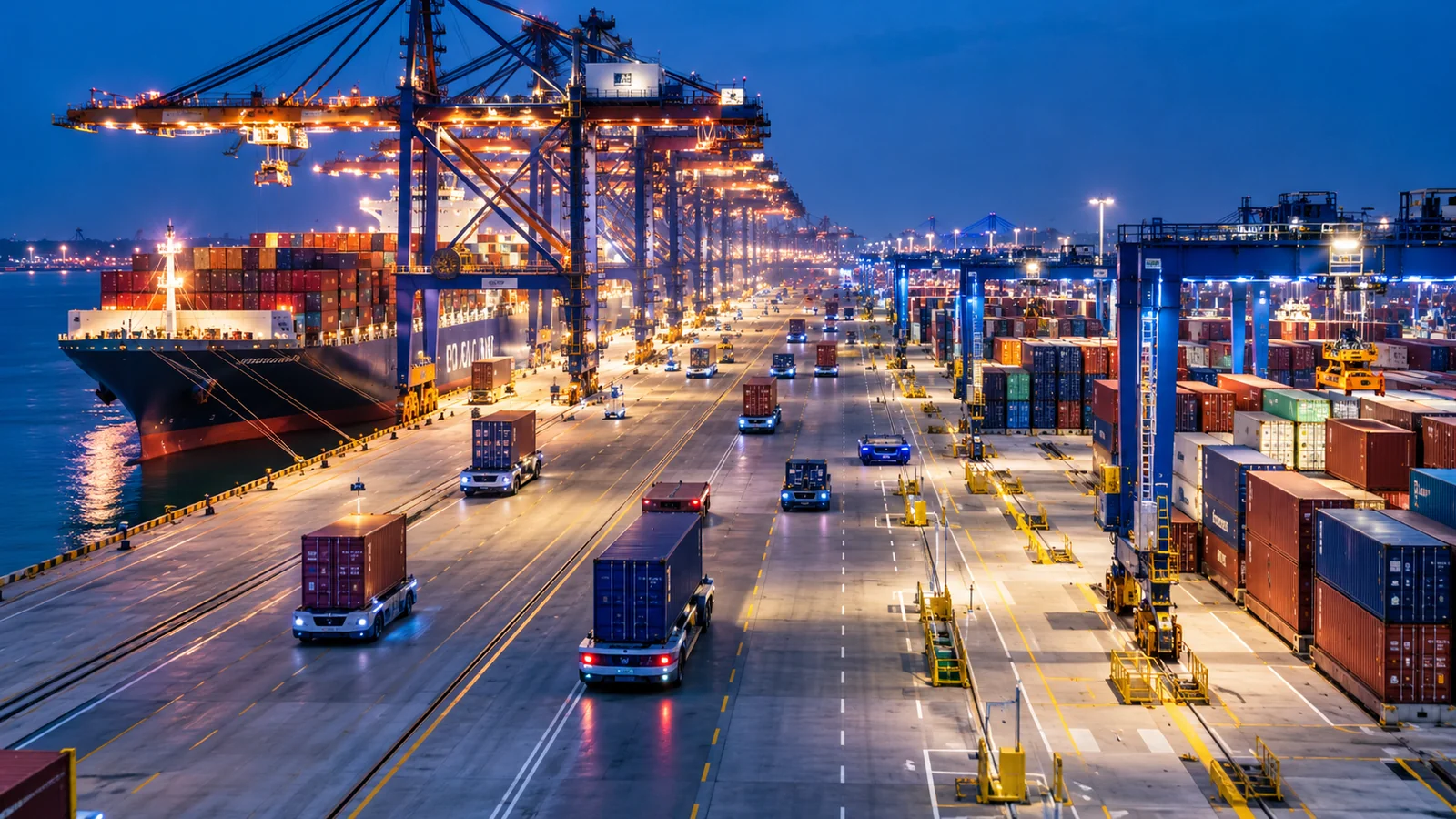
Shanghai’s Yangshan Deep-Water Port in China is demonstrating how automation can transform large-scale container shipping. Its Phase IV terminal, which began trial operations on December 10, 2017, uses automated guided vehicles, automated cranes and an integrated terminal-management system to coordinate container handling.
In 2025, Yangshan Phase IV handled more than eight million twenty-foot equivalent units (TEUs), according to a report published by the Shanghai municipal government on August 14, 2026. The terminal uses automated machinery and centralized software to coordinate operations across its quayside and container-storage areas.
Despite its high level of automation, the facility should not be described as a completely human-free port. The terminal's operator confirms that personnel remotely control and supervise certain cranes. The technology automates many physical tasks, but human oversight remains part of the operating model.
How the Automated Terminal Works
Yangshan Phase IV combines three principal types of container-handling equipment with a terminal-management system developed by Shanghai International Port Group (SIPG).
- Quay cranes: These cranes transfer containers between ships and the terminal's transport vehicles. Operators can control cranes remotely rather than working inside the crane cabins.
- Automated guided vehicles: These driverless vehicles transport containers between the quay and storage areas.
- Rail-mounted gantry cranes: These machines move and stack containers in the terminal yard.
- Intelligent Terminal Operation System: SIPG's software coordinates equipment movements and terminal operations.
The system's central advantage is coordination. Containers must move between ships, transport vehicles and storage areas in the correct sequence. Integrated scheduling helps align these activities and manage the movement of equipment throughout the terminal.
According to SIPG's published technical overview, the terminal's original design included seven container berths, a 2,350-meter quay and approximately 2.23 million square meters of terminal area. Its original planned annual throughput capacity was 6.3 million TEUs.
Reported Performance and Equipment
A Shanghai municipal government report published in August 2026 provides several concrete figures for the terminal's operations.
- Annual throughput: More than eight million TEUs in 2025.
- Quay cranes: 29.
- Rail-mounted gantry cranes: 121.
- Automated guided vehicles: 155.
- Peak crane productivity: More than 60 containers per hour for the terminal's fastest crane, according to the report.
The same report states that the terminal's overall efficiency is approximately 30 percent higher than traditional operations. This is an officially reported comparison; the published figure should not be interpreted as an independently verified improvement applicable to every port.
Throughput and crane productivity measure different aspects of performance. Annual throughput counts container volume over a year, while crane productivity measures how quickly a crane handles containers. Neither figure alone measures the performance of the entire shipping and inland-transport network.
Remote Control and Digital-Twin Technology
The terminal uses a digital-twin system to monitor and coordinate operations. A digital twin is a digital representation of a physical system that can help operators understand equipment status and the progress of ongoing activities.
In an August 2026 report, Shanghai's municipal government also described an F5G all-optical network used for remote control of large equipment. According to the report, crane operators can work from a control center more than 30 kilometers away, with remote operation also possible from locations in downtown Shanghai more than 100 kilometers away.
Remote control does not mean that the equipment operates without people. Instead, it allows operators to control machinery from a separate location, reducing the need for workers to remain inside crane cabins or close to active cargo-handling areas.
Reliable communications, equipment sensors and control software are essential to this arrangement. The available sources do not establish that every operation is fully autonomous or that human intervention is never required.
What About the Claim of a Zero-Human Port?
The phrase “zero-human port” overstates what the available evidence establishes about Yangshan Phase IV. The terminal is highly automated, but its operator describes remote human control and supervision as part of the system.
Automation allows machines to perform many repetitive physical tasks. It does not, by itself, establish that maintenance, troubleshooting, operational planning and emergency response can be performed without people.
The evidence supports describing Yangshan Phase IV as a large-scale automated container terminal. It does not support claiming that the entire facility operates with zero human involvement.
Environmental Considerations
SIPG states that the terminal's three principal types of cargo-handling equipment are electrically driven. This eliminates direct exhaust emissions from those machines during operation, although it does not establish that all activities associated with the terminal are emission-free.
The terminal operator also identifies shore power, energy monitoring and energy-efficient lighting among its energy-saving measures. The available sources do not provide sufficient information to calculate the terminal's total lifecycle carbon emissions or to quantify its overall environmental advantage against every conventional terminal.
What the Development Means for Global Shipping
Yangshan Phase IV demonstrates that automated cranes, driverless transport vehicles and centralized control software can be integrated into a high-volume container terminal.
Its operating figures show that the technology is deployed in a real industrial environment rather than being limited to a laboratory demonstration. However, the performance of one terminal cannot establish that every port can achieve the same throughput, efficiency or operating costs.
Future assessments of port automation should examine equipment reliability, safety, maintenance costs, energy consumption, cybersecurity and the role of human operators. The available evidence does not establish when, or whether, large container terminals will operate entirely without human involvement.
Conclusion
Shanghai's Yangshan Phase IV is a documented example of large-scale port automation. Its combination of automated vehicles, cranes, remote-control technology and integrated terminal-management software supports the movement of millions of TEUs each year.
The verified milestone is not a port with no humans. It is a high-volume terminal where automation performs much of the physical work and software coordinates complex logistics operations, while remote human control and supervision remain part of the system.
Sources
- Shanghai Municipal Government, “Yangshan Port Phase IV boasts world-class efficiency,” August 14, 2026: Official report.
- Shanghai International Port Group, technical overview of Yangshan Phase IV: Terminal operator's information.
- Shanghai International Port Group, 2025 annual container-throughput results: Official company report.


