

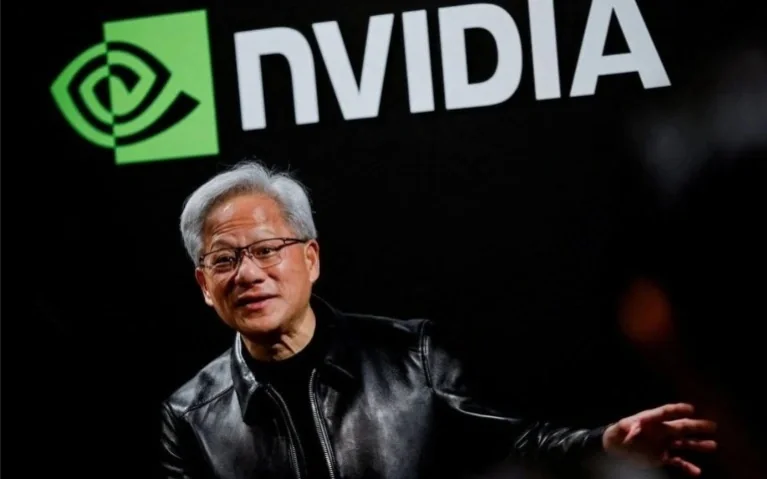
NVIDIA CEO Jensen Huang endorsed Kazakhstan’s ambition to become an AI nation during his first visit to the country on October 23, as new computing infrastructure commitments gave the strategy a more concrete foundation. In Astana, Huang met President Kassym-Jomart Tokayev and joined technology minister Zhaslan Madiyev for a public discussion at the alem.ai International Artificial Intelligence Center.
The visit coincided with Firebird’s investment agreement with the Kazakh government and plans for a major NVIDIA-powered computing facility. According to NVIDIA, Firebird has secured a U.S. export license for 45,000 Grace Blackwell GPUs, with the first phase of its Kazakhstan project targeting commercial operations in the third quarter of 2027. [48]
The immediate significance is the connection between national ambitions and infrastructure: Kazakhstan is seeking not only to use AI applications, but to develop computing capacity, local-language models and industrial systems that domestic companies can build on.

What Huang actually said about an AI nation
The quotation circulating on social media is supported by reporting from the event. The Astana Times quoted Huang saying:
“This is the first country that I have been to where the president declared the country to be an AI nation.”
The wording matters. Huang described his own experience of visiting countries; he did not establish that Kazakhstan was the first country worldwide to adopt a national AI strategy. Nor does the statement, by itself, demonstrate technological leadership or successful implementation across the economy.
Kazakhstan’s Ministry of Artificial Intelligence and Digital Development published a related formulation, quoting Huang as saying it was the first country he had visited where the president declared AI development a national priority. The ministry places the visit within Kazakhstan’s Year of Digitalization and Artificial Intelligence.
Behind the phrase is a strategy for sovereignty: developing the ability to build and operate AI using national data, local expertise and computing resources, including systems that understand Kazakh-language and cultural contexts.
The computing infrastructure behind the ambition
NVIDIA’s account distinguishes equipment already deployed from substantially larger projects still being built or planned. Kazakhtelecom has deployed 400 NVIDIA H200 GPUs and 480 NVIDIA B300 GPUs in Astana and Almaty—a combined 880 processors.
The next expansion centers on Data Center Valley in Ekibastuz, northeastern Kazakhstan. Firebird is developing its first phase with Kazakhtelecom, while a planned second phase would bring Firebird’s total potential AI infrastructure capacity in Kazakhstan to approximately 500 megawatts.
- Existing deployment: 400 H200 GPUs and 480 B300 GPUs in Astana and Almaty.
- Firebird expansion: a U.S. export license covering 45,000 NVIDIA Grace Blackwell GPUs, with the first phase targeting commercial launch in the third quarter of 2027.
- Kazakhtelecom’s 2027 plans: more than 1,000 GPUs in Data Center Valley, alongside more than 1,000 NVIDIA Vera Rubin GPUs in the Ekibastuz region.
These figures describe different stages of development. An export license is not a delivery confirmation, and planned capacity is not an operational installation. NVIDIA’s announcement does not provide a commissioning schedule for every licensed processor.
The power figures also refer to different scopes. The ministry describes Data Center Valley as a broader cluster planned to reach up to 1 gigawatt, with its initial 215-megawatt capacity fully reserved. Firebird’s approximately 500-megawatt figure concerns its own potential infrastructure across phases. Reserved capacity should not be confused with measured electricity consumption or completed computing capacity.

From GPU clusters to public services
One application demonstrated during Huang’s visit was alem.gpt, an AI assistant intended to let people access government, business and other services through natural-language interactions. According to the ministry, its models run on Alem.Cloud GPU clusters equipped with NVIDIA H200 processors.
The demonstration included digital documents, eGov QR and integration between government and banking systems through a digital mortgage application. It showed a specific use case for locally hosted AI, although the ministry’s account did not publish response-time benchmarks, accuracy evaluations or independently measured cost savings.
Language capability is another priority. In NVIDIA’s account of the discussion, Madiyev said:
“We want AI that understands and speaks Kazakh and captures cultural contexts and cultural specifics.”
That objective connects infrastructure spending with model development. Additional computing capacity can support training, adaptation and deployment, but processor counts alone do not establish how accurately a model handles Kazakh or how reliably it performs public-service tasks.
Physical AI brings robotics into the strategy
The discussion also covered physical AI: systems that use artificial intelligence to interact with the physical world. Madiyev identified factories, mines, agriculture, transport and logistics as potential areas for development.
The ministry described several projects presented during the visit. QazTWIN develops digital twins for industry, construction and urban infrastructure, incorporating robotic crawlers from Astana Dynamics to inspect confined or hazardous spaces. ARC Aero develops aircraft and hardware and software for autonomous flight control.
Freedom also presented City-Scale Physical AI, a project to build digital twins of Almaty and Astana for training and testing autonomous robots using NVIDIA technologies. The announcement describes a development initiative, not a completed citywide robotic deployment.
These projects give the strategy identifiable applications beyond chatbots and content generation. However, the visit’s disclosures do not provide standardized robotics benchmarks, verified fleet sizes or comparative evidence of productivity gains.
The next milestone is delivery, not another declaration
The clearest near-term test is Firebird’s targeted commercial launch in the third quarter of 2027. Over the next 12 to 24 months, progress will be measurable through commissioned facilities, installed processors and usable access for developers—not simply licensed hardware or announced megawatts.
Firebird also plans to establish Firebird Labs Kazakhstan, offering support for startups, research and talent development through funding, computing access and research partnerships. NVIDIA separately announced an investment in Kazakhstan-founded generative-video company Higgsfield, but its account did not disclose the investment amount.
The commercial rationale is to convert energy and computing resources in