


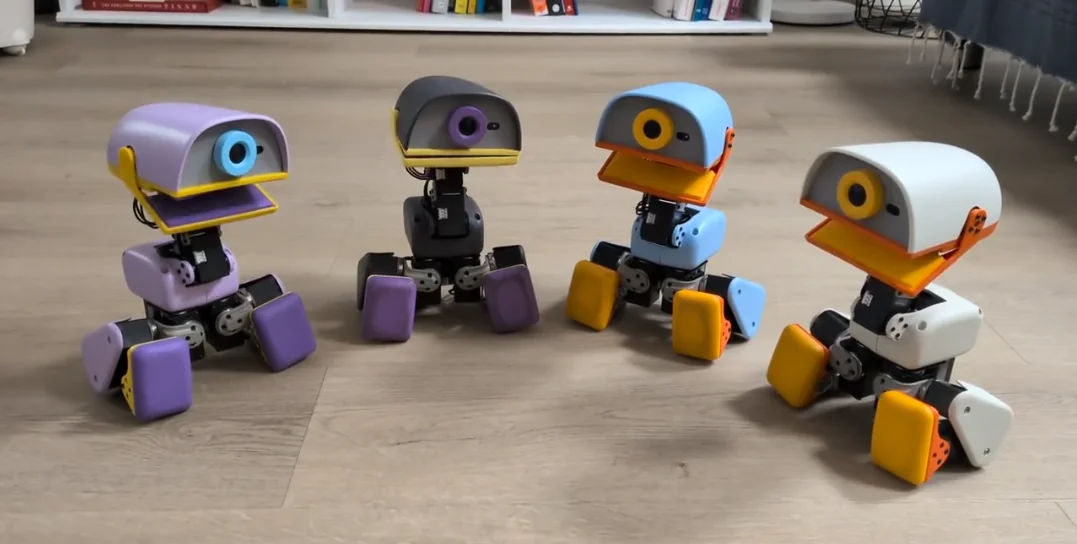
Pollen Robotics, the Bordeaux-based robotics team at Hugging Face, has opened pre-orders for Microduck, a 25-centimeter bipedal robot designed for reinforcement learning experiments. Priced at an introductory $399 before taxes and shipping, the open-source platform ships with seven pre-trained behaviors and tools that let users train new policies in simulation before running them on the physical hardware. Pre-orders began on August 27, 2026, with first deliveries targeted for North America and Europe before the end of the year.
The robot arrives as researchers and developers seek more accessible ways to work with physical AI. By combining a compact biped with a complete sim-to-real pipeline, Microduck aims to lower the barrier between desktop experiments and real-world robot control.
Technical Architecture and Specifications
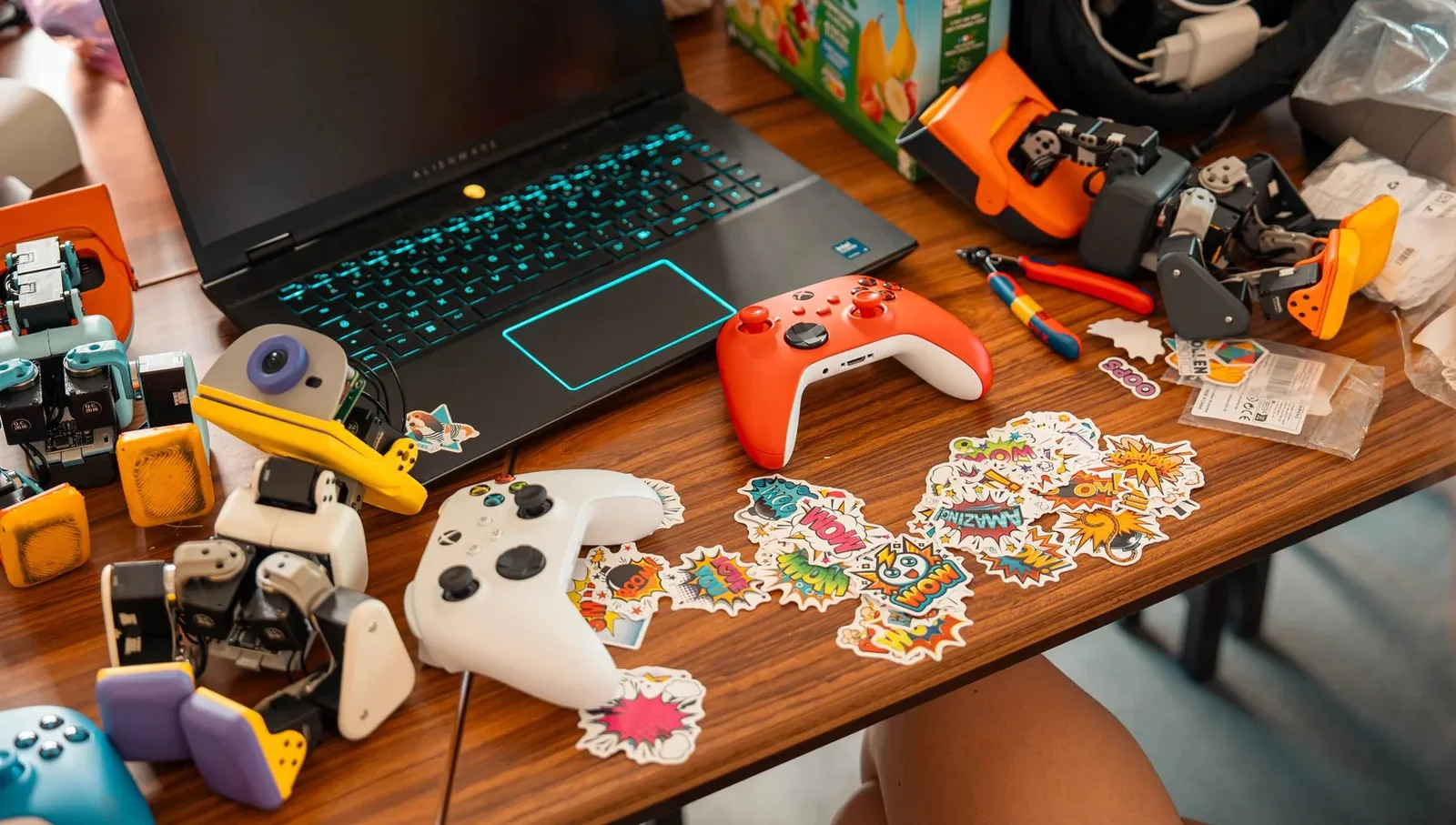
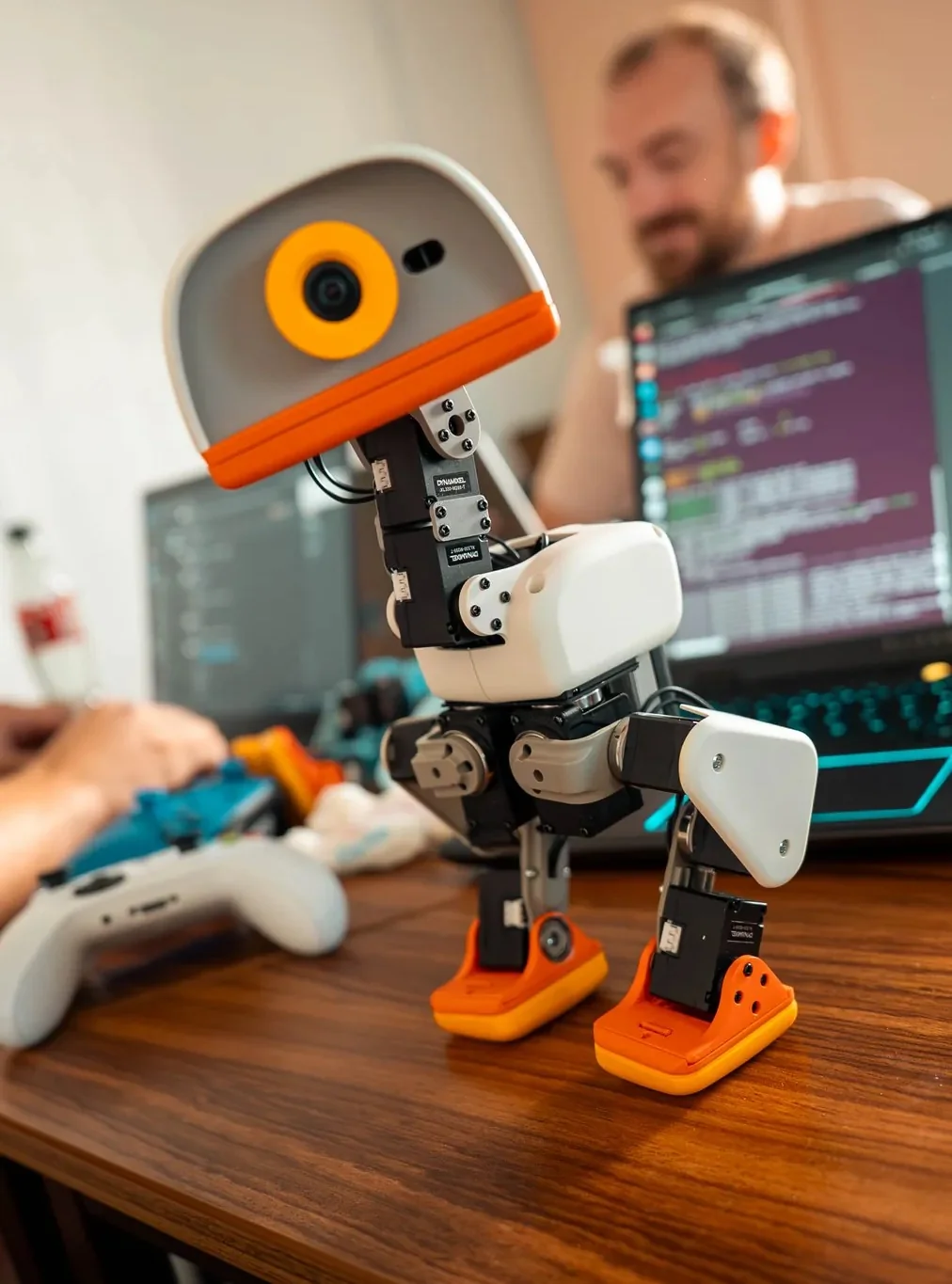
Microduck stands 25 cm tall and 14 cm wide, with a weight under 800 grams. It uses 15 motors that provide degrees of freedom across the legs, head, and neck. An articulated beak serves as a simple gripper for picking up small objects.
Onboard sensing includes a front-facing camera with a dedicated recording indicator, an 8x8 time-of-flight LiDAR matrix for range data, and two inertial measurement units—one in the body and one in the head. Audio hardware consists of microphones and a speaker that generates a unique voice for each unit. Two NFC antennas, one in the head and one in the beak, support interaction with tagged objects. Connectivity covers Wi-Fi and Bluetooth.
Compute is handled by a Rockchip RK3566 processor with an AI accelerator, paired with 1 GB of RAM and 32 GB of storage. Behavior policies run onboard at 50 Hz. Power comes from a removable NP-F550 camera battery rated at 2600 mAh, providing roughly one hour of runtime depending on activity.
The robot ships with a game controller, a rechargeable battery, and a USB-C cable. Four colorways are available at launch: Cream, Graphite, Lavender, and Sky. Optional packs include a charger set with spare batteries, an accessory kit with rollers, a ball, laser pointer and NFC tags, and a developer kit with spare motors and tools.
How Behaviors Are Trained and Deployed
Every movement on Microduck is generated by a neural policy rather than a fixed animation. The seven behaviors included at launch are:
- Velocity-tracking walking gait
- Sitting and standing
- Kicking
- Grabbing objects with the beak
- Roller-skating locomotion when skates are fitted
- Recovering from a fall to a standing position
Users can retrain any of these policies or create new ones. Training occurs in a MuJoCo physics simulator, either on a local machine or via Hugging Face Jobs. Parallel environments accelerate learning; a usable walking policy can be trained in roughly one to two hours on a single GPU. The resulting policy is exported as an ONNX file and loaded onto the robot, where it runs at the same 50 Hz rate used during training.
The full software stack—Python SDK, simulation environment, reinforcement-learning training code, and robot runtime—is released under the Apache-2.0 license on GitHub. Mechanical and electronic design files remain closed, so the project is open-source software rather than open-source hardware.
Real-World Performance and Availability
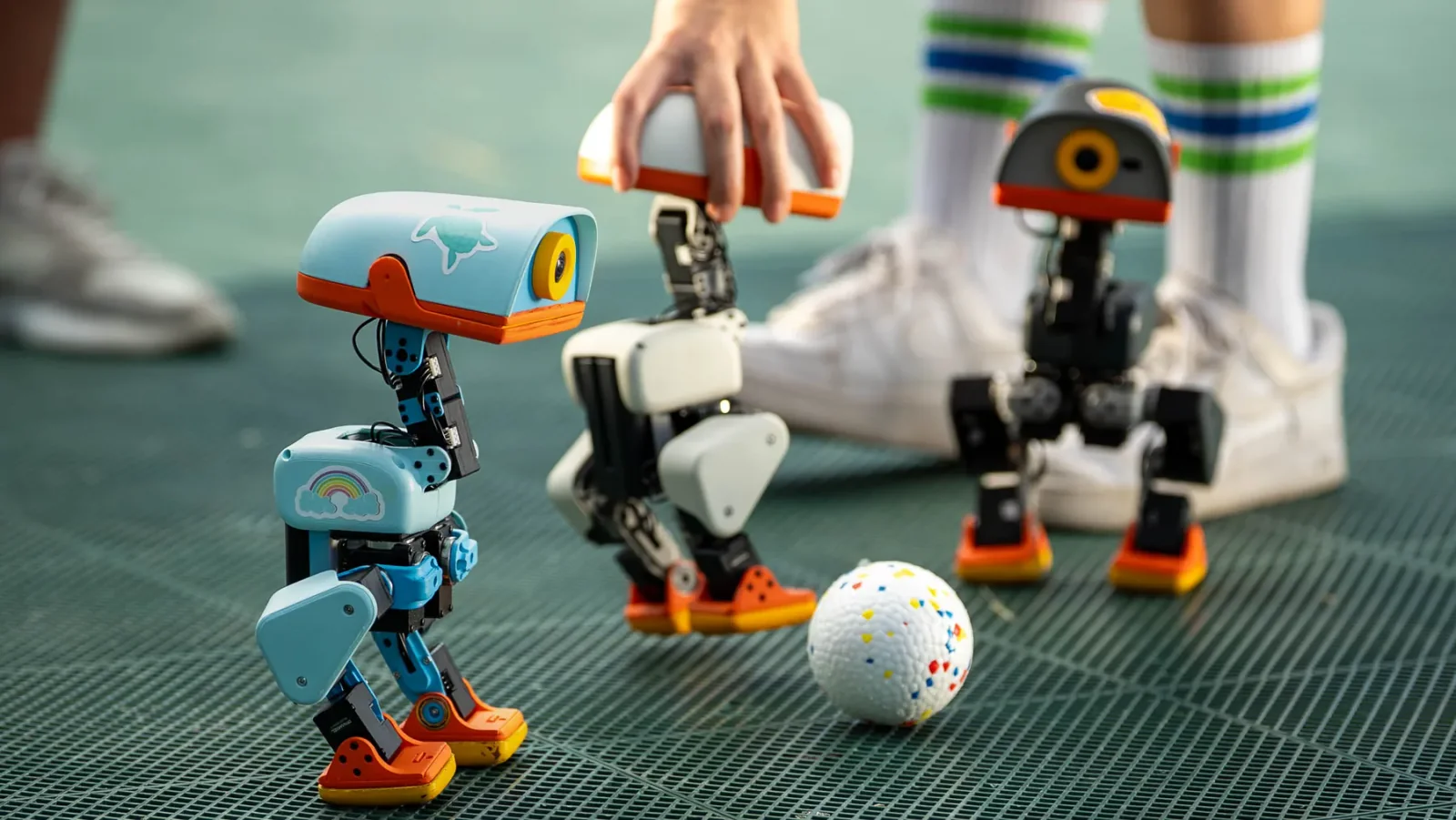
Out of the box, Microduck can be driven with the included controller without writing code. It recovers autonomously from many common fall positions and can switch between trained policies on the fly. Optional accessories enable roller skating, laser-pointer following, and NFC-triggered interactions. Multiple units can be used together for multi-robot experiments.
Recent demonstrations, including work shown with Nvidia tools at GTC Berlin, illustrate the sim-to-real transfer process using Isaac Lab and related simulation environments. Policies trained virtually transfer to the physical robot with the expected need for iterative refinement to account for real-world dynamics.
Pre-orders are open at the introductory price of $399. Current estimates for new orders indicate a lead time of four to six months. The robot is aimed at students, researchers, developers, and enthusiasts working with physical AI and reinforcement learning.
Industry Context and Outlook
Microduck is the second consumer robot from Pollen Robotics after Reachy Mini. By packaging a full reinforcement-learning and sim-to-real workflow around an affordable biped, the project addresses a practical gap: many learning algorithms remain difficult to test on real hardware at low cost.
Challenges over the next 12 to 24 months include refining battery life for longer sessions, expanding the library of community-trained policies, and continuing to improve the reliability of sim-to-real transfer across varied surfaces and conditions. The open software stack and public policy-sharing model are intended to support iterative progress by the wider community.
Official materials from Pollen Robotics describe the shipping behaviors as a starting point rather than a fixed limit. The company states that the open-source tools allow users to train, deploy, refine, and publish new skills, keeping the platform extensible as the field of physical AI advances.
Source:


