


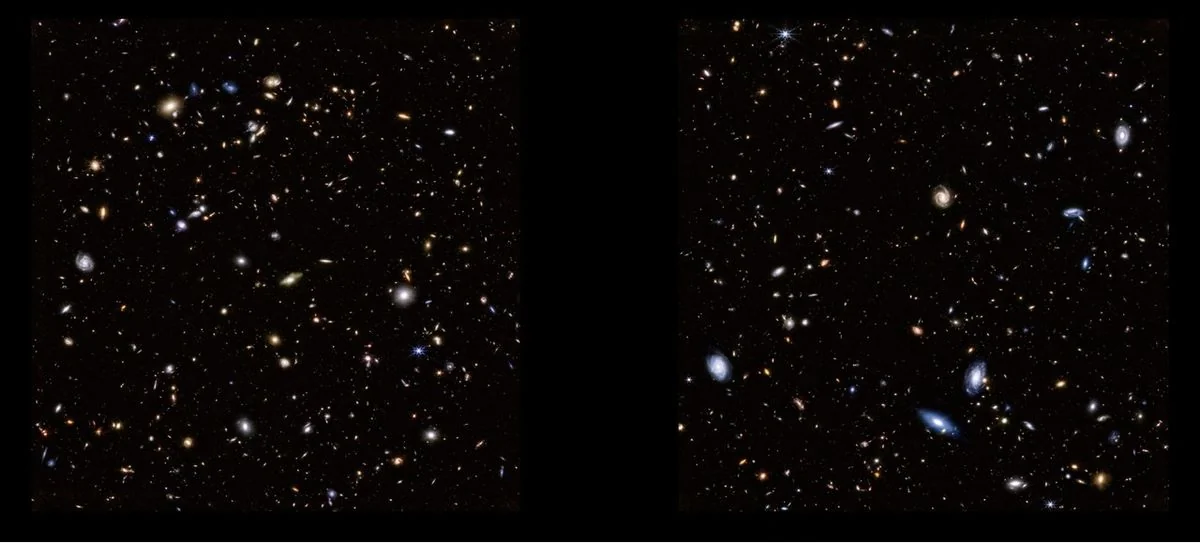
Astronomers using the James Webb Space Telescope have identified more than 700 galaxies that existed within the first billion years after the Big Bang, according to results from the JWST Advanced Deep Extragalactic Survey and related programs. These objects, observed through deep infrared imaging and spectroscopy, date to periods when the universe was between roughly 370 million and 700 million years old.
The findings expand the known population of early galaxies far beyond pre-launch predictions and coincide with multiple detections of active supermassive black holes in the same cosmic epoch. Some of these black holes appear disproportionately massive compared with the stellar content of their host systems, prompting revisions to models of how the first galaxies and black holes assembled.
Technical Approach and Instruments
The discoveries rely on JWST's Near-Infrared Camera and Near-Infrared Spectrograph. These instruments capture light stretched into the infrared by cosmic expansion, allowing detection of faint, highly redshifted sources invisible to earlier telescopes such as Hubble. Spectroscopic follow-up measures precise redshifts, star-formation rates, and the presence of broad emission lines that indicate gas orbiting at high speeds around central black holes.
In the JADES program, researchers examined two small sky patches and catalogued 717 galaxies with complex structures and intense star formation already under way. Parallel surveys, including COSMOS-Web, later expanded the census to nearly 800,000 galaxies across a wider area spanning most of cosmic history, confirming that early galaxies are both more numerous and more diverse than expected. Details on the JADES results are available from Space.com coverage of the 717-galaxy find and the broader COSMOS-Web release summarized by ScienceDaily.
Empirical Results and Black Hole Connections
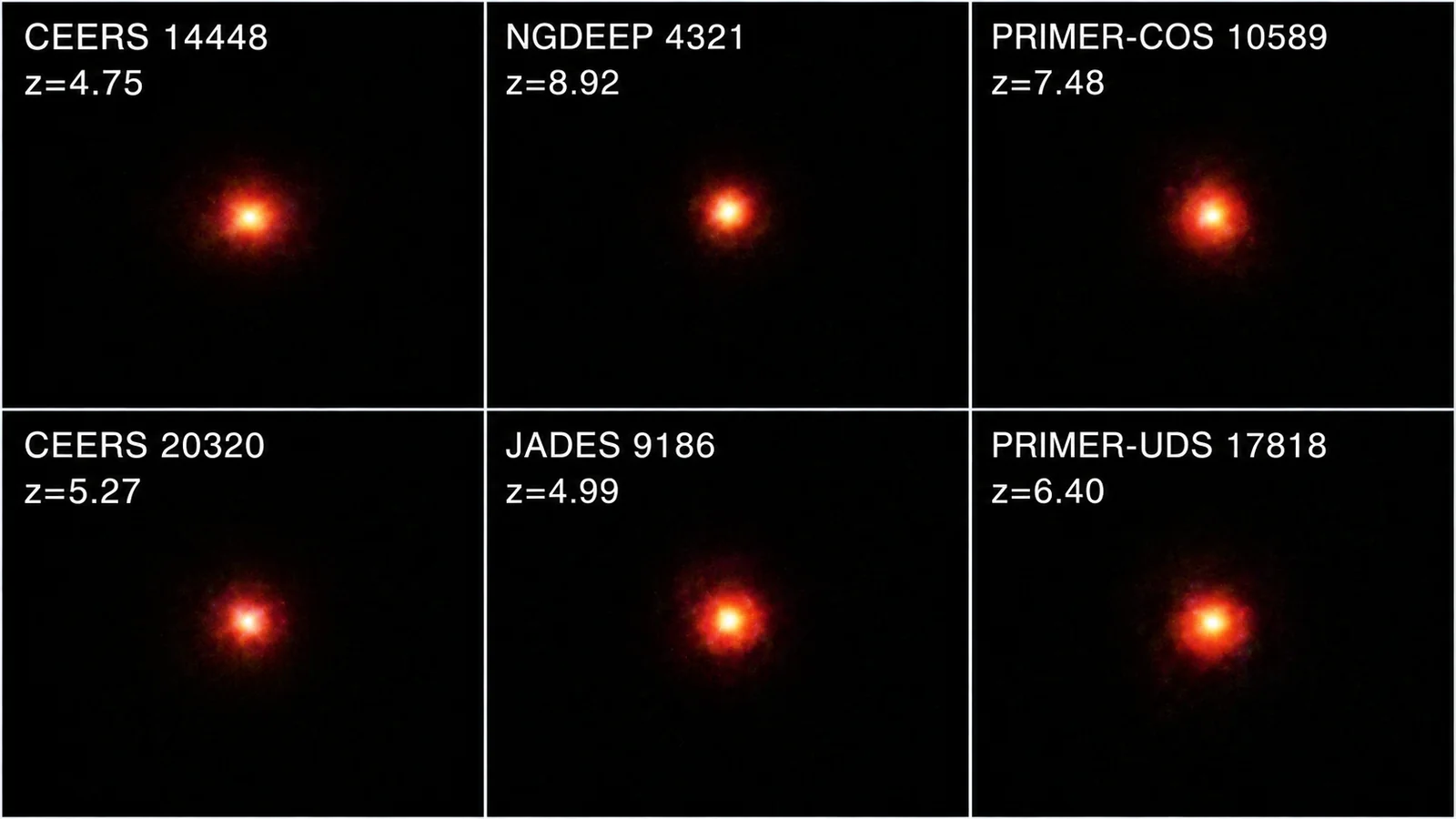
Many of the early galaxies display strong emission lines consistent with rapid star formation. A subset, nicknamed little red dots because of their compact size and red colors, show spectral signatures of accreting black holes. In one well-studied case, Abell2744-QSO1, observed when the universe was about 700 million years old, the central black hole reaches roughly 50 million solar masses and constitutes approximately two-thirds of the system's total mass. Gas kinematics indicate Keplerian rotation around a compact mass, with little evidence for a substantial surrounding stellar population at that epoch. Official reporting appears on the ESA/Webb site and in related analysis from Big Think.
Additional examples include CEERS 1019, hosting one of the most distant active black holes confirmed to date, and other systems where black-hole mass exceeds local scaling relations by factors of tens to hundreds. Stacking analyses of larger galaxy samples suggest that median black-hole masses are lower, closer to extrapolated local relations, indicating that individual luminous detections preferentially sample the high-mass end of the distribution. NASA's account of the CEERS black-hole detection is published at NASA Science.
- Over 700 galaxies catalogued in the first ~650 million years of cosmic time
- Black-hole masses ranging from millions to tens of millions of solar masses at redshifts greater than 7
- Star-formation rates elevated relative to later epochs
- Metallicities in some systems measured at only a few thousandths of solar values
Implications and Open Questions
The abundance of bright early galaxies and overmassive black holes challenges standard hierarchical formation scenarios in which black holes grow slowly inside already-formed galaxies. Alternative pathways under investigation include direct collapse of massive gas clouds into heavy seeds and brief phases of super-Eddington accretion. Ongoing spectroscopic campaigns aim to distinguish these mechanisms by measuring gas dynamics, chemical enrichment, and the relative timing of star and black-hole growth.
Further JWST observations, combined with X-ray data from Chandra and future facilities, will test whether the earliest black holes formed before, during, or after their host galaxies. The data already demonstrate that the first billion years of cosmic history were more dynamic and productive than previously modeled. Additional peer-reviewed context appears in reviews such as the Nature Astronomy summary of massive black holes in the first billion years (Nature Astronomy).
Sources:


