

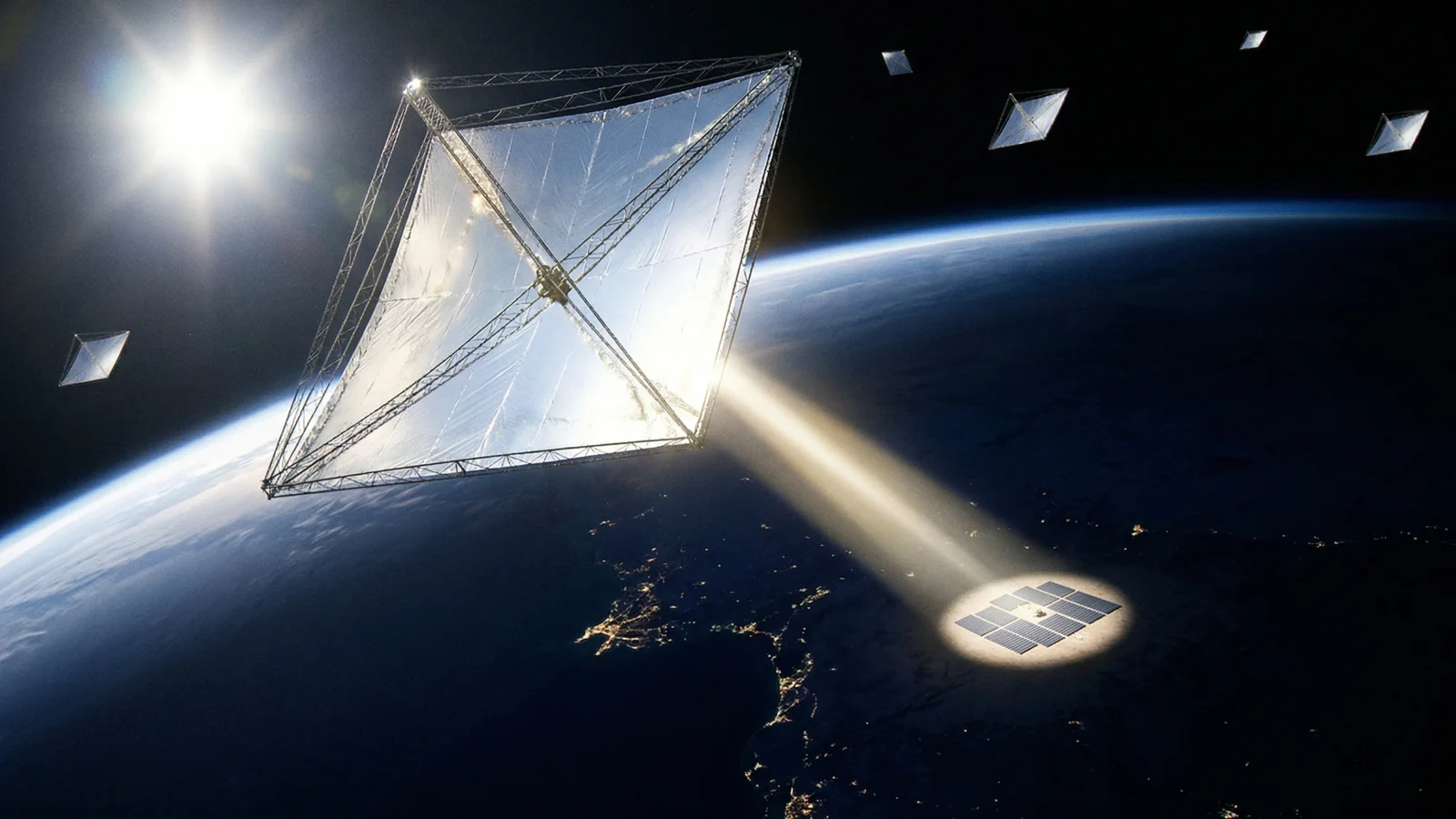
Reflect Orbital, a California-based space startup headquartered in Hawthorne, is advancing plans to deliver sunlight on demand by reflecting it from orbit onto targeted locations on Earth after dark. The company received authorization from the Federal Communications Commission on July 9, 2026, to construct, launch, and operate its first demonstration satellite, Eärendil-1, with a launch planned later in 2026 via a SpaceX rideshare mission.
Founded in 2021 by Ben Nowack, a former SpaceX engineer, and Tristan Semmelhack, a former Zipline mechanical engineer, Reflect Orbital designs satellites equipped with large, deployable thin-film mirrors. These reflectors are intended to redirect sunlight that would otherwise miss Earth toward specific ground sites for applications including extended solar power generation, emergency response, and other uses requiring nighttime illumination without new ground infrastructure.

Technical Architecture and Specifications
Eärendil-1 is a roughly 142-kilogram spacecraft that folds into a compact volume approximately the size of a microwave oven for launch. Once in low Earth orbit at an altitude of about 600–650 kilometers, it deploys an 18-meter by 18-meter (approximately 59-foot) steerable reflector composed of four triangular membrane panels. The reflective surface is an aluminized plastic film only thousands of atoms thick, tensioned by carbon-fiber booms. The design aims to cast a light spot roughly 5 kilometers in diameter.
Pointing is managed with control moment gyroscopes, allowing the mirror to be reoriented within seconds to track a target as the satellite passes overhead. A single pass is expected to illuminate a given area for about four minutes. The company states that the initial demonstration will produce illumination comparable to the brightness of a full moon over the targeted zone. Longer-term plans call for larger reflectors and coordinated operations from multiple satellites to increase duration and intensity.
Reflect Orbital’s website describes the service as orderable via an app or website for approved locations, with the ability to adjust intensity and turn the illumination on or off. The company has reported receiving more than 260,000 inquiries related to potential uses.
Empirical Data and Real-World Impact
Prior to orbital testing, the company conducted a ground-based demonstration in 2024 using a smaller approximately 2.5-meter mirror suspended from a hot-air balloon to redirect sunlight onto solar panels during twilight conditions. Reflect Orbital has raised a total of approximately $35.2 million, including a $6.5 million seed round led by Sequoia Capital in 2024 and a subsequent $20 million round involving Lux Capital and others. It also received a $1.25 million Phase II SBIR award from the U.S. Air Force Research Laboratory and AFWERX.
In mid-October 2026, Reflect Orbital announced a two-launch agreement with India’s Skyroot Aerospace using its Vikram rocket series. The company has stated that potential customers include solar farm operators seeking to extend generation hours, as well as entities involved in search-and-rescue and emergency response. Pricing for commercial service has been reported in the range of $5,000 per hour under certain contract terms, according to interviews with the CEO.
“Sun is the most powerful resource in the solar system,” Reflect Orbital CEO Ben Nowack said in an interview with Aerospace America, “and we currently have no control over where and when it shines, so we’re trying to do that.”
Industry Context and Future Outlook
The concept of orbital mirrors to redirect sunlight has historical precedents, including proposals by Hermann Oberth in the 1920s and the Soviet/Russian Znamya experiments in the 1990s, which briefly demonstrated a reflected beam. Reflect Orbital’s roadmap, as published on its website, envisions scaling from initial demonstration satellites in 2026 to dozens by 2027, thousands in subsequent years, and as many as 50,000 by 2035, with goals of supporting both lighting and energy services that could increase the capacity factor of solar farms.
The FCC authorization for Eärendil-1 is limited to the single demonstration satellite and a two-year radio communications license. The commission noted that effects on optical astronomy fell outside its jurisdiction and referenced the company’s commitments to coordinate with NASA and the National Science Foundation. Public comments on the application exceeded 1,800, many expressing opposition.
Astronomers and dark-sky organizations have raised concerns about potential light pollution and interference with observations. Studies have modeled the brightness of reflected beams, with some estimating significant visibility outside the intended target area. Nowack has stated that the company will maintain exclusion zones around observatories and sensitive areas, operate satellites in an “off” mode when not actively reflecting, and limit service to consenting locations with appropriate approvals. He has described the initial operational footprint as limited, noting that early business models could be supported by a small number of sites covering thousands of acres each.
Engineering challenges over the next 12–24 months include successful deployment and control of the large membrane reflector in orbit, precise beam targeting, coordination of multiple satellites for longer illumination periods, and navigation of regulatory and community concerns. The company has indicated it will use data from the 2026 demonstration to refine safeguards and technology before any broader deployment.
Sources: Wikipedia – Reflect Orbital; Reflect Orbital official website; The Verge; Aerospace America; Payload Space.