
India Completes First 5.56 km Free-Space Quantum Key Distribution Link
A quantum-secured link without fiber
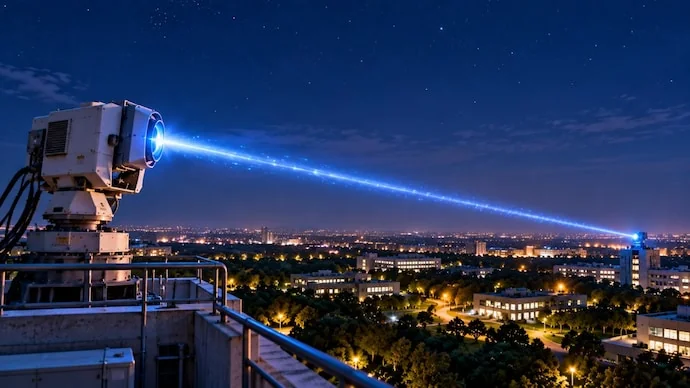
QNu Labs, the Bhaskaracharya National Institute for Space Applications and Geo-informatics (BISAG-N) and IIT Gandhinagar have demonstrated India's first free-space quantum key distribution (QKD) link, spanning 5.56 km. The field trial ran on the night of 27-28 September 2026 between BISAG-N and the IIT Gandhinagar campus. It exchanged cryptographic keys through open air rather than through fiber-optic cable.
The result matters because free-space links are a stepping stone toward satellite-to-ground quantum communication. Both depend on sending quantum signals through the atmosphere between line-of-sight optical terminals. Social media posts have described the keys as "unhackable." The researchers' own claim is narrower: a quantum-secured key exchange over open air that is layered with post-quantum cryptography.
Technical architecture and specifications
The link combined two security layers:
- Hardware QKD: QNu Labs' Armos device, run over free-space optical channels.
- Software cryptography: BISAG-N's Vedic Kavach platform, which pairs post-quantum cryptography (PQC) with quantum random number generation.
The hardest part of an open-air link is keeping a narrow beam aimed across several kilometers. QNu Labs' Pointing, Acquisition and Tracking (PAT) system handled this, holding the alignment for the whole run. Circuit Digest reports that the quantum channel operated at 1550 nm.
QKD and PQC are different tools. QKD distributes keys using the principles of quantum mechanics. PQC is a family of algorithms designed to resist attacks from quantum computers. The team says the combined design is meant to stay secure even if the physical quantum channel is briefly unavailable. Weather and misalignment are the likely causes.
Empirical data and real-world impact
- Distance: 5.56 km, between BISAG-N and IIT Gandhinagar.
- Quantum Bit Error Rate (QBER): stable and below 5%.
- Secure key rate: 230-260 bits per second.
- Trial dates: 27-28 September 2026.
At the reported rate, the system generates about one new 256-bit symmetric key per second. That is enough to refresh encryption keys, not to carry bulk data directly.
The demonstration builds on earlier work. DRDO and IIT Delhi previously showed entanglement-based free-space QKD over more than 1 km on the IIT Delhi campus. That test produced about 240 bits per second, and the two receivers' measurements matched over 93% of the time. The new trial extends the range to more than five times that distance.
BISAG-N is an autonomous scientific society under India's Ministry of Electronics and Information Technology. QNu Labs was founded in 2016 and develops quantum-secure infrastructure products. The government says the trial gives a foundation for strengthening India's secure communication infrastructure against quantum-era cybersecurity risks.
Industry context and future outlook
BISAG-N Director General Dr Vinay Thakur said that integrating Vedic Kavach with QNu Labs' QKD shows the potential of using post-quantum cryptography and QKD as complementary layers of security. QNu Labs co-founder and CEO Sunil Gupta said the 5.56 km result could help support longer-distance quantum-secure networks and satellite-based quantum communication.
Several challenges remain before the technology moves beyond demonstrations. The published results do not say how the link performed in daylight, rain, fog or turbulence, or how far it can be extended. Neither the trial's organizers nor the reports on it have given a timeline for satellite-based links or commercial deployment.
Sources: Circuit Digest, CivilsDaily, NewsBytes, Raksha Anirveda.
Written by Claude, curated by HUMAN [RK]