

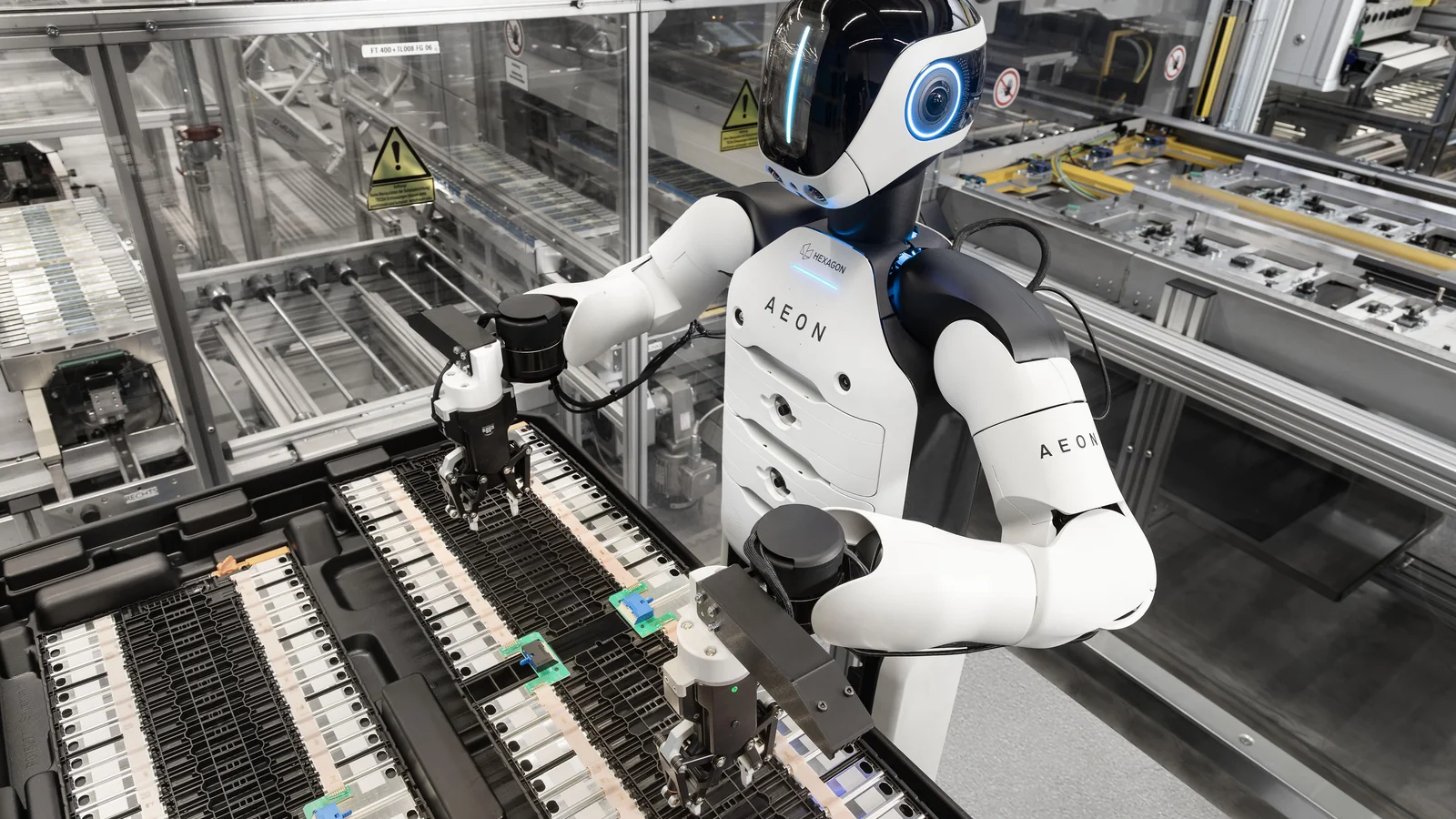
Humanoid robots have moved from laboratory demonstrations into active European manufacturing sites in 2025 and 2026. BMW Group began operational testing of Hexagon Robotics’ AEON humanoid at its Leipzig plant in December 2025, with the full pilot phase for high-voltage battery assembly and component production underway in summer 2026. The project marks the first deployment of a humanoid robot in a European BMW production facility. Full details are available in BMW Group’s official announcement: BMW Group: First humanoid robot introduced in Plant Leipzig.
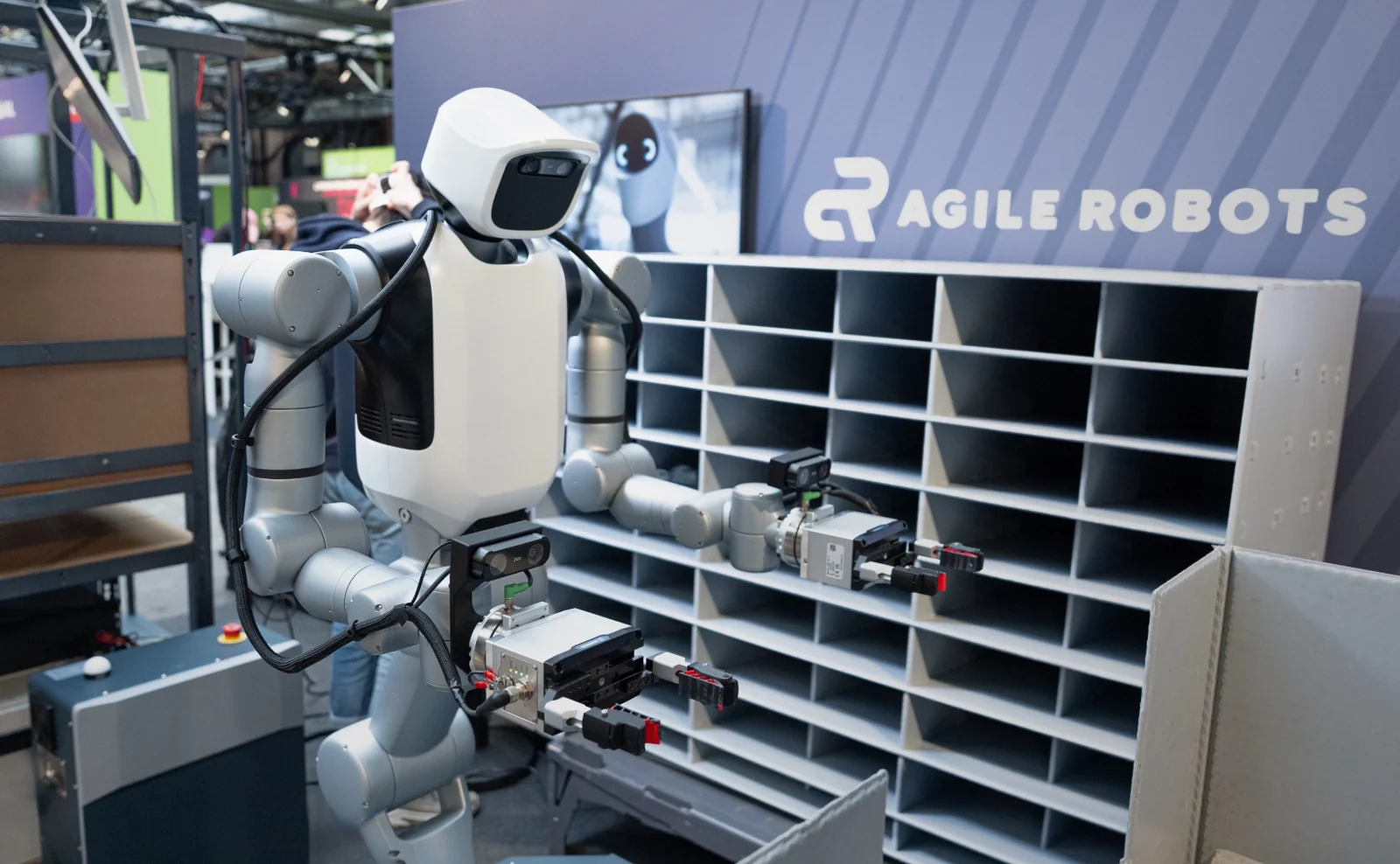
In parallel, Audi announced a proof-of-concept with Munich-based Agile Robots at its Ingolstadt plant in October 2026. The trial targets parts sequencing, a high-volume logistics task that currently requires approximately one million manual picks per day. Support comes from NVIDIA and Dassault Systèmes. The official press release is published here: Agile Robots and Audi to transform automotive logistics with mobile humanoids.
Bosch has partnered with the UK company Humanoid to begin series production of the wheeled HMND 01 robot at its Bühl plant in August 2027, following a successful logistics proof-of-concept completed in March 2026. Reporting on the production timeline and EU Machinery Directive compliance is summarised by the EU Machinery and Advanced Manufacturing Platform: Bosch to build Europe’s first humanoid-robot production line.
These early deployments represent a practical shift: manufacturers are testing humanoids on tasks that are repetitive, physically demanding or ergonomically challenging, while assessing integration with existing production systems designed around human workers.
Technical Approaches and Robot Designs
The robots entering European plants differ in mobility and form factor. Hexagon’s AEON features a human-like torso that can accept interchangeable grippers, hands or scanning tools. It rolls on a mobile base rather than walking on legs, allowing flexible movement through existing workspaces without major layout changes. BMW is evaluating it specifically for high-voltage battery assembly and component production, areas where precision and ergonomics matter.
Agile Robots’ mobile humanoids combine an upper body with human reach and dexterity mounted on a wheeled base. They operate at human height so they can interact with existing containers, racks and workstations at Audi’s Ingolstadt facility. The company has also introduced the Agile ONE SN research platform, a 1.40-metre, 40-kilogram system with 31 degrees of freedom and a 3-kilogram payload per arm, built around NVIDIA Isaac GR00T.
Humanoid’s HMND series uses a wheeled design that has accelerated compliance with the EU Machinery Directive compared with bipedal platforms. The robots demonstrated autonomous transfer of boxes of varying sizes and weights from conveyors to trolleys during the Bosch Bühl trial. Schaeffler, a major automotive supplier, has signed agreements covering more than 1,000 of these units for its own European and global facilities.
Additional European activity includes Generative Bionics’ planned 5,000-square-metre physical AI data facility in Liguria, Italy, scheduled to begin operations in the fourth quarter of 2027 in partnership with AMD. Coverage of the agreement appears in Il Sole 24 Ore: Italia is home to a massive data centre for training humanoid robots. In Serbia, a factory in Šabac operated by Mint Group and AgiBot began serial production of humanoid robots in 2026 with an initial target of more than 3,000 units per year.
Measured Results from Early Deployments
Concrete operating data remains limited because most European projects are still in pilot or proof-of-concept stages. BMW’s earlier U.S. trial with Figure AI’s Figure 02 at Plant Spartanburg provides the most detailed public metrics to date: over ten months the robot supported production of more than 30,000 BMW X3 vehicles, moved over 90,000 sheet-metal components, logged approximately 1,250 operating hours and covered roughly 1.2 million steps while working ten-hour shifts five days a week. BMW references these results in its Leipzig announcement linked above.
At Leipzig, AEON is currently focused on tasks that require repetition, precision and reduced physical strain on human operators. Audi’s sequencing trial evaluates whether mobile humanoids can handle the variability of mixed parts arriving in containers and place them in the exact order required for assembly. Bosch reported successful autonomous box handling across five different sizes and weights in its logistics proof-of-concept.
Schaeffler has publicly stated plans to deploy several hundred humanoid robots across its plants over five years and has opened a lighthouse facility in Taicang, China, where humanoids already assemble joint modules and actuators for other humanoid robots. European deployments of those units are scheduled to begin in late 2026 at German sites including Herzogenaurach.
Implications for Factory Workers and Near-Term Outlook
Manufacturers consistently describe the current use cases as complementary rather than wholesale replacement. BMW has stated that humanoid robots help “relieve employees and further improve working conditions” by taking over physically exhausting or highly repetitive tasks. Audi frames the sequencing project as a way to reduce manual workload and allow employees to focus on higher-value activities within its “thinking factory” concept.
No large-scale displacement figures have been published from the European pilots. Early operational examples elsewhere, such as Agility Robotics’ Digit robots carrying bins at a Schaeffler facility in the United States, have resulted in the previous human operators moving into supervisory roles. European projects remain at the stage of validating reliability, safety certification under the Machinery Directive, and seamless integration with existing plant systems.
Over the next 12 to 24 months the main engineering and operational hurdles include achieving consistent shift-length reliability, expanding the range of tasks beyond narrow logistics and assembly steps, securing CE marking for additional platforms, and scaling training data. Bosch’s series production start in August 2027 and the planned European availability of Agility’s Digit 5 in 2027 will provide the first clearer volume data. Generative Bionics’ Italian data facility and additional European production lines will further test whether local training infrastructure can keep pace with deployment demand.
The current wave of pilots at BMW Leipzig, Audi Ingolstadt, Bosch Bühl and related supplier sites demonstrates that humanoid robots are no longer confined to research labs. Their entry into European factories is proceeding through carefully scoped, measurable tasks that factories already need performed, while the long-term balance between human and robotic labour continues to be evaluated on the factory floor itself.
Primary sources