



Precision at 500Hz: How AI Computer Vision and Smart Balls Eliminated Football’s Offside Guesswork
Category: SPORTS & FITNESS
The Hook & Core Fact
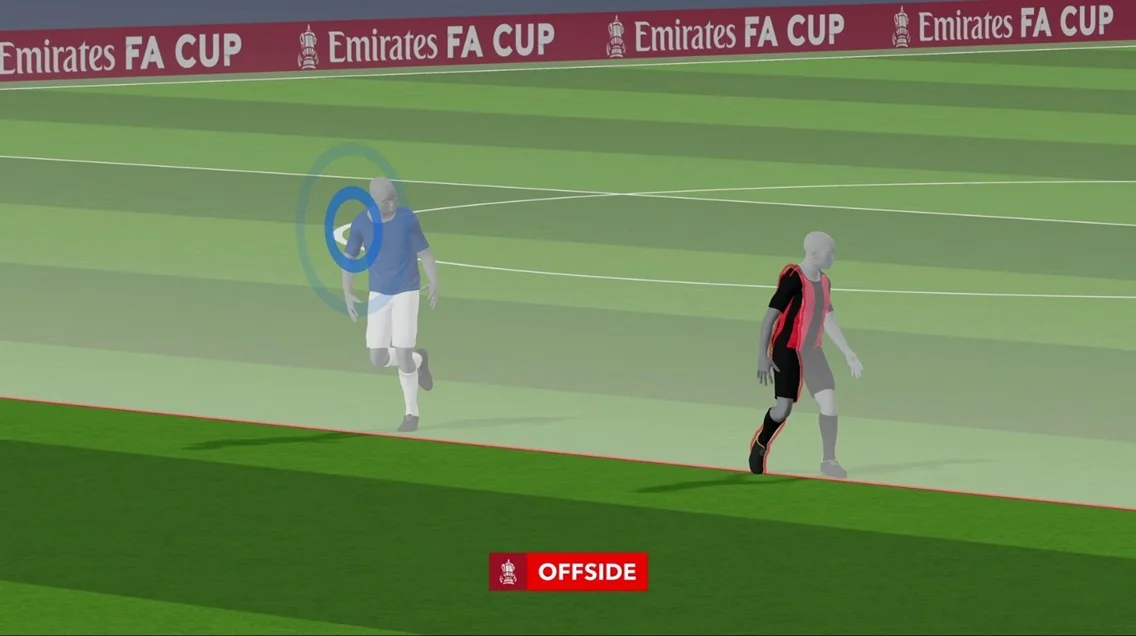
The global football landscape has officially transitioned into a fully digitized officiating era, replacing manual video assistant reviews with semi-automated offside technology (SAOT). Spearheaded across major domestic competitions and the 2026 FIFA World Cup stage, these AI-driven computer vision and spatial tracking platforms have slashed average offside decision times by over 30 seconds. By combining synchronized multi-angle optical feeds with micro-sensor spatial data inside match balls, elite leagues are eliminating human line-drawing errors in favor of automated 3D geometric rendering.
This deployment represents a major leap in sport-centric spatial computing. Rather than relying on human operators manually selecting video frames and drawing visual reference lines across two-dimensional broadcast feeds, autonomous computer vision algorithms process hundreds of millions of spatial coordinates in real time. The resulting data layer delivers near-instantaneous validation to officiating hubs while providing television broadcasts and stadium screens with precise, millimeter-accurate 3D animation.
Technical Architecture & Specifications
The technical architecture relies on two complementary hardware and software stacks working under strict temporal synchronization:
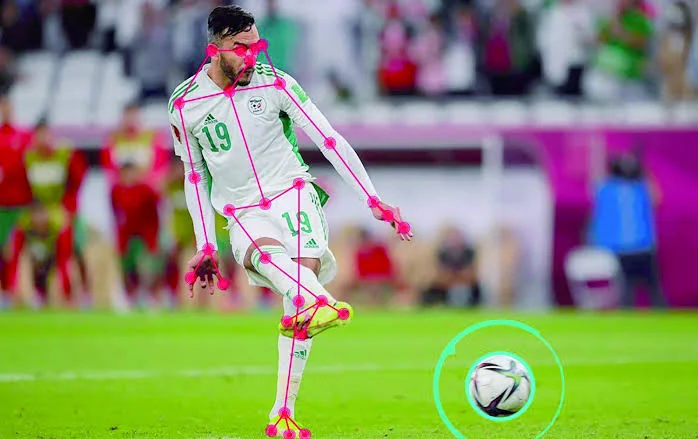
- Optical Tracking & Skeletonization: Stadium installations feature between 12 and 30 dedicated high-resolution computer vision cameras mounted directly beneath stadium roofs. Operating at frequencies up to 50 Hz, these camera arrays run deep learning pose-estimation models that build a 3D skeletal mesh for every player, tracking 29 to 10,000 individual surface keypoints—including offside-relevant limbs, knees, feet, and shoulders—while explicitly filtering out non-playable regions like hands and arms.
- Inertial Sensor Integration: Official match balls house a central suspension structure holding a 500 Hz Inertial Measurement Unit (IMU) sensor. The sensor registers acceleration spikes, angular velocity shifts, and high-jerk events 500 times per second, transmitting real-time spatial motion vectors to surrounding stadium receivers.
- Multi-Sensor Data Fusion: Machine learning engines (such as GeniusIQ and custom deep-learning pipelines) receive the sensor timestamp of the ball impact and match it precisely with the multi-view optical tracking keypoints to establish the exact frame of the pass.
Empirical Data & Real-World Impact
Field deployment benchmarks show substantial performance gains compared to legacy Video Assistant Referee (VAR) workflows:
- Decision Latency: Manual line drawing previously averaged 70 to 75 seconds per tight offside check. The semi-automated platform reduces baseline line-generation processing down to less than 5 seconds, bringing average total officiating verification down to approximately 25 to 30 seconds.
- Data Density: Across a standard 90-minute match, the multi-camera optical network captures and processes over 150 million distinct spatial data points.
- Temporal Precision: The 500 Hz ball sensor provides kick-point detection accuracy down to 2 milliseconds, resolving ambiguities caused by motion-blurred broadcast frames during high-speed passes.
- Field Adoption: Fully validated systems are currently active across all 16 host venues for the 2026 FIFA World Cup, UEFA Champions League fixtures, and domestic competitions including the English Premier League.
"The biggest benefit of semi-automated offsides is around the efficiency of the process... The manual use of technology can take time, particularly in the more complicated situations. We're looking forward to making it quicker but retaining the accuracy." — Howard Webb, PGMOL Chief Refereeing Officer
Industry Context & Future Outlook
Despite significant technical advances, critical edge-case engineering challenges remain over the next 12 to 24 months. Optical line-of-sight occlusions—where multiple players physically crowd together during set pieces or corner kicks—can temporarily block camera views, requiring spatial interpolation algorithms to project missing joint locations. Furthermore, the system remains intentionally "semi-automated" because human officials must still manually evaluate subjective infractions, such as whether an offside-positioned player actively interfered with an opponent's field of vision or ability to play the ball.
Technology roadmaps indicate that governance bodies like FIFA are using current tournament data to lay the groundwork for potential fully automated offside triggers by 2030, alongside AI-assisted real-time biomechanical foul detection. For now, the integration of high-speed optical tracking and inertial sensing has established a new global baseline for officiating precision in elite athletics.


