
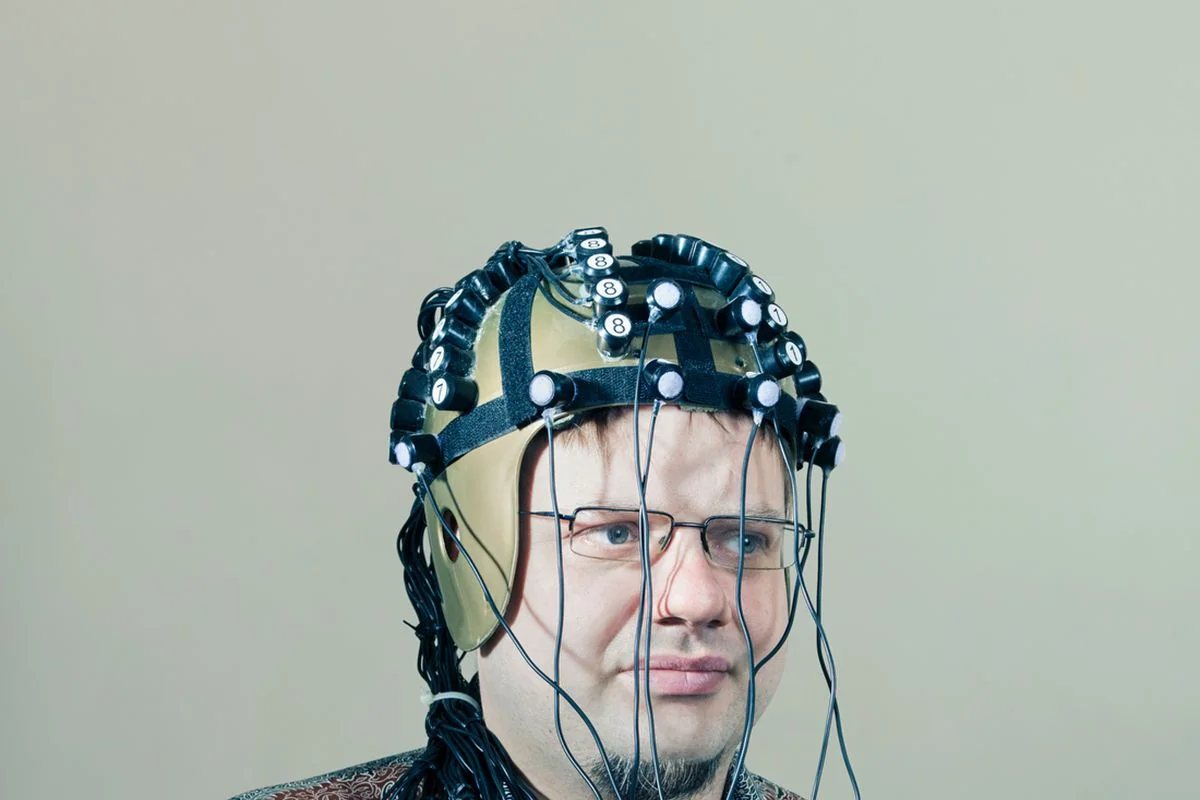
The God Helmet, an experimental device developed by Canadian neuroscientist Michael Persinger and engineer Stanley Koren, was designed to investigate whether weak magnetic fields applied around the head could influence unusual subjective experiences. The research attracted attention because some participants reported sensing an unseen presence or experiencing unusual sensations during experiments. However, independent research has challenged the claim that the magnetic fields themselves reliably produce these effects.
First investigated in the 1980s and 1990s, the device remains an intriguing example of how neuroscience attempts to study experiences that people may interpret as spiritual, paranormal or otherwise difficult to explain. Its findings also highlight a fundamental challenge in experimental research: separating the effects of a physical intervention from expectation, suggestion and individual differences.
How the God Helmet works
The original apparatus used a helmet fitted with small electromagnetic coils positioned around the temporal regions of the head. These coils generated weak, patterned magnetic fields intended to influence activity in brain regions associated with perception, memory and emotional processing.
Unlike conventional transcranial magnetic stimulation, which uses substantially stronger magnetic pulses to stimulate neural tissue, the God Helmet experiments used fields typically around the microtesla range. The research explored whether carefully timed magnetic-field patterns could influence the subjective feeling that another presence was nearby.
In a 2002 study published in the Journal of Nervous and Mental Disease, Persinger and researcher Faye Healey tested 48 university participants under double-blind conditions. Participants were exposed to weak, pulsed magnetic fields over different regions of the head or to a sham-field control condition. Sessions lasted 20 minutes, and participants wore opaque goggles in a quiet room.
The researchers reported that participants receiving stimulation over the right temporoparietal region, or across both hemispheres, described more experiences of a sensed presence, fear and unusual smells than participants in the other conditions. The study supported the authors' hypothesis that such experiences might be experimentally influenced, although the findings would later be challenged by independent researchers.
Independent research challenges the claims
A major test came in 2005, when Pehr Granqvist and colleagues published a study in Neuroscience Letters. The team conducted a double-blind experiment involving 89 participants, including a control group exposed to a sham magnetic field.
The researchers found no evidence that exposure to the weak magnetic fields caused sensed-presence experiences, mystical experiences or the other reported sensations. Instead, individual characteristics associated with suggestibility were linked to the experiences participants described.
The results challenged the claim that the helmet could reliably induce these experiences through magnetic stimulation alone. They also demonstrated why control conditions matter: when participants do not know whether a device is active, researchers can better assess whether the intervention itself accounts for the reported effects.
The debate did not end there. Persinger and colleagues questioned aspects of the replication, including whether the magnetic-field patterns used were appropriate for testing their original hypothesis. Other researchers have since explored the relationship between suggestion, expectation and unusual subjective experiences, leaving the wider scientific discussion more nuanced than a simple claim that the device either works or does not work.
What later studies found
Research published in 2014 by Carlos A. Tinoca and João P. L. Ortiz reported a partial replication using a helmet containing eight magnetic coils. The study involved 20 volunteers and examined reports of spiritual experiences under magnetic stimulation, alongside the possible effects of suggestion and expectation.
The authors reported differences between the experiences described by stimulated participants and those in control conditions. However, the small sample and the study's partial-replication design limit how broadly its findings can be applied. It does not resolve the disagreement raised by the larger, double-blind 2005 experiment.
Other research has examined placebo versions of the God Helmet. A 2014 study by psychologist Michiel van Elk used a placebo helmet to investigate induced spiritual experiences and their relationship to individual differences. Its findings linked reported experiences to factors including beliefs about the device, absorption and paranormal beliefs, illustrating how psychological context can influence what people experience during an experiment.
What the evidence means for neuroscience
The God Helmet does not establish that a machine can detect God or create contact with a supernatural entity. Its research concerns subjective experiences and the possible mechanisms that influence them, not the existence or non-existence of supernatural beings.
The device also should not be confused with established brain-stimulation technologies. Transcranial magnetic stimulation is used in clinical and research settings, with protocols that differ substantially from the weak-field patterns used in God Helmet experiments. Evidence supporting one technique cannot automatically be applied to another.
For neuroscience, the broader question is how perception, expectation, sensory conditions and brain activity combine to produce the feeling that another person or presence is nearby. Such experiences can feel vivid and meaningful to the person experiencing them, but subjective intensity alone does not establish their cause.
What comes next
The God Helmet's lasting significance lies in the questions it raises about experimental design and the study of consciousness. Researchers investigating unusual experiences need adequately powered studies, carefully matched control conditions, transparent methods and independent replication before concluding that a particular technology produces a specific effect.
Future work on brain stimulation may help explain how neural processes contribute to the perception of presence and other altered experiences. For now, the available evidence does not support treating the God Helmet as a reliable way to induce spiritual experiences through magnetic fields. Its story is a reminder that an intriguing hypothesis must withstand controlled testing before it can be considered an established scientific finding.
Sources: This article is based on published research indexed by PubMed, university research repositories and scientific journals: Persinger and Healey's 2002 experiment; Granqvist and colleagues' 2005 double-blind study; Cook and Persinger's 2001 study; Tinoca and Ortiz's 2014 partial replication; and van Elk's 2014 placebo-helmet study.
\`\`\`