


On October 2, 2026, Polish streamer Tamae and his video editor, known as Zaaif, released Game Keeper: Somebody Messed Up My Shop! on Steam. According to a fan-run wiki, the two-person team, operating as VeinStudios, built the game in a little over a month, partly live on stream. Five days later, Google Labs launched Playground, a prompt-only game maker, which shows how quickly the tooling around this kind of project is changing.
Game Keeper is not a fully AI-made game, and its developers say so on the store page. It does sit inside a wider shift. Tools such as Claude, Google Playground, Google AI Studio and AI-assisted add-ons for Unreal Engine now let beginners and small teams produce playable software far faster than before. Valve's AI-disclosure data shows how quickly this is spreading on the largest PC storefront.
The case study: Game Keeper by VeinStudios
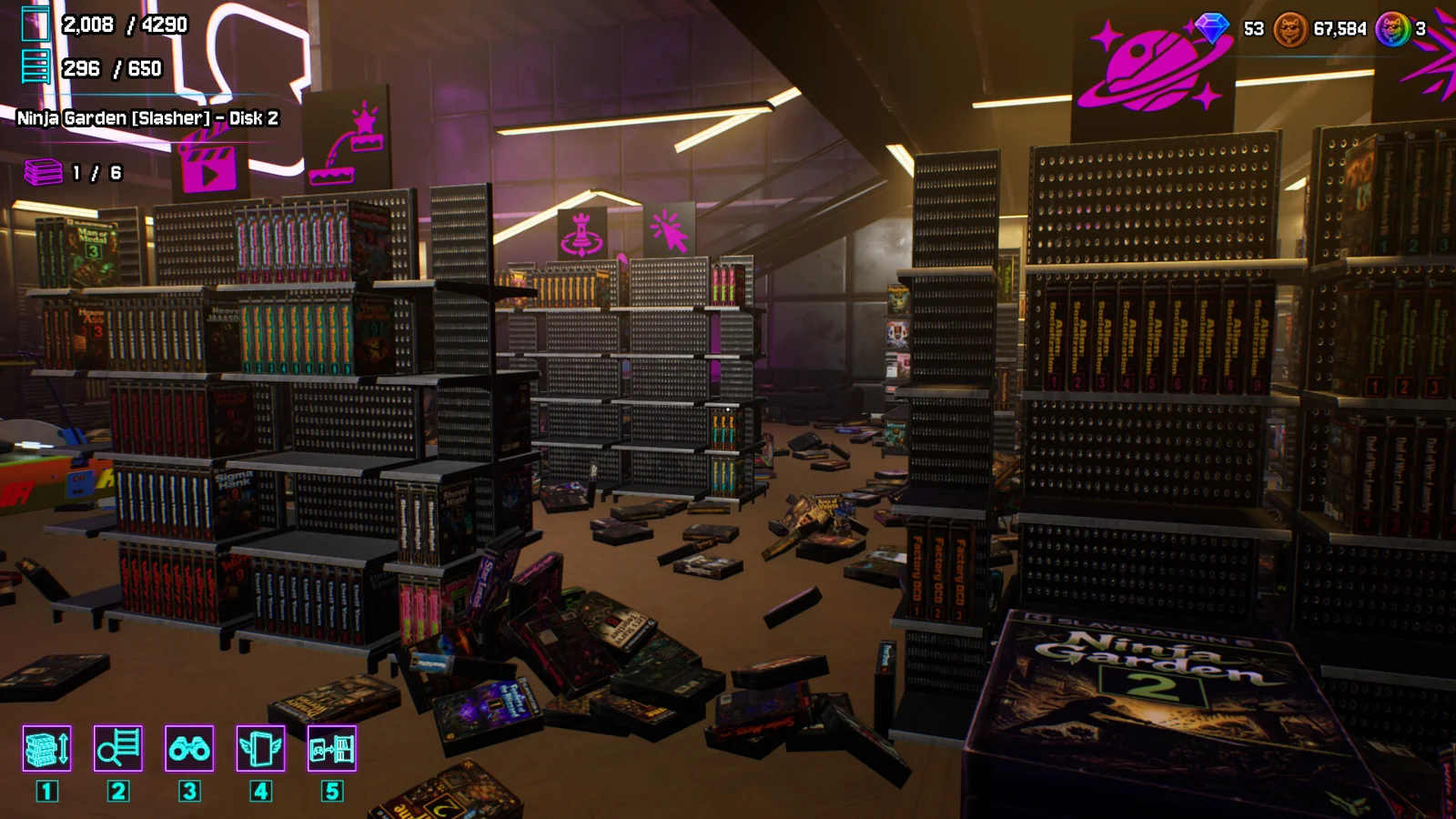
The Steam listing describes a single-player organizing game set in a chaotic video game store. The player must put 4,290 cases back on 96 racks, sorted by genre and order, and complete 650 parody-filled series. A cat named Jeff supplies the "questionable help." The store lists Polish among its supported languages, and the wiki says the game supports 28 languages in total. Per the same wiki, the devlog lists a price of 29.99 zł, with 10% off for launch week.
The wiki credits Tamae with design, visuals and UI, and Zaaif with Unreal Engine blueprints and code. It also says the game belongs to the same collectathon sorting family as Librarian: Tidy Up the Arcane Library! and Cellar Keeper, both named by the developers as inspiration. Game Keeper adds a skill tree and a slot machine.
The developers' Steam disclosure says AI was used as a supporting tool for selected textures, sounds, localization and small portions of code. It adds that, in the developers' words, The game's concept, art direction, and design were created entirely by humans. The wiki says the devlog explains that AI was mainly used for the roughly 650 parody box covers. ROBOTICO could not find a public statement naming the specific AI tools the team used, so we are not attributing the game to any particular product, including Playground.
Google Playground: Google's prompt-only game maker

Google announced Playground on October 7, 2026, in a blog post by Maryam Karimzadehgan, a software engineer in its AI Innovation and Research group. The post calls it an experimental gaming platform that lets you create, play, and share custom games. It runs in the browser at playground.google and comes out of Google Labs, the company's public incubator for experimental products. Karimzadehgan wrote that it lowers the barrier to creation so a game idea can start with a few prompts and no coding experience.
Creators can start from an empty project, starter prompts or guided support. Google's landing page gives trivia, tower defense and racing as example genres. Creators then describe the game in chat, test it, and ask for changes to the physics, rules, characters or environment. They can choose 2D or 3D graphics and can upload reference images, which the AI turns into stylized game assets. Coverage of the launch says the platform uses Google's Gemini, Nano Banana (images) and Lyria (music) models inside a custom engine harness.
Finished games can stay private, be shared through a link or be published to a public Explore gallery, which surfaces titles based on player ratings and play activity. A Play Games profile lets users claim a handle, like games and follow creators. Games can carry leaderboards, and multiplayer is available in select genres.
Access is limited for now. Playground is open to users aged 18 and older in the United States. Browsing and playing games is free, while creating them uses a weekly token system: free users get a limited allowance, and Google One AI subscribers get higher limits. Google has said it plans to expand to more countries, but ROBOTICO did not find a date. Google also describes the product as an early experiment, so features and limits may change.
Google has named Unity as a future integration partner. Coverage of the launch says Unity Spark, Unity's more advanced creation tool, will add professional-level mechanics and higher-fidelity 3D later this year. At the time of those reports, Spark was still in testing with a closed beta due soon.
Technical architecture: the main routes to an AI-built game
Projects like this tend to follow one of four technical routes, and each has a different learning curve.
- Prompt-only game platforms. Google Playground is the newest example. Everything from generation to editing to publishing happens in a chat box, and no code is exposed to the creator.
- Prompt-to-app builders for developers. Google AI Studio's Build mode is a separate, more general Google tool. Users describe an app in a text box, and Gemini generates it. Google's documentation says users can iterate through chat or annotation mode, import projects from GitHub and build multiplayer experiences. A Google codelab walks beginners through a retro Snake game with an integrated music player, generated from a single prompt and deployed to Google Cloud Run.
- Chat-based builders. Claude can generate playable web games through its Artifacts feature. TechRadar's reviewer described getting a Mario-style platformer called "Press Quest" after roughly 30 seconds, then noted the result was uneven and included stray HTML text he could not remove.
- Agentic coding inside full engines. Developers are connecting Claude Code to engines such as Unreal Engine through the Model Context Protocol (MCP). One creator documented an endless runner built in Unreal Engine 5.7 with two free open-source plugins: UnrealClaude, which gives the AI access to viewport screenshots and object manipulation, and Vibe UE, which handles Blueprint editing and Python scripting. A separate walkthrough reports that Unreal Engine 5.8 ships with native MCP integration.
The limitations of the engine-based route are consistent across accounts. The Unreal walkthrough notes that Claude Code produced working lane-switching, obstacle and collectible logic, but its Blueprint graphs often became disorganized "spaghetti." The 72-hour 3D platformer project found that current coding models cannot reliably place lights and props in a 3D scene from screenshots, so that work was faster to do by hand. Art in these workflows usually still comes from separate image or 3D-generation tools.
Other examples from the field
- Meet Claude (Farniente Lab, free to play, released March 13, 2026): a short satirical visual novel on Steam. Its disclosure says the writing, code, art, music and deployment were all generated with AI, primarily Claude. The disclosure adds: That's not a disclaimer, it's the premise.
- World of ClaudeCraft (Levy Street Games): a free-to-play micro-MMO with nine classes, three zones and about 60 quests. Its disclosure says the code was written with an AI coding assistant and that most sound effects and all spoken NPC lines were generated with ElevenLabs audio models.
- Zapaleni: a Ukrainian text RPG inside a Telegram bot. Its author, a product manager who says he cannot code, reports building it with Claude Code over six weeks of evenings. He reports 164 players seven weeks in, with 109 active in the last day. These figures are self-reported.
- Grumbulus: a browser game about angry clouds that its creators say was built in two evenings with Claude, with around 15,000 lines of code. The write-up also warns that AI-generated code across many files can carry integration bugs.
- Galactic Mayhem Turbo: a cave-flying shooter made with vanilla HTML and JavaScript for an itch.io jam focused on AI-created games. Its author says he wanted to test whether something playable could be made in an hour or two.
Empirical data and real-world impact
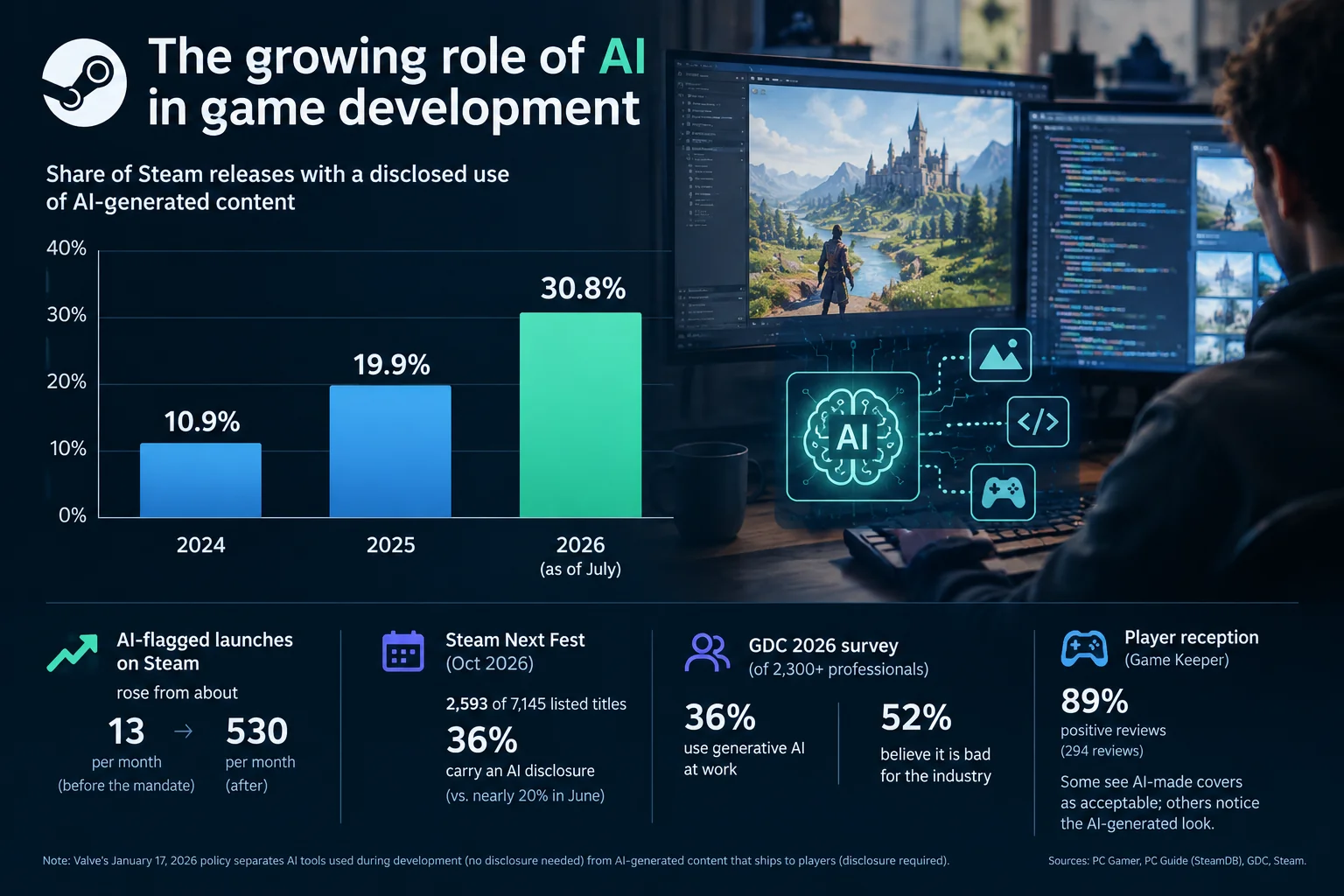
Valve's January 17, 2026 policy rewrite separated AI tools used during development, which need no disclosure, from AI-generated content that ships to players, which does. That distinction matters when reading the numbers below. Code written by an assistant may not appear in a disclosure at all, so the figures likely understate real AI involvement in game-making.
- Sulka Haro, co-founder of the studio behind Pax Dei, analyzed roughly 53,600 Steam releases from mid-2023 to mid-2026. He found AI disclosures on 10.9% of 2024 releases, 19.9% of 2025 releases and 30.8% of 2026 releases as of July, as reported by PC Gamer.
- The same analysis estimates AI-flagged launches rose from about 13 per month before the disclosure mandate to about 530 per month.
- For Steam Next Fest in October 2026, PC Guide reports, citing SteamDB, that 2,593 of 7,145 listed titles, just over 36%, carry an AI disclosure. Next Fest in June was nearly 20%.
- A GDC 2026 State of the Game Industry survey of more than 2,300 respondents reportedly found 36% of professionals use generative AI at work, while 52% believe it is bad for the industry. We saw these figures in secondary reporting, not in the survey itself.
Player reception of Game Keeper has been mixed on the topic of AI, even as overall reviews skew positive. An aggregator snapshot lists 89% positive from 294 reviews. Some Steam reviewers argue that the AI-made covers are acceptable given the budget and timeline, and others have said the AI-generated look is noticeable. On YouTube, one commenter on a recent Tamae video criticized the developer's use of AI. We have not independently verified these community sentiments beyond the posts we reviewed.
Industry context and future outlook
Google is entering a field that already has competitors. TechCrunch notes that Roblox announced its own Build feature in July, which creates games through natural-language prompts. A comparison published by talkesport also lists Meta's Horizon Create and Studio, dated September 2026, alongside Unity Spark. Playground itself is an experiment: it is limited to US adults, generation is token-capped, and the Unity Spark connection is still pending.
Over the next 12 to 24 months, several open questions will shape how far this goes. Disclosure rules may keep evolving as the line between development tools and shipped content stays contested. Haro's projection, as reported, puts the AI-flagged share of Steam releases at roughly half somewhere between 2027 and 2028 if current growth continues. That is an extrapolation, not a measured outcome.
On the engineering side, the documented weak spots are clear. Spatial placement in 3D scenes, tidy engine-native assets such as Blueprints, and bug-free multi-file code all still need significant human oversight. The most capable setups described above pair an AI coding agent with human decisions on design, balance and polish. The Zapaleni author says every mechanic and balance call was his own.
Commercial results for AI-disclosed games remain uncertain, and it is too early to say whether a month-long project like Game Keeper represents a repeatable model or a one-off helped by an existing streaming audience. ROBOTICO will follow Steam's disclosure data, Playground's rollout and the developers' own updates as the picture develops.
Sources:
Game Keeper: Somebody Messed Up My Shop!
- Steam store page and AI content disclosure (VeinStudios)
- Steam Community hub, announcements and player reviews
- Tamae, YouTube video and viewer comments
Google Playground
- Google, Introducing Playground: Create and play custom games (official announcement)
- TechCrunch, Google experiments with an AI-powered gaming platform
- Technology.org, Google Labs launches Playground (Unity Spark plans)
Other tools and workflows
- Google Codelabs, Vibe Code with Gemini in Google AI Studio
- TechRadar, building a Mario-style game with Claude
- TechEBlog, Claude Code endless runner in Unreal Engine 5
- daily.dev, Claude Code in Unreal Engine 5 (walkthrough summary)
Other AI-built games
Market data and policy


