



Harry Kane won the 2026 Men's Ballon d’Or in London on 26 October, finishing ahead of Kylian Mbappé and Lamine Yamal after a season in which he scored 73 goals for club and country across all competitions. His victory provides a timely opportunity to examine a question at the intersection of football and artificial intelligence: could an AI model have predicted the winner using player statistics and match-performance data?
The answer is testable, but it requires more than feeding goals and assists into an algorithm. A credible prediction would need to account for different positions, playing time, the strength of opponents, team achievements and the limitations of the available data. No verified retrospective model has been presented here to demonstrate that AI would have selected Kane as its winner.
What the 2026 Ballon d’Or results tell us
According to UEFA's report on the 2026 awards, Kane scored 73 goals for club and country during the 2025/26 campaign. He also scored 14 goals in the UEFA Champions League as Bayern Munich reached the semi-finals and retained the Bundesliga title as part of a domestic treble.
Kane finished first in the men's Ballon d’Or ranking, followed by Mbappé in second place and Yamal in third. The ceremony also recognised Alexia Putellas as the women's winner, while Yamal received the men's Young Talent of the Year award.
These results offer a useful starting point for a data-driven investigation. Kane's goal output provides a clear performance indicator, but the final award reflects a broader assessment of players rather than a simple competition to score the most goals.
How an AI model could evaluate footballers
A system designed to estimate Ballon d’Or voting outcomes could combine several sources of information into a single analytical framework. Depending on data availability, its inputs could include conventional statistics, advanced performance metrics and player-tracking information collected during matches.
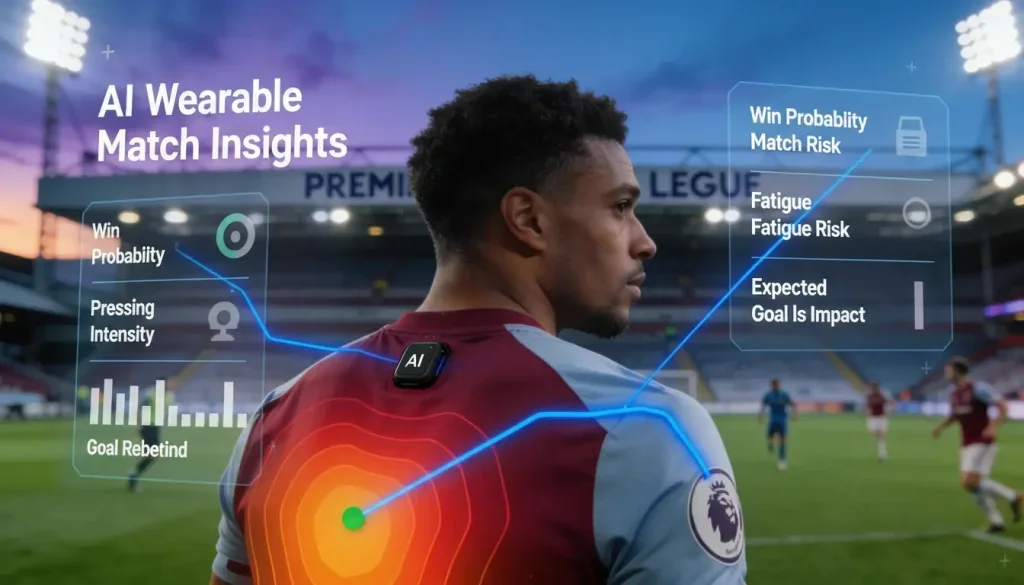
FIFA documents the use of Electronic Performance and Tracking Systems (EPTS), which include camera-based tracking and wearable technologies. These systems can measure player and ball positions, while some configurations incorporate additional devices to monitor physical workload and physiological parameters.
Such data does not automatically produce an award prediction. It provides raw measurements that analysts or machine-learning models could use to evaluate specific aspects of performance.
1. Goals, assists and attacking contribution
For forwards, a model could consider goals, assists, shots, expected goals (xG), expected assists (xA) and involvement in attacking sequences. These metrics help distinguish finishing output from the quality and frequency of opportunities created.
Expected goals estimate the probability that a particular shot will result in a goal based on characteristics such as shot location and angle. Comparing actual goals with expected goals can help analysts assess finishing performance, although it does not fully capture every aspect of a striker's contribution.
Kane's 73-goal campaign would make his scoring output an important input in such a model. However, that figure alone would not establish how an algorithm should rank him against players whose influence comes through other roles.
2. Movement and contribution away from the ball
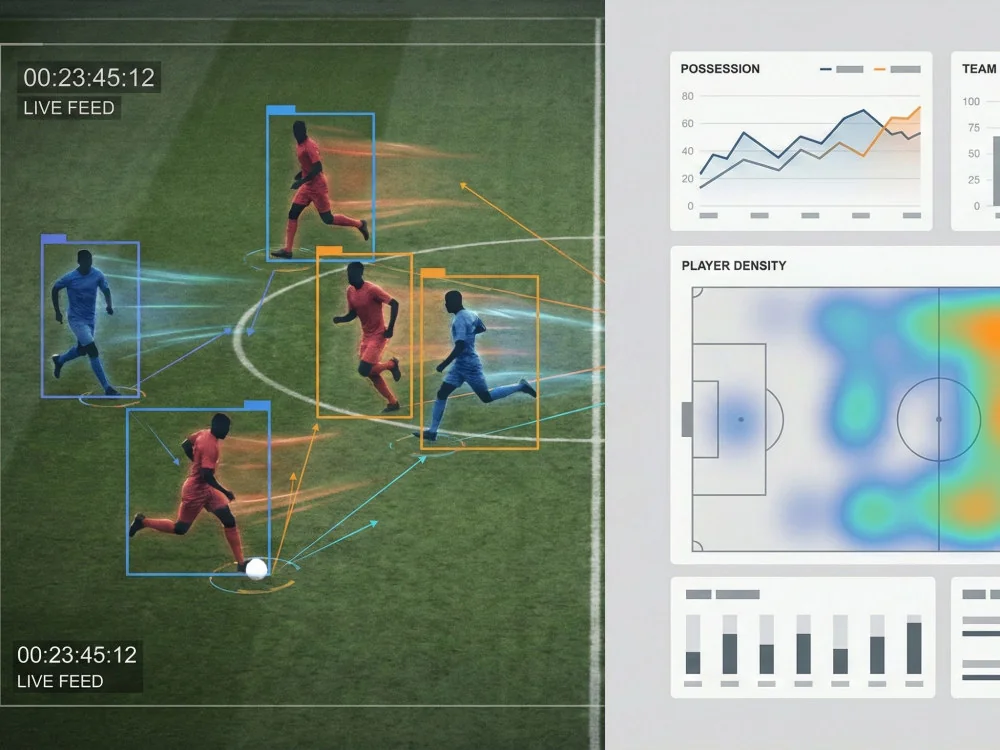
Computer vision and optical tracking could help assess off-ball movement, positioning, pressing and involvement in defensive transitions. A player who creates space for teammates or disrupts opposition attacks may contribute substantially without recording a goal or assist.
FIFA notes that optical tracking systems can collect player and ball position data at high sampling rates. The organisation also identifies limitations, including occasions when players are obscured from cameras and measurements require manual correction.
These constraints matter because an AI model is only as reliable as the measurements and labels used to train and evaluate it. Missing tracking data or inconsistent definitions of performance could influence the resulting rankings.
3. Team success and the quality of opposition
An award-prediction model could also include domestic league results, cup competitions, international tournaments and the strength of the teams faced. These variables would help place individual statistics in context.
However, team success and individual performance are not interchangeable. A player can produce outstanding individual numbers for a team that wins few trophies, while another may benefit from playing in a highly successful side. The model would need to make its treatment of those factors explicit rather than assuming that one automatically determines the other.
What the technology can measure — and what it cannot
Sports analytics already provides tools for collecting and interpreting performance information. The proposed Ballon d’Or application would combine those capabilities into a model designed to estimate award rankings. It should be treated as a possible analytical project, not an established system used by the award organisers.
A practical model could use the following inputs:
- Attacking output: goals, assists, expected goals and expected assists.
- Possession and creativity: chances created, progressive passes and ball progression.
- Defensive contribution: interceptions, recoveries, pressing actions and position-specific defensive metrics.
- Physical activity: distance covered, movement intensity and workload, where reliable tracking data is available.
- Team and competition context: match results, competition strength and minutes played.
The exact variables and their weights would need to be justified and tested. Some statistics are easier to compare across leagues and positions than others, while differences in data collection can make direct comparisons unreliable.
AI could identify patterns in large datasets, estimate relationships between performance indicators and historical voting results, and generate a ranking. It could not establish an objective definition of the world's best player simply by processing more numbers.
How researchers could test whether AI would have picked Kane
A meaningful experiment would start with historical Ballon d’Or results and player-performance data from the corresponding seasons. Researchers could train a model on earlier editions, then test it against seasons excluded from training to determine how accurately it predicts the eventual rankings.
For the 2026 award, the model would need to be developed without using the final voting results as inputs. Its predictions could then be compared with the published rankings to measure how well the system performed.
A rigorous evaluation could include several tests:
- Predict the winner: determine whether the model ranks the eventual winner first.
- Compare the top ten: measure how closely its shortlist matches the official ranking.
- Test different positions: examine whether defenders, midfielders and forwards are evaluated fairly.
- Check across seasons: establish whether the results remain reliable beyond the data used to train the model.
- Compare against simple baselines: test whether the model improves on straightforward rankings based on goals, assists or other basic statistics.
Researchers should also distinguish between predicting the voting outcome and evaluating footballing performance. A model trained to reproduce historical votes would learn patterns in voter preferences, including any biases reflected in those decisions. It would not necessarily discover which player performed best by an independent sporting standard.
No prediction accuracy, performance benchmark or AI-generated 2026 ranking can responsibly be reported without actually building and testing the model against suitable data.
Why human judgment would still matter
The Ballon d’Or is decided through a voting process rather than a computer-generated performance score. The Premier League's published account of the 2026 results states that the shortlist was compiled by journalists from France Football and L’Équipe, with voters submitting ranked selections that earned points according to their positions.
This distinction creates two different problems for AI. One is estimating how players performed during a season. The other is predicting how voters will interpret those performances when making their selections.
Those questions overlap, but they are not identical. Voters may consider a player's influence on decisive matches, consistency over a season, performances for club and country, and achievements that are difficult to reduce to a single metric.
AI models also inherit limitations from their training data. If some competitions have more detailed tracking coverage than others, players from well-documented leagues may receive more comprehensive evaluations. Position-specific metrics and contextual adjustments can reduce certain problems, but they do not eliminate them.
For that reason, an AI-generated ranking would be best presented as a transparent analytical comparison alongside the official results, rather than as a replacement for the award's voting process.
The next step for AI-powered football analysis
Over the next 12 to 24 months, the main opportunity is not necessarily to automate individual football awards. It is to improve the quality, consistency and interpretability of player-performance analysis.
More comprehensive tracking datasets, stronger contextual models and better methods for explaining algorithmic rankings could make comparisons between players more useful. Researchers would still need to address data access, differences between competitions, model bias and the difficulty of translating complex performances into a single score.
A credible Ballon d’Or prediction system would also need to publish its methodology, disclose which data was available and demonstrate its accuracy on seasons it had not seen before. Without those safeguards, a ranking might look scientific while simply reflecting arbitrary choices about which statistics matter most.
Kane's 2026 victory offers a concrete case study for testing these ideas. His 73 goals provide a strong starting point for evaluating attacking performance, while the final rankings provide an outcome against which a model could be assessed. Whether an AI system would have predicted him correctly remains an open question until that analysis is carried out.
Sources: This article is based on reporting and technical documentation from UEFA's 2026 men's Ballon d’Or results, the Premier League's report on the award and voting process, and FIFA's documentation on Electronic Performance and Tracking Systems.
```


