



Polish-American robotics company Clone Robotics is developing humanoid androids that move using artificial muscles rather than relying exclusively on conventional electric motors. Its technology combines a human-inspired skeletal structure with proprietary Myofiber actuators, aiming to reproduce the mechanics of biological movement. The company's official website presents Clone Alpha as a bipedal android designed for domestic assistance, while its earlier Protoclone prototype demonstrated the company's distinctive approach to musculoskeletal robotics.
The company has attracted attention for building machines that resemble the human body not just in appearance, but also in their underlying mechanical architecture. Rather than treating a humanoid as a collection of rigid links driven by electric motors, Clone is attempting to reproduce the relationship between muscles, tendons and bones in an engineered system.
That approach places Clone Robotics in a distinctive part of the humanoid robotics market. However, realistic anatomy and promising actuator specifications are not the same as demonstrated general-purpose intelligence or reliable household performance. The key question is whether this biological inspiration can translate into robots that perform useful tasks safely, consistently and economically.

Technical Architecture: How Clone's Artificial Muscles Work
At the centre of Clone Robotics' approach is Myofiber, the company's proprietary artificial-muscle technology. According to its official product documentation, these actuators are designed to move a skeleton by connecting muscle-like units to anatomically appropriate attachment points on the bones.
This configuration differs from the architecture used by many conventional humanoid robots. Traditional systems typically employ electric motors, gearboxes and mechanical linkages to generate joint movement. Clone instead aims to recreate muscle-and-tendon mechanics, potentially allowing its robots to reproduce more biologically inspired patterns of motion.
Artificial muscles and mechanical movement
Human muscles generate movement by contracting and transmitting force through tendons to bones. Clone's Myofiber system seeks to reproduce this principle using engineered musculotendon units. The company says these units are manufactured as integrated structures intended to reduce tendon-related failures.
Clone's published specifications describe a target combination of response time below 50 milliseconds, unloaded contraction exceeding 30% and contraction force of at least one kilogram for an individual artificial muscle fibre weighing three grams. These are manufacturer-provided technical claims and should not be interpreted as independently verified performance benchmarks for a complete android.
For a full humanoid, the engineering challenge extends well beyond the performance of an individual actuator. Hundreds of moving components must operate together while maintaining balance, controlling forces, responding to unexpected contact and avoiding damage to the robot or its surroundings.
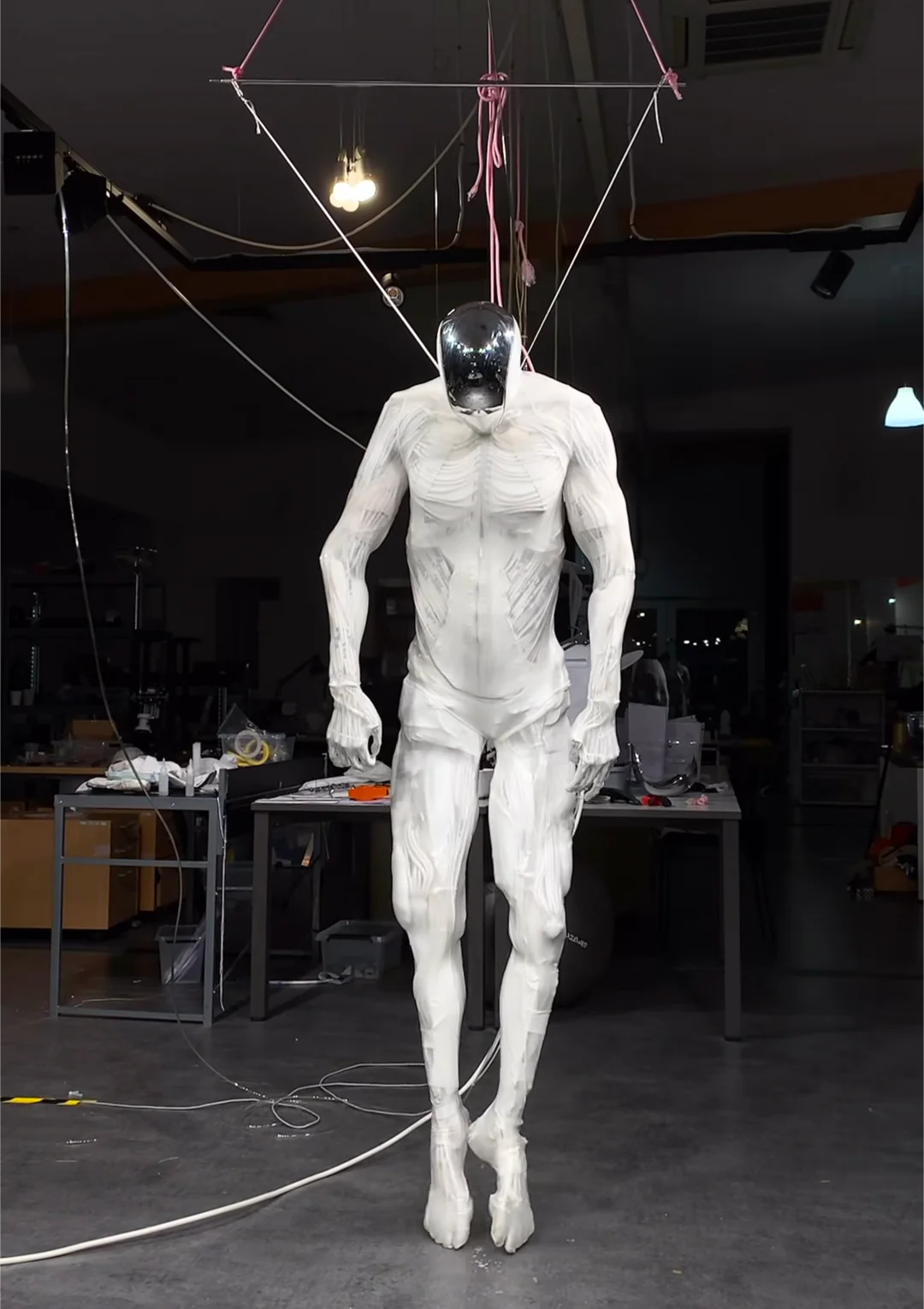
A human-inspired skeleton and soft exterior
The company's designs emphasise a musculoskeletal structure intended to support lifelike movement. Clone also describes soft-body elements as part of its approach to physical interaction.
A compliant exterior and muscle-like actuators could offer advantages in applications where robots must handle everyday objects or operate close to people. However, softness alone does not establish that a robot is safe for unsupervised domestic use. That requires testing of collision forces, pinch points, mechanical failures, emergency stopping and behaviour around unpredictable obstacles.
Water, electricity and onboard computing
Clone's official Android page describes its artificial-muscle system as operating with water and electricity. The company also advertises GPU computing at the edge, suggesting an architecture intended to support onboard robotic processing.
The public product information does not provide enough detail to establish the complete power system, hydraulic operating pressures, compute hardware, energy consumption or thermal characteristics of the finished android. Those specifications matter because an actuator that performs well in isolation may behave differently when integrated into a full-body machine with numerous simultaneously controlled joints.
The same distinction applies to artificial intelligence. An onboard GPU provides computing resources, but it does not by itself establish which AI models are running, how the robot interprets its environment or whether it can reliably complete unfamiliar tasks without human assistance.
Clone Alpha and Protoclone: From Prototype to Intended Product
Clone Robotics has presented several stages of its development, including its musculoskeletal prototypes and the proposed Clone Alpha product.
Protoclone attracted attention through footage showing a highly anatomical android suspended in a workshop environment. The prototype illustrated the company's interest in reproducing biological structures and movement mechanisms. However, footage of a suspended machine is not equivalent to evidence of autonomous walking, independent balance or successful completion of everyday tasks.
Clone Alpha is the company's proposed bipedal android companion. Its official website describes an intended domestic role and advertises a limited Alpha Edition of 279 units. The product page also describes a Telekinesis training platform intended to let users teach the robot additional skills.
The company's advertised use cases include remembering a home's layout, retrieving objects, preparing simple food, handling laundry, vacuuming and loading a dishwasher. These represent the intended application areas described in the product materials, not a verified list of tasks that have all been demonstrated successfully under independent testing.
The distinction is important. A robot may perform a particular manipulation sequence in a controlled demonstration but struggle with the same task when objects move, lighting changes, furniture is rearranged or an unexpected obstacle appears.
Empirical Data and Real-World Impact
Clone's publicly available product pages provide information about its design philosophy and selected actuator specifications, but they do not establish a comprehensive, independently validated performance profile for its complete humanoid systems.
The available manufacturer documentation does not provide a sufficiently detailed set of independently verified benchmarks for household task success rates, autonomous operating time, battery or power consumption, lifting capacity, walking endurance, maintenance intervals or total operating costs.
That leaves several important questions unanswered for potential customers, developers and industrial adopters.
- Mobility: How reliably can the android walk, turn, recover from disturbances and navigate cluttered indoor environments?
- Manipulation: Can its artificial muscles and articulated hands handle fragile, irregular or slippery objects consistently?
- Autonomy: Which tasks can it complete independently, and which require remote operation, demonstrations or human intervention?
- Reliability: How long can the integrated system operate before requiring maintenance or replacement of mechanical components?
- Economics: What will the complete system cost to manufacture, purchase, operate and service?
These measurements will be essential for determining whether Clone's architecture can compete with more established motor-driven humanoid platforms in practical applications.
Why artificial-muscle robotics matters
Artificial muscles could offer a different set of trade-offs from conventional robotic actuators. Biological movement relies on distributed force generation, compliant structures and coordinated muscle activity. Reproducing some of those characteristics mechanically could help robots manipulate objects in more human-compatible ways.
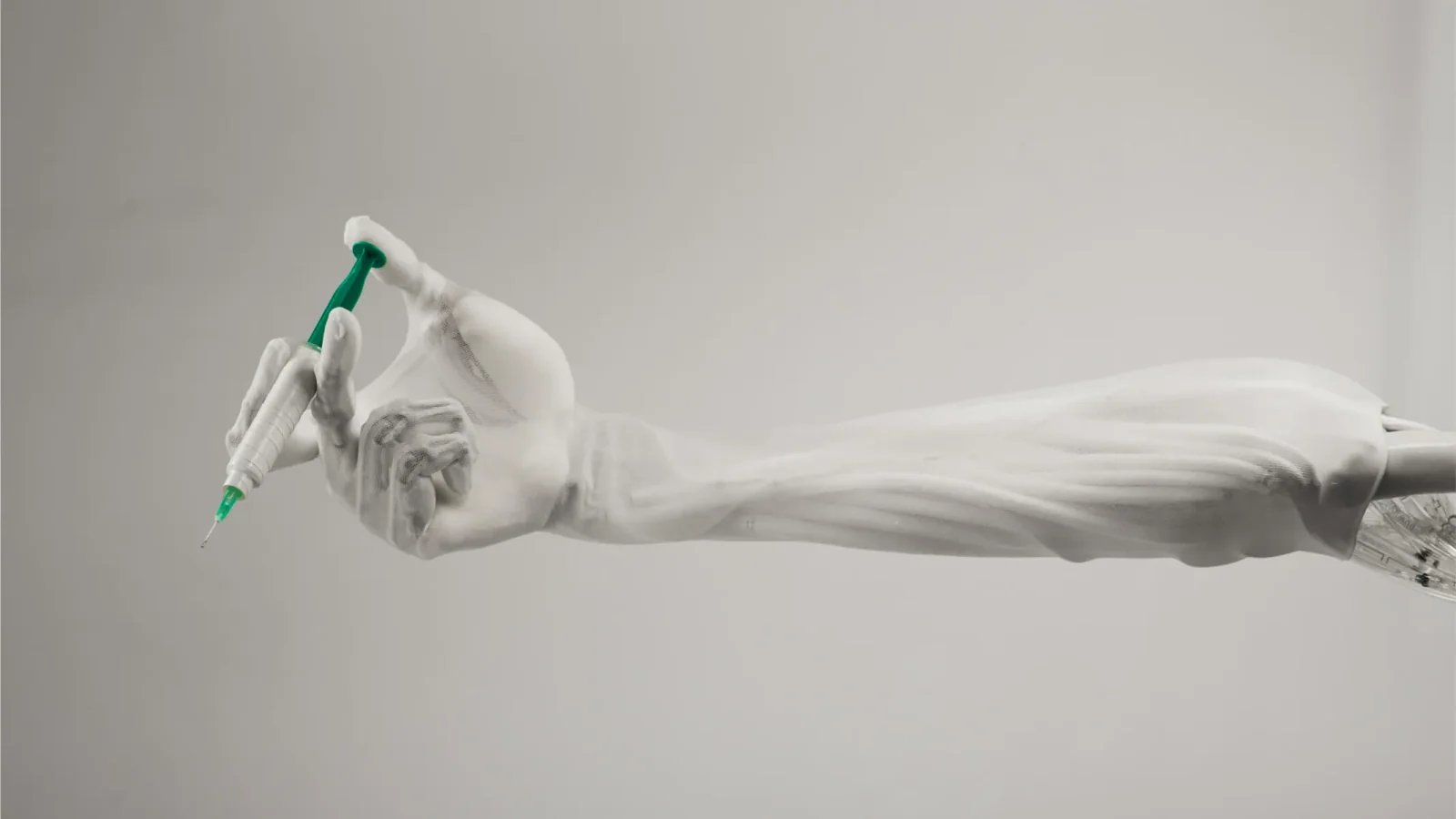
Human-shaped hands are particularly relevant because homes, workshops and workplaces have been designed around human anatomy. A robot capable of using existing handles, tools, switches and kitchen equipment could require fewer changes to the surrounding environment.
Clone's separate robotic-hand programme reflects this priority. The company's documentation describes articulated thumbs, multiple finger and wrist movements, and artificial-muscle-driven manipulation. These features are relevant to dexterity, although product descriptions alone cannot establish performance across the full range of human manual tasks.
There is also a potential research benefit. A musculoskeletal platform could provide a test bed for investigating the relationship between actuator mechanics, tactile feedback, movement control and robot learning. The extent of that benefit will depend on the quality of the hardware, available sensor data and the methods used to train and evaluate the system.
AI and Robot Learning: The Missing Pieces
Building a convincing physical body is only one part of creating a useful humanoid. A practical domestic robot must also recognise objects, understand spatial relationships, plan movements, coordinate its joints and recover when an action fails.
Clone advertises natural-language interaction and onboard computing for its Android platform. However, the publicly available product information does not identify a complete, independently evaluated AI architecture or provide comparative benchmarks demonstrating general-purpose household autonomy.
Natural-language conversation and physical task execution are separate capabilities. A robot may understand a spoken request yet still lack the perception, planning and motor-control systems needed to fulfil it safely.
Training presents another challenge. Human demonstrations can provide useful examples of how to perform tasks, but a system must generalise beyond the exact situations shown during training. It must also recognise when it lacks the information or physical capability to proceed safely.
For Clone, the practical test will be whether its proposed training platform can turn demonstrations into repeatable skills across different homes and operating conditions. Publicly available materials do not yet establish that level of generalisation.
Industry Context: An Alternative to Conventional Humanoids
The humanoid robotics sector includes several competing approaches to actuation, perception and control. Many developers focus on electric motors and established mechanical transmission systems, while Clone is pursuing a more explicitly biomimetic design.
Neither approach automatically guarantees superior results. Electric actuators benefit from established engineering practices and a broad industrial supply chain. Artificial-muscle systems may offer different mechanical characteristics, but they introduce their own challenges involving pressure control, fluid management, durability, manufacturing consistency and coordinated actuation.
For the technology to become commercially competitive, Clone will need to demonstrate that the complete system can deliver useful performance outside controlled development environments.
That includes proving that the robot can operate for extended periods, recover from errors, maintain predictable behaviour and complete tasks at a cost that makes sense for its intended customers.
What to Watch Over the Next 12 to 24 Months
The next meaningful milestones for Clone Robotics will be measurable demonstrations of integrated performance rather than visual realism alone.
- Independent mobility tests: Reproducible demonstrations of walking, turning, balance recovery and navigation without continuous physical support.
- Task-level benchmarks: Published success rates for representative domestic tasks, including details of environmental conditions and human intervention.
- Hardware reliability: Evidence of actuator endurance, maintenance requirements and operating performance over repeated use.
- Transparent product specifications: Clear information about the complete robot's dimensions, mass, operating requirements, safety features and computing hardware.
- Commercial readiness: Confirmed delivery schedules, customer access, support arrangements and evidence that advertised functions are available in the delivered product.
These are evaluation priorities, not confirmed company commitments or guaranteed milestones. Actual progress will depend on engineering results, manufacturing capacity and the readiness of the integrated hardware and software.
Safety will be particularly important if the company intends to place its androids in private homes. A useful domestic robot must operate around people, pets, fragile objects and changing environments. That requires dependable perception, controlled physical interaction, robust failure handling and clear limits on autonomous behaviour.
The Bottom Line
Clone Robotics is pursuing a distinctive direction in humanoid development by combining artificial muscles, a human-inspired skeleton and a proposed natural-language interface. Its Myofiber technology and musculoskeletal architecture make the company an interesting participant in the effort to build more human-compatible robotic systems.
Its potential should nevertheless be assessed against demonstrated performance rather than appearance or ambitious product descriptions. Publicly available specifications provide a starting point for understanding the technology, but important questions about full-body mobility, autonomous manipulation, durability, safety and commercial operation remain open.
If Clone can demonstrate reliable performance across these areas, its approach could become a useful alternative to conventional humanoid architectures. For now, the most important measure of progress will be evidence that its artificial-muscle systems can move beyond compelling prototypes and deliver repeatable results in real-world environments.
Sources: Clone Robotics — Official Android Product Page; Clone Robotics — Clone Alpha Product and Pre-Order Information; Clone Robotics — Official Robotic Hand Documentation; Clone Robotics — Public GitHub Organisation and Software Repositories.


