

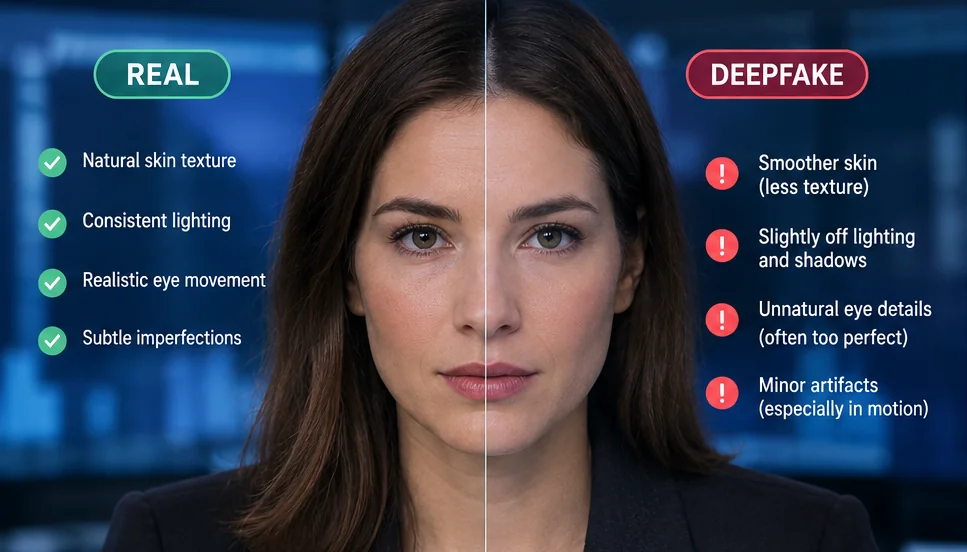
Seeing is no longer a reliable shortcut to believing. In October 2026, the Dubai Police Future Foresight Centre published a study warning that realistic AI-generated video, images and voices could complicate digital security, undermine trust in online information and make it harder to verify evidence used in investigations. The study also points out an awkward side effect: even genuine recordings may now be questioned, simply because people know how easy fakes have become.
That second problem matters as much as the first. Researchers describe it as the "liar's dividend": when convincing fakes are everywhere, someone caught on camera can dismiss real footage as synthetic. The question for 2026 is therefore two-sided. Can we spot fake video, and can we still prove that real video is real?
Why the old tells no longer work
Early deepfake detectors relied on visible flaws: blending boundaries around faces, odd frequency patterns and flicker between frames. A 2026 review by Shaina Raza, Jessee Ho, Mahveen Raza and Christos Emmanouilidis, listed in the Social Science Research Council's MediaWell database, argues that modern diffusion transformers generate minute-long, high-resolution clips with coherent motion and complex scenes. In the authors' account, this has systematically erased many of the artifacts early detectors depended on.
The review organizes detection around five forensic assumptions: physiological integrity, temporal coherence, geometric consistency, semantic consistency and provenance signals. It traces how each has weakened across three generations of technology: GANs, diffusion models and video foundation models. It also compares five detection approaches (spatial-frequency, temporal, multimodal, vision-language and agentic) and audits thirteen benchmarks. According to the authors, trustworthiness and deployment readiness remain systematically under-measured in those benchmarks.
Lab accuracy versus the real world
Published detectors can look strong on paper. One academic model, GenConViT, reports an average accuracy of 95.8% and an AUC of 99.3% across the datasets it was tested on. Its authors also acknowledge a wider limitation: detection methods often fail to generalize to more diverse videos, such as those with different facial poses, lighting angles and movements. Strong benchmark scores do not guarantee performance on unfamiliar generators or messy real-world footage.
What humans can (and can't) catch
People are not a dependable backstop either. According to Veriff's Deepfakes Report 2026, as summarized by Enterprise AM, US respondents who judged 16 visuals (eight real, eight AI-generated) averaged a detection score of 0.07 on a scale from -1 to 1, where 0 equals pure chance. In one side-by-side test of video, 70% of respondents misidentified the AI-generated clip as real. The same report found that 79% of US respondents were concerned about deepfake-driven personal fraud, the top concern in its survey.
Real-time impersonation is part of the picture. Enterprise AM, citing reporting from 404 Media, notes that a Chinese-developed tool called Haotian AI is marketed to scammers and can be used on WhatsApp, Zoom and Teams. Separately, the 2026 International AI Safety Report, as cited by The Guardian, notes that AI-generated content has become harder to distinguish from real media than it was a year earlier.
- The World Economic Forum's Global Risks Report 2026 ranks misinformation and disinformation as the second most significant global risk over the next two years, according to the Dubai study coverage.
- One of the first high-profile wartime deepfakes was a fabricated video of Ukrainian President Volodymyr Zelenskyy appearing to urge troops to surrender, which circulated after Russia's 2022 invasion, according to Northwestern University's Buffett Institute.
The other approach: prove origin instead of detecting fakes
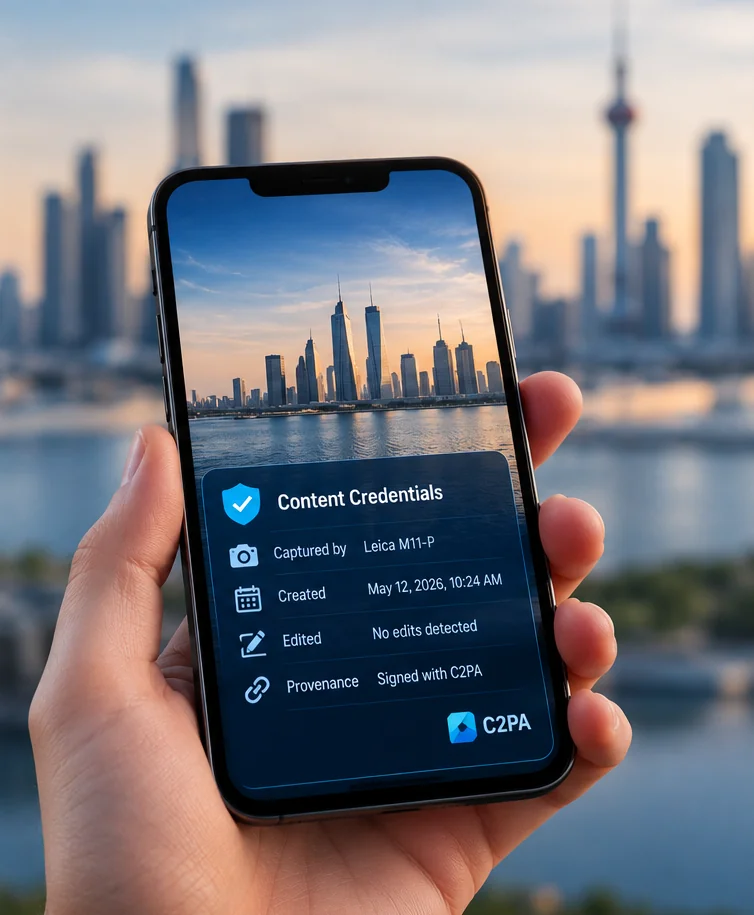
Because detection is an arms race, much of the industry is shifting toward provenance. The Coalition for Content Provenance and Authenticity (C2PA), founded in 2021, defines an open standard that attaches cryptographically signed metadata to media. This metadata is shown to users as "Content Credentials". Instead of asking whether a clip looks fake, a viewer can check who captured or generated it and what edits were made along the way. Industry summaries put C2PA membership above 6,000 members and affiliates as of January 2026, with Adobe, Microsoft, Google and OpenAI among the supporters.
Where adoption stands
- Cameras: Leica shipped the first cameras with built-in Content Credentials (M11-P, later SL3-S). Nikon and Sony are also described as participating, though coverage varies by model.
- Phones: Google has brought C2PA-based "Trusted Images" to Pixel and Android, according to a Content Credentials explainer. Most other smartphone cameras do not yet sign natively, which means most user-generated video remains unsigned.
- AI tools: Adobe Firefly, Google Imagen and OpenAI products are reported to embed credentials that label content as AI-generated. Midjourney is reported not to do so as of mid-2026.
- Platforms: LinkedIn shows a "CR" icon, and TikTok labels videos whose manifest declares AI generation. However, a platform can support credentials and still strip them in practice.
Several of these adoption details come from industry explainers rather than official vendor documentation, so readers should verify specifics for any product they rely on.
The remaining gaps
Provenance has its own weak points. A signature can prove where a file came from, but unsigned footage proves nothing either way, and most everyday video is unsigned. Industry analyses also flag a human factor: user engagement with Content Credentials is low, and some visitors at CES 2026 reportedly misread the icon as marking AI-generated content rather than authentic content with a provenance record.
Enterprise AM's explainer notes that consumer detection tools, including McAfee's Deepfake Detector and Digimarc's C2PA validator extension, can flag suspicious content, but none are foolproof.
What to watch over the next 12 to 24 months
- Native signing on phones. Provenance only helps ordinary people if the devices they actually use sign content at capture.
- Platform behavior. Credentials must survive uploads, compression and resharing, and be displayed clearly.
- Better benchmarks. Researchers call for evaluation that measures generalization, robustness, trustworthiness and deployment readiness, not just accuracy on familiar datasets.
- Organizational process. Security guidance increasingly treats unsolicited video, especially anything requesting money or credentials, as a risk signal to verify through a second channel.
The Dubai Police study frames the broader goal as more than catching fakes. It aims to preserve trust in genuine information as AI changes how media is created and shared. For now, no single tool settles the question. Video can still be evidence, but increasingly it needs context, a verifiable source and a second check before anyone acts on it.
Sources referenced: