

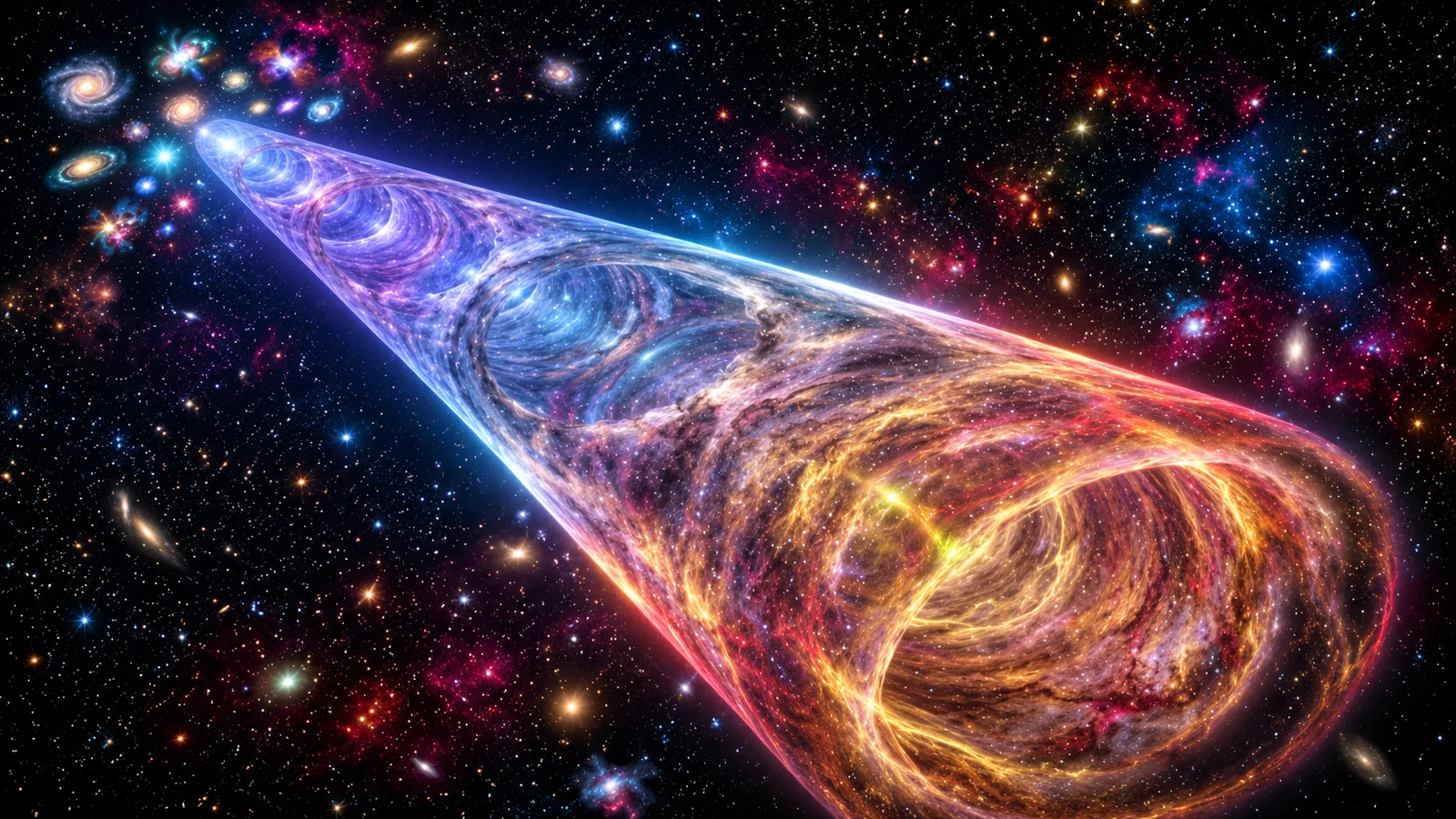
Those eye-catching social media posts about an "interstellar tunnel connecting our solar system to other stars" trace back to genuine, peer-reviewed science. In a study published in Astronomy & Astrophysics on 29 October 2024, a team led by the Max Planck Institute for Extraterrestrial Physics (MPE) used data from the eROSITA X-ray space telescope to build a new 3D model of the Local Hot Bubble, the thin, million-degree gas that surrounds the solar system. Hidden in that model was a tunnel-like channel of hot plasma pointing toward the constellation Centaurus.
The catch, and it is an important one: the "tunnel" is not a wormhole or a shortcut through spacetime. It describes a channel of hot, low-density plasma running through the surrounding cooler interstellar medium. The researchers say it may connect our local bubble with a neighbouring superbubble, a larger cavity carved out by ancient stellar explosions.
How the discovery was made
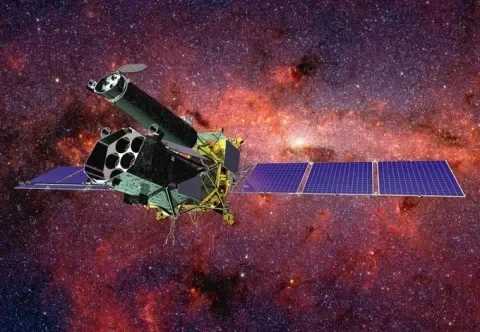
The work is the first in a series analysing the diffuse soft X-ray background, led by MPE PhD student Michael Yeung. The instrument at the centre of it, eROSITA, is an X-ray telescope flying aboard the SRG observatory, and it has a decisive advantage: according to the MPE release, it is the first X-ray observatory to observe the sky from an orbit completely outside Earth's geocorona, avoiding contamination from the halo of gas around our planet. The first eROSITA All-Sky Survey (eRASS1) also happened to coincide with a solar minimum, which sharply reduced interference from solar wind charge exchange, an X-ray-emitting process discovered in 1996 that had muddied local-bubble measurements for decades.
In other words, the eRASS1 data released to the public this year provides the cleanest view of the X-ray sky to date, making it the perfect instrument for studying the LHB.
That is Yeung, the lead author of the study, referring to the 2024 public release of the survey data. His team divided the western Galactic hemisphere into about 2,000 regions and extracted a spectrum from each one, filling in the lowest energies below 0.2 keV with archival data from ROSAT, eROSITA's MPE-built predecessor. Fitting all of those spectra is what produced both the temperature map and the 3D structure of the bubble.
Hotter south, cooler north
The numbers describe a bubble that is anything but uniform. In the high-latitude regions of the surveyed western Galactic hemisphere, more than 30 degrees above or below the Galactic plane, the southern half of the Local Hot Bubble is hotter: 0.12 keV, or about 1.4 million kelvin, versus 0.10 keV, about 1.2 million kelvin, in the north. The paper reports 121.8 ± 0.6 eV versus 100.8 ± 0.5 eV for those zones. The researchers said the pattern could be explained by the latest numerical simulations of the bubble being expanded and reheated by supernova explosions over the last few million years.
The 3D shape is not photographed but inferred: the team assumed a relatively uniform gas density, calibrated against sight lines to giant molecular clouds on the bubble's surface, and converted the measured emission intensity in each direction into a distance to the bubble's edge. That model shows the bubble stretching further toward the Galactic poles, where the hot gas meets the least resistance, away from the crowded Galactic disc. The paper also reports that the bubble's average thermal pressure divided by Boltzmann's constant is about 10,100 K cm-3, with an uncertainty of roughly +1,200 to -1,500, lower than that of typical supernova remnants and wind-blown bubbles, which the authors suggest could indicate that the bubble is open at high Galactic latitudes.
Then there is the tunnel. In the paper's words, the team "found tunnels of dust cavities filled with hot plasma, potentially forming a wider network of hot interstellar medium."
What we didn't know was the existence of an interstellar tunnel towards Centaurus, which carves a gap in the cooler interstellar medium (ISM). This region stands out in stark relief thanks to the much-improved sensitivity of eROSITA and a vastly different surveying strategy compared to ROSAT.
That is Michael Freyberg, a co-author who was part of the pioneering ROSAT-era work three decades ago. The team's interactive 3D model of the solar neighbourhood, which combines the bubble with known supernova remnants, superbubbles and 3D dust maps, also contains the previously known Canis Majoris tunnel, a similar channel on the Galactic disc that may connect our bubble to the Gum Nebula or another superbubble called GSH238+00+09.
Where the Sun sits in all this
One more surprise from the 3D model: the timing. The Sun, it turns out, is a recent arrival.
Another interesting fact is that the Sun must have entered the LHB a few million years ago, a short time compared to the age of the Sun.
"It is purely coincidental that the Sun seems to occupy a relatively central position in the LHB as we continuously move through the Milky Way," added co-author Gabriele Ponti. In other words, we are just passing through the middle of a cosmic cavity, and by the standards of the Sun's lifetime, we only recently got here.
What the study established, and what it did not
The authors themselves are careful about the limits of the finding. The Centaurus tunnel may be a local example of a wider network of hot gas sustained by stellar feedback across the Galaxy, an idea popular since the 1970s but still difficult to prove. The connection to a neighbouring superbubble is described as potential, not established, the 3D model rests on a constant-density assumption, and this first paper covers only the western Galactic hemisphere.
Whether the Centaurus channel truly links up with a neighbouring superbubble, and whether similar tunnels riddle the Galaxy, are exactly the questions the study leaves open. The good news is that the instrument that made the discovery was built for repeated all-sky scans, so the data to answer them is still coming in.
This article is based on the press release from the Max Planck Institute for Extraterrestrial Physics, the study published in Astronomy & Astrophysics (A&A 690, A399, 2024), and its arXiv preprint.