
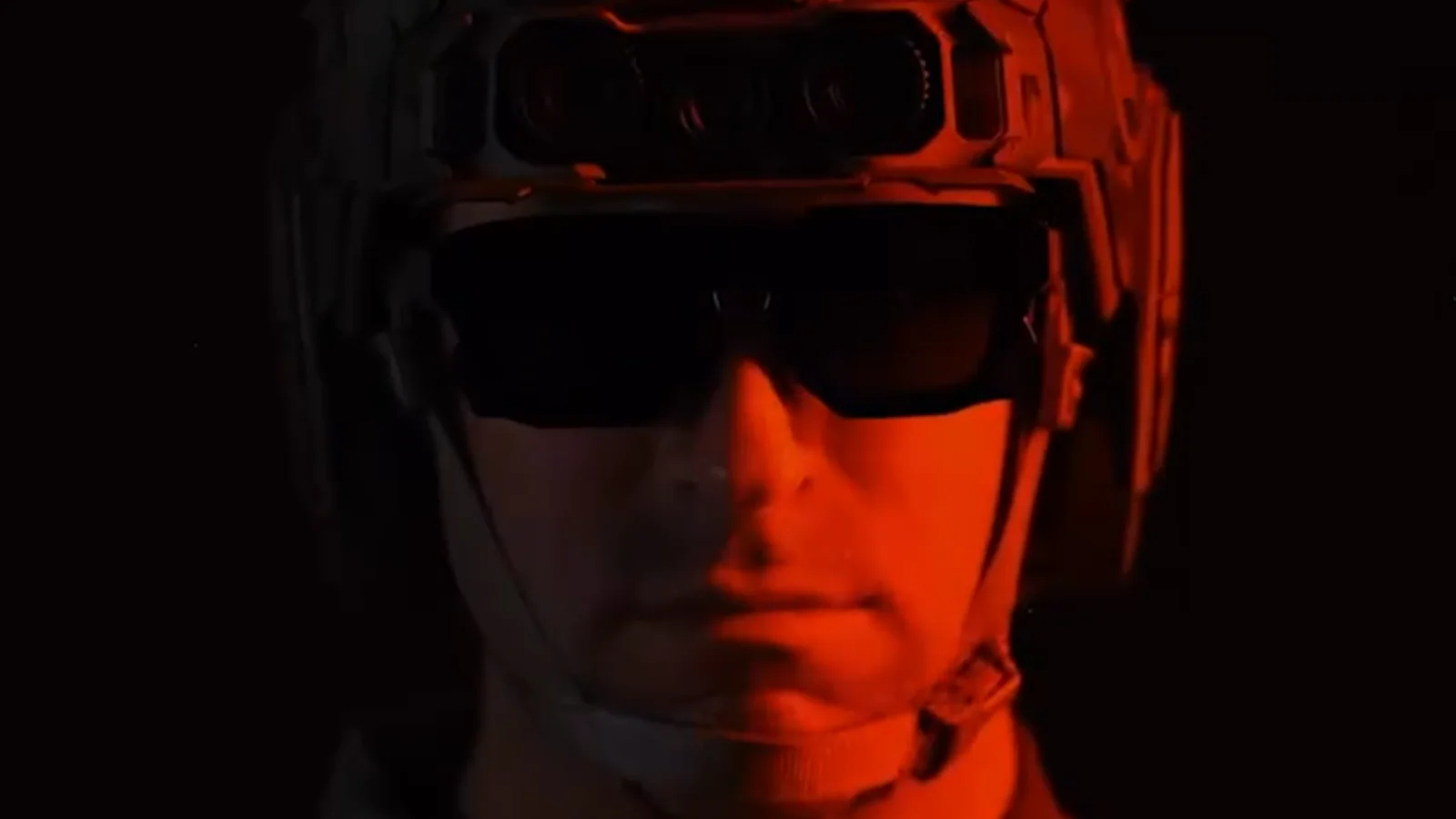
Anduril Industries unveiled EagleEye on October 13, 2025, at the Association of the United States Army annual meeting in Washington, D.C. The system is a modular, AI-powered family of mixed-reality head-mounted displays and helmets designed to place real-time battlefield information, mission command tools, and sensor feeds directly into a soldier’s field of view.
EagleEye builds on Anduril’s work delivering the U.S. Army’s Soldier Borne Mission Command (SBMC) and Soldier Borne Mission Command–Architecture (SBMC-A) programs. These efforts form a mixed-reality platform intended to give soldiers integrated situational awareness, mission planning, and training tools. The company positions the system as a step toward treating every warfighter as a connected node on the battlefield while reducing weight and cognitive load compared with earlier approaches.
Technical Architecture and Specifications
EagleEye is built as a helmet-native platform rather than a detachable add-on. It pairs Anduril’s Lattice software with heads-up display hardware and integrated sensors. Lattice fuses data from distributed sensors across the battlespace into a unified operational picture and highlights salient threats.
Core capabilities include:
- Mission planning via a high-resolution collaborative 3D sand table that supports rehearsal, coordination, and live video feeds pinned to terrain
- Enhanced perception through optically transparent daytime HUDs and digital night-vision HUDs that overlay digital information on the real world
- Blue force tracking that shows teammates’ precise locations in three-dimensional space rather than simple map dots
- Edge connectivity that lets operators task unmanned aerial systems, call for fires, and control robotic teammates while remaining mobile
- Lattice mesh networking designed for denied, degraded, intermittent, or limited communications environments
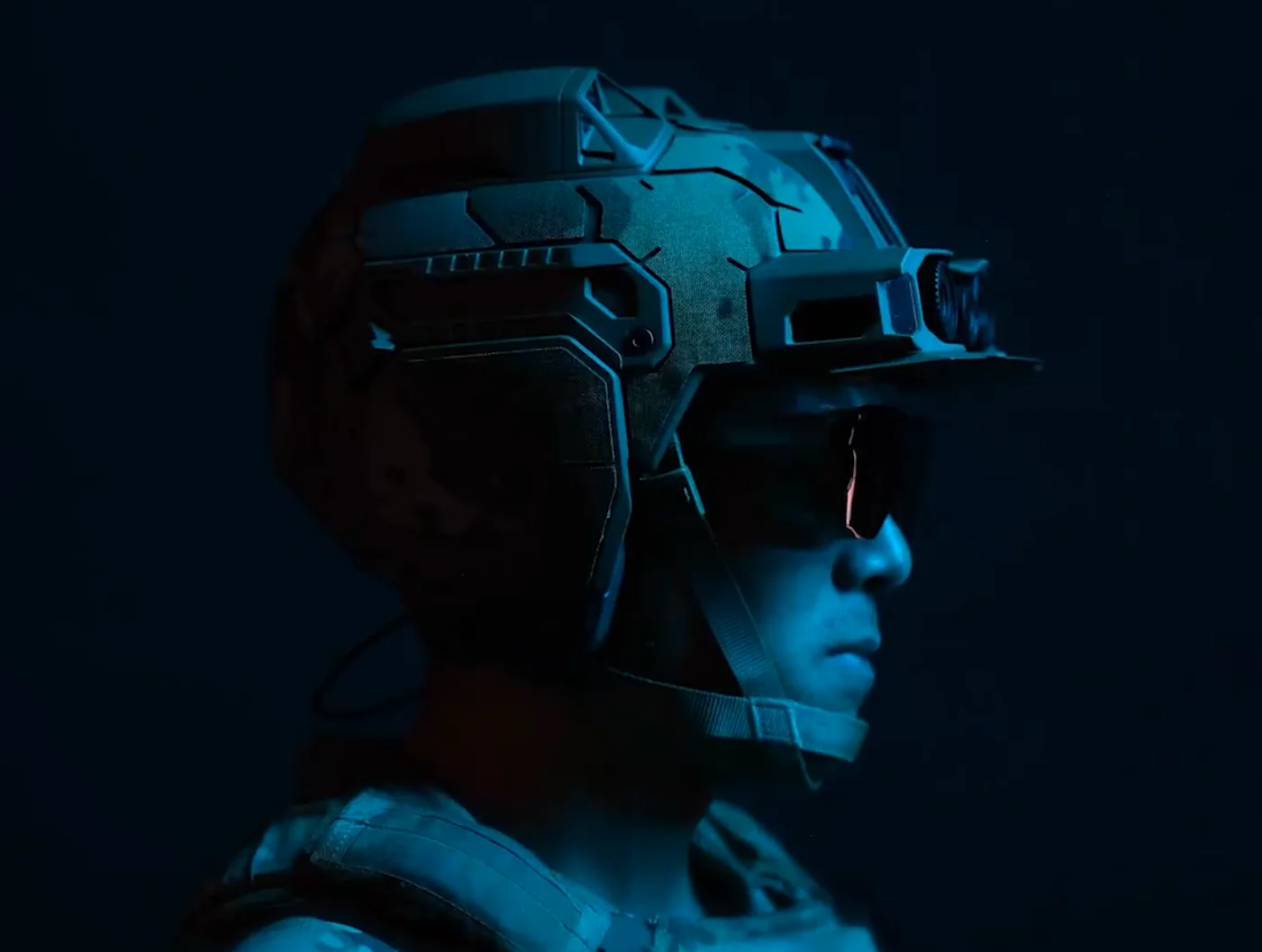
Hardware configurations include helmet, visor, and glasses variants. One primary variant for the Army’s SBMC program uses lightweight ballistic augmented-reality glasses developed with Oakley Standard Issue; compute and battery elements are distributed on the helmet to reduce front-heavy weight. Another variant is a full-face ballistic shell with a night-focused mixed-reality reprojection system that is not optically transparent and aims for rifle- and fragmentation-rated protection across the visor.
Additional features listed by Anduril include rear- and flank-view sensors, spatial audio, radio-frequency detection for threat alerts, beyond-full-cut ballistic protection, and blast-wave mitigation in an ultralightweight shell. Partners supplying technology include Meta for display and waveguide elements, Qualcomm for compute, Oakley for eyewear, and Gentex for ballistic helmet components.
Program Status and Real-World Context
In September 2025 the U.S. Army awarded Anduril a $159 million contract to prototype advanced helmet-mounted night-vision and mixed-reality systems under the SBMC program, the follow-on effort after the service transitioned the earlier Integrated Visual Augmentation System work. Anduril is already delivering software architecture under SBMC-A.
Company founder Palmer Luckey stated that Anduril expected to deliver roughly 100 units of early EagleEye systems to selected Army personnel in the second quarter of 2026. As of later reporting, phase-one systems have been provided for testing and approximately 170 redesigned phase-two prototypes are planned, with further testing expected to begin in early 2027. Anduril has indicated it aims for unit costs roughly half of the $50,000 to $80,000 range previously associated with the earlier program.
Luckey described the system in official remarks: “We don’t want to give service members a new tool—we’re giving them a new teammate. The idea of an AI partner embedded in your display has been imagined for decades. EagleEye is the first time it’s real.”
We don’t want to give service members a new tool—we’re giving them a new teammate. The idea of an AI partner embedded in your display has been imagined for decades. EagleEye is the first time it’s real.
Industry Context and Outlook
EagleEye arrives after years of challenges with prior mixed-reality soldier systems, including issues of weight, balance, latency, and cybersickness. Anduril emphasizes modularity, with high parts commonality across variants and software-first architecture intended to allow rapid updates. Remaining work over the next 12 to 24 months centers on field testing of prototypes, refinement of helmet ergonomics for mixed-reality stability, integration with existing soldier equipment, and evaluation of performance under realistic operational conditions.
The system is not yet a production item. Outcomes of Army testing will determine any larger-scale procurement decisions. Anduril continues to develop additional variants and has indicated plans to expand commercial technology partnerships.
Sources: