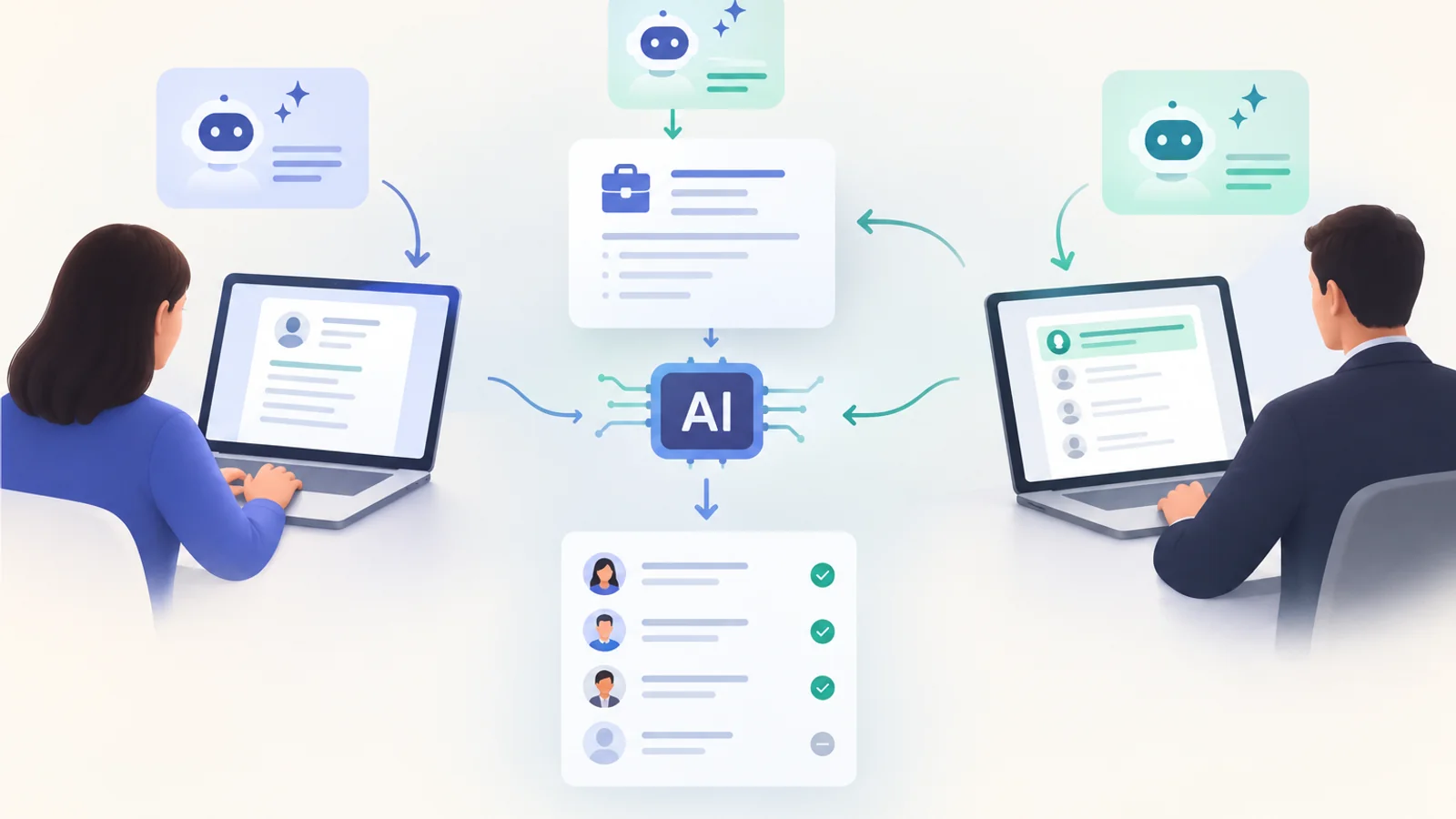
Job hunting is becoming an automated exchange: a candidate uses generative AI to tailor a CV to a vacancy, the employer uses AI to write or optimize the advertisement, and an applicant tracking system or matching model decides which applications rise to the top. The process is not hypothetical. Recruiters, job platforms and HR vendors report that AI is now embedded across job descriptions, resume screening, candidate communication and interview scheduling.
The shift matters because the first stage of hiring is no longer simply a human reading a human-written document. It is increasingly a machine-assisted comparison between a machine-optimized application and a machine-optimized job requirement.
What employers are actually using
AI in recruitment is most concentrated in high-volume administrative work. A 2024 survey of 2,366 HR professionals by SHRM found that 64% of organizations used AI to support recruitment, interviewing or hiring. Among those organizations, nearly two in three used AI to help generate job descriptions, while about one in three used it to review or screen resumes, communicate with applicants or automate candidate searches.
Industry research points in the same direction. HR.com’s Future of AI and Recruitment Technologies report found that 53% of surveyed organizations used AI in talent acquisition, up from 26% in its prior study. Among AI users, 61% used it for automated job descriptions, 55% for candidate communication and 45% for resume filtering.
- Job-description generation: AI drafts postings, rewrites requirements and converts descriptions into advertisements.
- Resume parsing and matching: software extracts skills, titles, education and experience, then compares them with vacancy criteria.
- Candidate ranking: systems prioritize applications based on keyword, semantic or skills-based similarity.
- Screening interviews and scheduling: chatbots and automated tools handle early questions and calendar coordination.
These systems do not all operate identically. Older applicant tracking systems largely rely on keyword filters and structured fields. Newer tools use natural-language processing to identify related terms—for example, recognizing that “project management” and “program management” may describe overlapping work—and can produce ranked shortlists rather than simple pass-or-fail results.
The candidate side of the loop
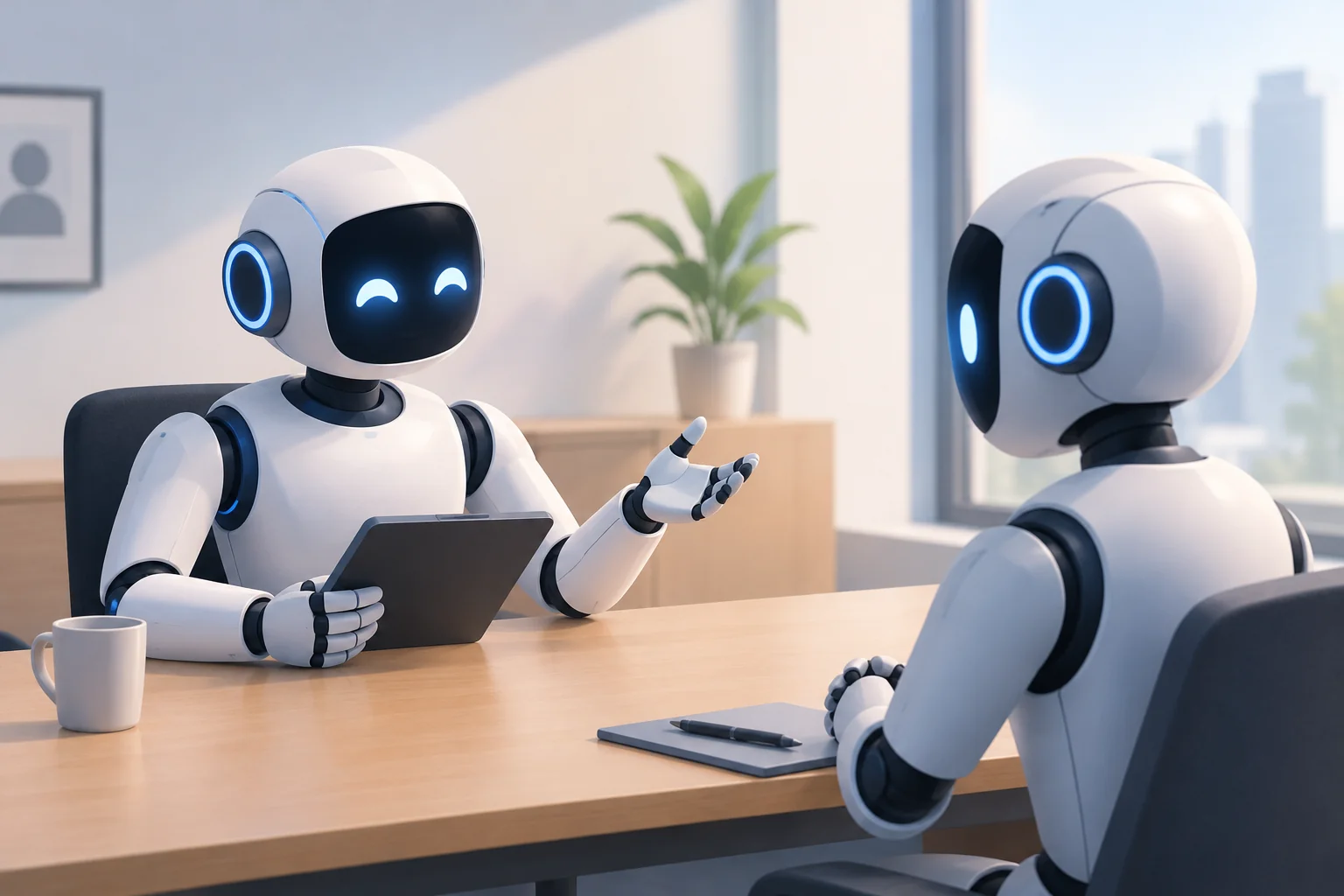
Job seekers have adopted the same technology. CV-Library’s latest Candidate Behaviour Barometer, based on responses from 1,043 candidates and 233 recruiters or direct employers, found that 29% of candidates had deliberately changed a CV or cover letter because they believed AI might screen it—almost three times the proportion recorded in 2025.
The same survey found that 83% of recruiters encountered signs of AI-written applications frequently or occasionally, while 69% agreed that AI-generated applications made it harder to identify the strongest candidates. More than a third of recruiters said they were less confident than a year earlier that an application accurately reflected a candidate’s skills.
Volume is also rising. The New York Times reported that applications submitted through LinkedIn increased by more than 45% year over year, with the platform averaging 11,000 applications per minute. Generative AI tools make it easier to produce large numbers of tailored applications quickly, and some candidates now use agents that search for roles and submit applications automatically.
Where the technology can fail
The central technical problem is mismatch. A candidate may have relevant experience but describe it in language the screening model does not associate with the job posting. Conversely, an application can be optimized for keywords without reflecting genuine capability.
AI-generated applications can also contain factual errors. A September 2025 report cited by India Today described a job seeker who submitted 87 applications in one month using AI and encountered mistakes including incorrect company names and job titles in cover letters.
Bias remains another concern. Stanford researchers analyzed four million job applications processed by one AI hiring tool over the four years to December 2022. Their analysis indicated that some candidates were rejected from multiple roles more often than would be expected if employers had assessed them independently, and that Black and Asian applicants were recommended for jobs at lower rates. The researchers cautioned that the evidence was limited to one tool and that factors such as education and immigration status could also have affected the results.
AI can standardize initial evaluations, but peer-reviewed research also identifies algorithmic bias from training data as a central ethical risk in automated recruitment.
Real-world deployments
Employers are already using these tools at scale. Chipotle’s chief executive, Scott Boatwright, said at a conference that the company’s AI chatbot screening and scheduling tool, Ava Cado, had reduced hiring time by 75%, according to reporting by The New York Times.
LinkedIn’s Future of Recruiting research found that, among talent-acquisition professionals already using or experimenting with generative AI, 35% said time saved by the technology went toward candidate screening, while 26% said it went toward skills assessments.
The practical effect is that automation is changing not only who reviews an application, but how many applications a recruiter can realistically examine. When a posting attracts hundreds or thousands of responses, a system that ranks candidates can determine which applications receive meaningful human attention.
What happens next
Over the next 12 to 24 months, the likely battleground will be verification rather than drafting. If both job ads and CVs can be generated in seconds, employers are likely to place more weight on structured skills assessments, work samples, references and interviews that test applied knowledge.
Regulation is also becoming more consequential. AI hiring systems can affect access to employment, so employers face growing pressure to document screening criteria, test for disparate impact, disclose automated decision-making where required and retain human oversight for rejections—particularly for borderline or nontraditional candidates.
For now, the hiring funnel looks increasingly symmetrical: AI helps candidates present themselves, AI helps employers define the role, and AI helps both sides decide whether they match. The unresolved question is whether that automation widens access to opportunity or simply makes the earliest stage of recruitment harder to interpret.
Sources: BBC News, SHRM, HR.com, CV-Library via IET, The New York Times and Springer.