

On November 2, 2026, The New York Times Company and the publishers of the New York Daily News, the Chicago Tribune and the Orlando Sentinel filed two separate federal lawsuits against Brave Software, the San Francisco company behind the Brave browser and Brave Search. Both cases were filed in the US District Court for the Southern District of New York. They allege that Brave copied journalism into a huge search index, sold access to it to AI companies, and gave users ways around paywalls and publisher ads.
The suits add to a growing list of publisher-versus-AI disputes. Until now, most of them targeted chatbot makers. These cases go after a company that supplies search data to those chatbots. Brave is also already in court with News Corp, which makes this its second major publisher fight in under two years.
What the complaints say Brave built
The Times case is numbered 26-cv-9549, and the case from the three newspapers is 26-cv-9554. Each complaint has five counts: direct, contributory and vicarious copyright infringement; circumvention of access controls under the Digital Millennium Copyright Act (DMCA); and unjust enrichment under New York law.
At the center is the Brave Index, which Brave's own materials describe as holding more than 30 billion webpages. According to the complaints, Brave built it with a crawler whose name it has never disclosed. The publishers argue that this leaves site owners unable to identify and block the bot. Brave's public help page, as described in the filings, gives a different reason: the crawler avoids a distinct identity so that sites that only welcome Google are not able to shut it out. Brave says its bot will not crawl anything Googlebot is barred from.
The complaints describe three products that draw on the index:
- Ask Brave, an AI answer feature in Brave Search that retrieves pages from the index and feeds them to a language model.
- The Brave Search API, a paid service with endpoints such as News Search, Web Search, LLM Context and Answers. The filings name Anthropic, Perplexity, Mistral, xAI and Cohere as customers. None of them is a defendant.
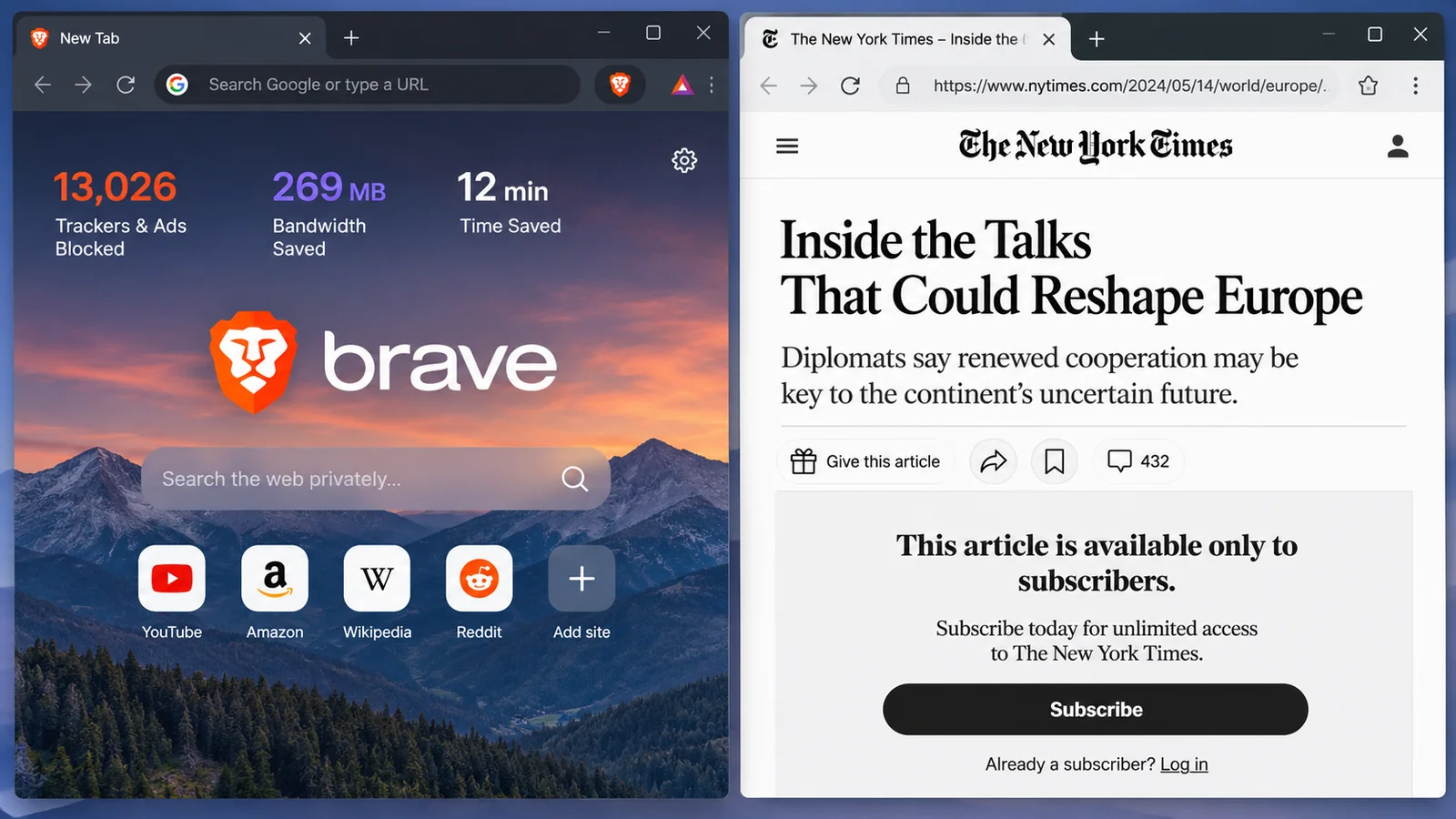
- The Brave browser, which blocks ads by default and includes a filter setting called Paywall blocker.
What the tests showed
Much of each complaint is made up of tests the plaintiffs ran themselves. In one Times test, the API's LLM Context endpoint returned 1,291 of the 1,295 words of a Times article. In another, Ask Brave produced roughly 87% of a paywalled Times story and noted that the remainder sat behind the paywall. The Daily News complaint reports that Ask Brave reproduced more than 1,200 words of a Chicago Tribune article about data center tax breaks. For one Orlando Sentinel article, the LLM Context endpoint returned the whole text.
The plaintiffs wrote these prompts, and in several cases they asked the tool to provide the full text before it did so. The filings do not show how often ordinary users make such requests. They also do not establish which API customers receive newspaper text, or how many people have switched on the paywall filter.
On the browser side, the complaints say the paywall blocker lets users read subscription articles without logging in. They cite a Reddit post and statements by Brave employees on public forums. The DMCA count rests on that feature.
Money, scale and the ad claim
The complaints cite third-party estimates putting Brave's 2025 revenue above $100 million and its audience at close to 130 million monthly users. Brave is a private company and does not publish these figures itself. The filings also state that Brave has made more than $100 million from publishers' work, but that number matches the estimate of Brave's total revenue. The filings do not break revenue down by product, so the share tied to the index is not established.
The Times says it holds more than 10 million registered works. The three other papers list more than 2 million registered articles. All four plaintiffs ask for statutory and actual damages, a permanent injunction, repayment of profits and a jury trial. Neither complaint states a dollar figure.
The fifth count stands apart from the copying claims. It targets the way Brave's browser removes publishers' ads and lets Brave sell its own. The complaints say this claim does not depend on any copying at all, and they seek the revenue Brave earned from that practice.
What comes next
The Times says it sent letters to Brave's chief executive, Brendan Eich, on August 11, 2025 and April 13, 2026, and received no reply. The filings describe no such letters in the case brought by the other three papers. In the Times case, those letters are used to support a claim of willful infringement, which can raise the ceiling on statutory damages.
Several legal questions are open. A court will have to decide whether the paywalls count as technological measures that effectively control access under the DMCA, and the complaints do not explain how the filter gets past them. It will also have to decide whether retrieving and returning article text for AI answers is infringement. Brave argued in its earlier suit against News Corp that indexing website content is fair use, which is a position it may repeat here. As of the coverage reviewed for this article, Brave had not publicly responded to the new lawsuits.
The publishers' lawyer, Steven Lieberman, put the argument bluntly in a statement:
Buying stolen goods secondhand doesn't make them legitimate.
The complaints also describe Brave as a burglar and an AI fence. The Times and the Alden-owned papers separately have copyright cases pending against OpenAI and Microsoft, and the Times has sued Perplexity. If the new suits succeed, pressure for licensing could move from AI developers to the search and data providers that supply them.
Sources: PPC Land and The Next Web.