

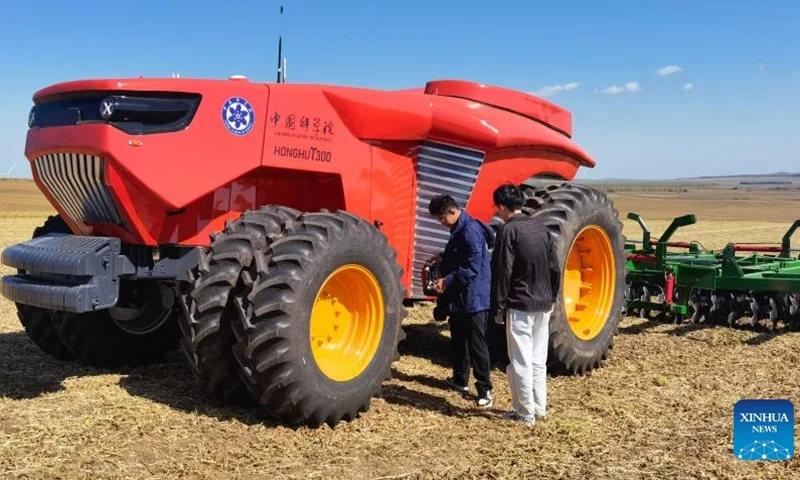
Autonomous electric tractors are beginning to move from technology demonstrations into real agricultural operations in China. In Hubei province, a driverless agricultural machine called the Honghu T70 has entered field trials, combining battery-electric propulsion, satellite positioning, artificial intelligence and environmental sensing to perform farming tasks without a driver sitting in a traditional cab.
The development was documented by Hubei's provincial agricultural authorities on April 14, 2025, following a field demonstration in Shiyan's Yunyang District. According to the report, nine electric intelligent tractors had been delivered to three village cooperatives for trial use. The machines were developed by the Chinese Academy of Sciences and manufactured by Shiyan Guoke Honghu Technology.
This is an important step for agricultural robotics. Rather than simply automating one operation on an existing tractor, the Honghu T70 combines electric propulsion, autonomous navigation and agricultural machinery control in a single platform. It also demonstrates how technologies originally associated with autonomous road vehicles can be adapted to uneven terrain and demanding outdoor working environments.
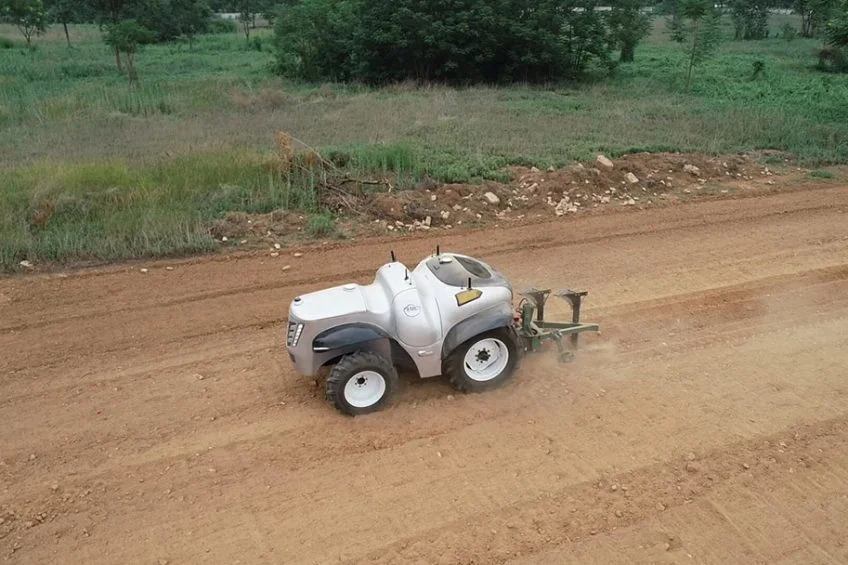
How the autonomous tractor works
The Honghu T70 is designed without a conventional driver's cabin. Its navigation and operating systems allow it to follow predefined routes, perform agricultural work and respond to changes in its surroundings.
According to the Hubei provincial report, its technical architecture combines several important technologies:
- BeiDou satellite navigation: Provides positioning information used to determine the machine's location and guide its movement through agricultural fields.
- Millimeter-wave radar: A sensor mounted at the front of the machine helps detect obstacles in its surroundings.
- Sensor fusion: Combines information from different sensors to build a more complete understanding of the operating environment.
- Artificial intelligence algorithms: Process environmental and operational information to support autonomous navigation, obstacle avoidance and adjustments to agricultural operations.
- 5G connectivity: Transmits information about terrain and changing soil resistance to the control system, allowing the machine to adjust its work.
The tractor also features an intelligent agricultural machinery control system. Operators can configure parameters such as the working area, operating speed and turning radius. The software then calculates an appropriate route for the machine to follow.
This approach is particularly relevant to agricultural environments, where the vehicle must do more than remain within marked lanes. Soil conditions can change considerably across a single field, and the tractor must maintain consistent performance while operating with heavy agricultural attachments.
Electric power meets autonomous farming
Unlike conventional diesel-powered tractors, the Honghu T70 uses lithium batteries as its energy source. The Hubei report provides several practical operating figures that offer an insight into its capabilities.
- Charging time: Approximately 1.5 hours.
- Operating time: Approximately 4–6 hours per charge.
- Energy consumption: Around 3 kWh per Chinese mu of cultivated land.
- Reported operating cost: Approximately one-sixth of that of comparable fuel-powered machinery.
One Chinese mu corresponds to approximately 667 square metres. The reported energy consumption therefore provides a useful indication of the machine's operating efficiency, although actual performance will depend on soil conditions, agricultural attachments and the type of work being performed.
The reported cost comparison is particularly interesting. Agricultural machinery consumes considerable amounts of energy during intensive operations such as ploughing and soil preparation. Replacing diesel engines with electric powertrains could reduce energy expenditure and eliminate exhaust emissions at the point of operation.
However, electricity costs, battery replacement, charging infrastructure and the availability of suitable power supplies will all influence the economics of large-scale adoption.
Real tractors, real field trials
The most significant part of this development is that the Honghu T70 is not limited to a laboratory prototype.
In early April 2025, nine machines were delivered to three village cooperatives in Shiyan's Yunyang District. These organizations were located in Zhengjiaya Village, Huashan Village and Sunjiawa Village.
A field demonstration on April 3 showed a cabless machine operating a rotary tiller, moving independently through farmland and performing turns. The provincial report also described four electric intelligent tractors returning to their storage facility under handheld remote control after completing field operations.
This distinction matters: autonomous field operation and remote supervision are complementary capabilities. The available reporting does not establish that every stage of operation, including charging, maintenance and recovery, is fully autonomous.
The provincial report also outlined the manufacturer's production ambitions at the time. Guoke Honghu said it could manufacture three electric intelligent tractor models with different power ratings and expected to produce and sell 1,000 sets of agricultural machinery during 2025, targeting approximately 600 million yuan in output value.
These figures were company expectations, not independently confirmed final production or sales results.
A broader agricultural robotics ecosystem
The Honghu T70 is part of a wider push to introduce intelligent machinery into agricultural production.
Guoke Honghu is also developing soil-testing robots and electric corn-harvesting machinery. The soil-testing platform is designed to collect information about soil composition, helping agricultural specialists understand variations in field conditions without relying exclusively on traditional manual sampling.
The combination of autonomous tractors and soil-analysis robots could eventually support a more connected agricultural workflow.
For example, soil-analysis systems could collect information about different areas of a field, while intelligent tractors could use operational data to adjust cultivation activities. Such integration could make agricultural operations more precise and improve how machinery, energy and human supervision are allocated.
However, the existence of these complementary technologies does not yet demonstrate a fully integrated, commercially established autonomous farming ecosystem.
China is also developing standards for autonomous farming
Hardware and software are only part of the challenge. Autonomous agricultural vehicles also require reliable technical standards, particularly when operating near workers, other machinery and unpredictable outdoor obstacles.
China has taken steps in this direction. The national standard GB/T 46270-2025, titled Agricultural Machinery Automatic Driving System Based on BDS, was published on August 29, 2025, and came into effect on March 1, 2026.
The standard establishes a national framework relating to BeiDou-based automatic driving systems for agricultural machinery. Its development involved organizations including China Agricultural University and several agricultural machinery and satellite-navigation technology companies.
This is relevant because consistent positioning and navigation requirements can help manufacturers develop compatible systems and improve the reliability of automated agricultural equipment.
Nevertheless, technical standardization does not automatically establish that every autonomous tractor meets all operational safety requirements. Real-world deployment still requires appropriate testing, supervision and procedures for handling unexpected situations.
What happens next?
Over the next 12 to 24 months, the biggest challenge for autonomous electric tractors will be demonstrating that they can operate reliably and economically beyond controlled demonstrations and limited field trials.
Several areas will be particularly important:
- Battery performance: Maintaining sufficient operating time during demanding agricultural tasks, particularly in large fields and difficult soil conditions.
- Navigation reliability: Maintaining accurate positioning when satellite signals are obstructed or environmental conditions change.
- Obstacle detection: Recognizing people, animals, vehicles and unexpected objects while maintaining safe operating distances.
- Machine compatibility: Supporting different agricultural attachments and operations without requiring extensive modifications.
- Operational economics: Establishing whether battery-powered autonomous machinery can deliver consistent financial advantages over conventional tractors.
- Human supervision: Developing practical procedures for remote monitoring, emergency intervention, maintenance and recovery.
There is also an important distinction between technological capability and commercial adoption. Delivering nine machines for cooperative trials is a meaningful milestone, but it does not establish widespread adoption across China's agricultural sector.
The beginning of a new generation of farm machinery
The Honghu T70 illustrates how agricultural machinery is evolving beyond conventional engine and transmission systems. Electric propulsion, satellite positioning, radar, AI-based navigation and connected control systems are increasingly becoming parts of the same machine.
The technology could eventually reduce the amount of direct human operation required for repetitive agricultural tasks while allowing farmers to supervise machinery remotely and manage larger areas more efficiently.
China's early field trials provide concrete evidence that driverless electric tractors are moving into practical agricultural environments. The next major milestone will be proving their reliability, safety and economic value across different crops, climates, soil conditions and farming operations.
For the agricultural robotics industry, the direction is becoming increasingly clear: the future tractor may not need a driver sitting behind the steering wheel. Instead, it may need reliable sensors, intelligent navigation, an efficient electric powertrain and a human operator supervising the work from a distance.
Sources:
1. Hubei Provincial Department of Agriculture and Rural Affairs – Official field report on the Honghu T70, its technical architecture, operating figures and delivery of nine tractors to village cooperatives (April 14, 2025): Read the official report.
2. National Public Service Platform for Standards Information – Official record of Chinese national standard GB/T 46270-2025, including its publication and implementation dates: Read the national standard record.
3. Agricultural Engineering – Zhang Chuanshuai, Chen Hua and colleagues, Development Status and Suggestions for Promotion and Application of Electric Tractors in China (2025), discussing electric tractor technologies and adoption challenges: Read the research publication.